

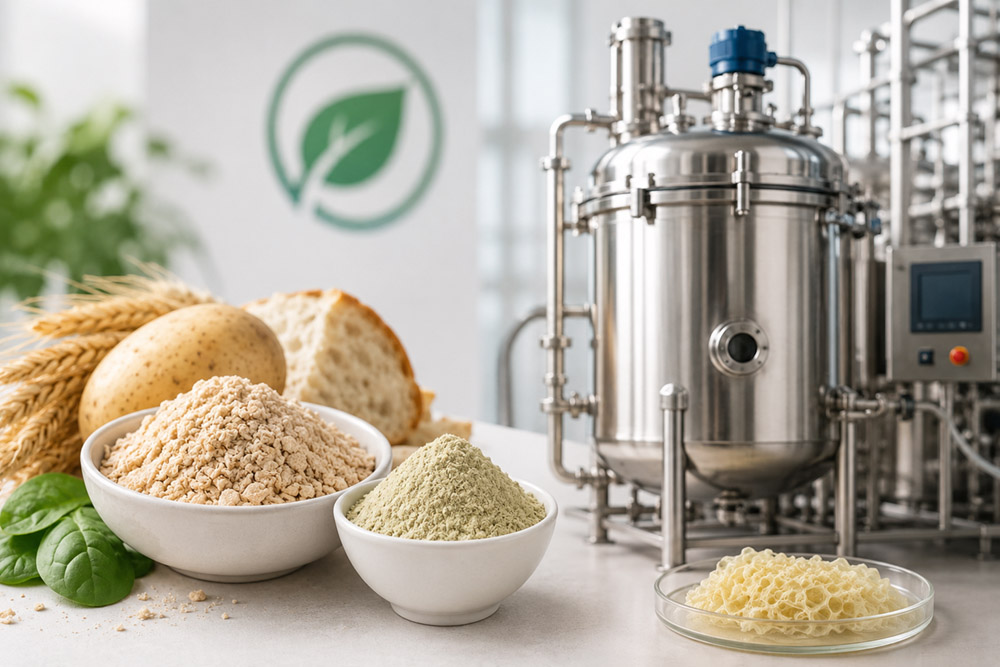
PROSCALE secures €7 million EU backing to scale single-cell proteins from food industry sidestreams

A new European initiative aims to demonstrate how food industry sidestreams can be transformed into scalable sources of microbial protein, with the launch of the €6.99 million (US$7.98 million) PROSCALE project.
Funded by the Circular Bio-based Europe Joint Undertaking (CBE JU), the four-year Innovation Action will run from September 2026 through August 2030. The project brings together a consortium of industrial and academic partners from across Europe to advance the production of fungal, yeast, and bacterial single-cell proteins through continuous fermentation processes.
• PROSCALE has secured €6.99 million (US$7.98 million) in funding from the Circular Bio-based Europe Joint Undertaking and will run from September 2026 to August 2030.
• The project aims to scale the production of fungal, yeast, and bacterial single-cell proteins using food industry sidestreams as fermentation feedstocks.
• The consortium targets a tenfold increase in fermenter capacity while reducing climate impacts, waste generation, and reliance on conventional protein sources.
The project arrives as Europe seeks to diversify protein production systems amid growing concerns over food security, supply chain resilience, and the environmental impacts associated with conventional agriculture.
According to project documentation, PROSCALE will focus on converting underutilized sidestreams from the food industry into high-protein ingredients for food applications. Feedstocks will include processing residues from potato, wheat, and vegetables, alongside by-products generated during baking and pasta production.
The goal is to produce multifunctional protein ingredients containing more than 50% protein on a dry matter basis. These ingredients are expected to include fungal mycoproteins, yeast proteins, and bacterial proteins suitable for a range of applications, including meat and dairy alternatives, sports nutrition products, health-focused foods, and staple products such as bread and pasta.
The project is being coordinated by VTT Technical Research Centre of Finland, with Research Professor Nesli Sozer serving as coordinator.
Announcing the project on LinkedIn, Sozer revealed that PROSCALE had also received the European Commission's Strategic Technologies for Europe Platform (STEP) Seal.
"Its official now!" she wrote. "Excited to share that our Innovation Action project, PROSCALE funded by Circular Bio-based Europe Joint Undertaking (CBE JU) — and has also been awarded the prestigious STEP Seal by the European Commission."
She added: "PROSCALE aims to accelerate the transition toward more sustainable, resilient, and resource-efficient protein systems by developing innovative approaches for the production and scaling of single cell proteins produced by continuous fermentation."
According to Sozer, receiving the STEP Seal represented recognition of the project's scientific and strategic importance.
"Receiving the STEP (Strategic Technologies for Europe Platform) Seal is a strong recognition of the project's scientific excellence, innovation potential, and strategic relevance for Europe's future competitiveness and technological sovereignty," she said.
Beyond scaling fermentation itself, the consortium plans to combine innovations in both upstream and downstream processing with a digital twin platform designed to improve operational efficiency and resource utilization.
A key objective will be enabling the use of lower-cost sidestream feedstocks that may currently be difficult to ferment. The project intends to develop methods for removing or detoxifying growth inhibitors, eliminating non-fermentable solids, and optimizing substrate formulations to improve fermentation performance.
The consortium also plans to establish quality parameters for large-scale production while demonstrating the functionality of single-cell proteins across multiple food categories. Areas of interest include palatability, nutritional performance, and in vitro digestibility.
Circularity forms another major component of the initiative. Rather than treating process outputs as waste streams, PROSCALE aims to apply a cascaded utilization model in which co-products are recycled, repurposed, or converted into new value streams.
Project documentation outlines plans for water and spent-medium recycling, as well as the conversion of carbon dioxide into C2 and C3 compounds. Additional opportunities include the development of pet food palatants and technical applications derived from project co-products.
The consortium has set ambitious environmental targets. PROSCALE aims to improve resource efficiency by between 40% and 60% through the use of underutilized food and feed sidestreams, while targeting a 20% improvement in climate neutrality across project processes.
The project also forecasts a 60% reduction in greenhouse gas emissions and water consumption compared with traditional protein production systems, alongside lower waste generation through improved feedstock transformation and optimized value chains.
Another long-term goal is a tenfold increase in fermenter capacity, which the consortium believes could help support future large-scale production of dietary protein within Europe.
The project's expected economic impact is equally significant. According to the consortium, successful commercialization could help European companies capture up to 10% of the single-cell protein market, generating approximately €850 million (US$971 million) in revenue while creating licensing opportunities around feedstock transformation technologies.
Partners include VTT, Duynie, Enifer, Circe Biotech, Tetra Pak, Barilla, Pınar, Sinonin Biotech, goodcalories, Wageningen University & Research, DIL Deutsches Institut für Lebensmitteltechnik, the University of Vaasa, EFFoST, EIT Food, Institut Lyfe Research and Innovation Center, and The American College of Greece.
With work set to begin in September, the consortium will spend the next four years attempting to demonstrate that food industry residues can become a scalable source of protein ingredients while supporting Europe's broader goals around food security, sustainability, and industrial resilience.

Join Us At One Of Our Upcoming Events

If you have any questions or would like to get in touch with us, please email info@futureofproteinproduction.com


%20-%20Photo%20Credit%20Matt%20Qu%C3%A9r%C3%A9e.jpg)

