Alternative protein scale-up problems often start in the lab, NIZO expert warns

Alternative protein companies are becoming more realistic about the difficulty of scaling new technologies, but many of the problems exposed during pilot production can be traced back to decisions made much earlier in the laboratory, according to experts working across fermentation, product development and food manufacturing.
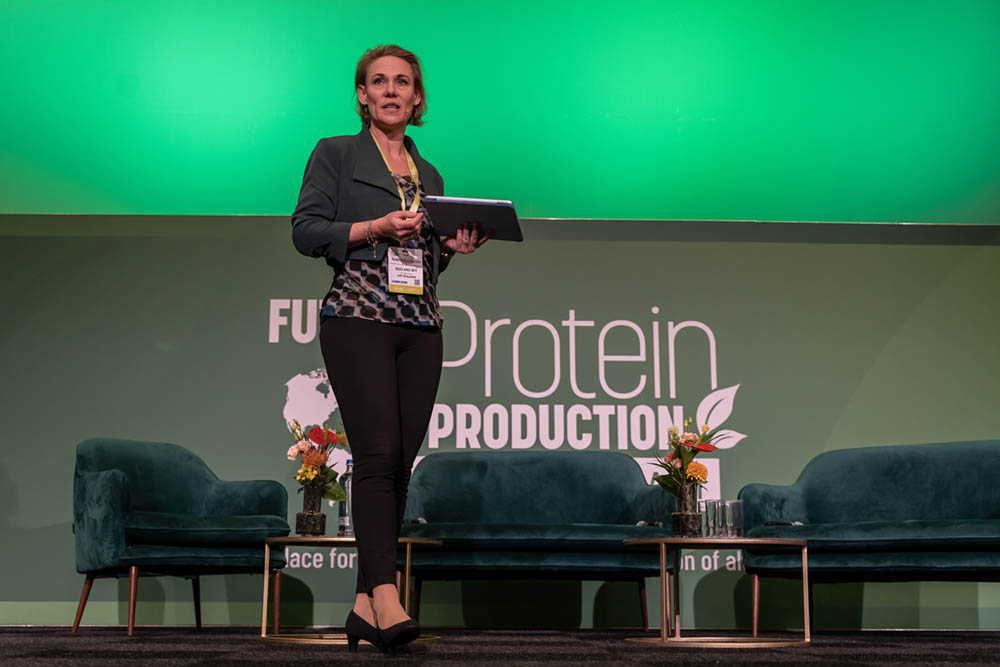
• NIZO's Robyn Eijlander said many scale-up problems originated in early decisions around biology, media, process engineering and manufacturability.
• Manufacturers were considering production constraints earlier, while asset-light strategies and partnerships offered alternatives to building dedicated facilities.
• Planteneers' Pia Meinlschmidt said formulation and processing could no longer be separated when developing products intended for commercial production.
The comments came during The Road to Amsterdam: The Biggest Questions Facing Alternative Proteins in 2026, a Protein Production Technology International webinar held on 16 July 2026 ahead of The Future of Protein Production Amsterdam in November.
The webinar attracted more than 600 registrations, with 65% of attendees joining live, and generated numerous audience questions spanning manufacturing, scale-up, investment, regulation and commercialization.
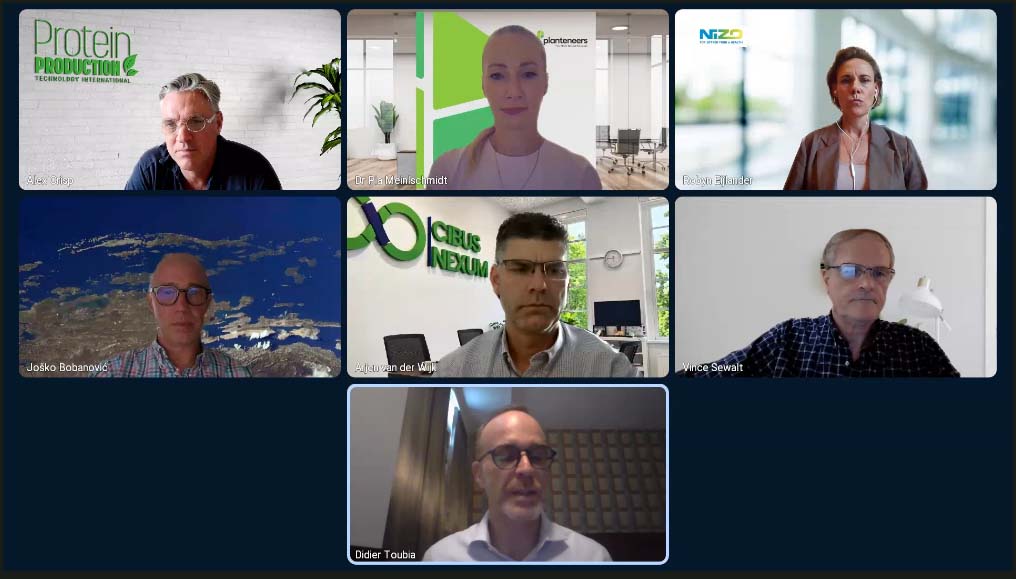
The panel included Robyn Eijlander, Program Manager & Science Innovation Manager at NIZO Food Research; Arjen van der Wijk, Co-founder of Cibus Nexum; Dr.-Ing. Pia Meinlschmidt, Head of Product Management at Planteneers; Joško Bobanović, formerly of Sofinnova Partners; Didier Toubia, Co-founder & CEO of Aleph Farms; and Vince Sewalt, Founder of Sewalt Bioconsulting.
Eijlander works at the point where many young food technologies face their first serious industrial test. NIZO is involved in product and process validation as companies move from laboratory to pilot scale, while she is also involved in the development of open-access scale-up facilities for aerobic and precision fermentation through Cellular Agriculture Netherlands.
Promising technologies continued to arrive from laboratories and academic research, she said, but many struggled to make the jump into commercial production.
“Scaling is not just making things bigger, especially in the food industry,” Eijlander said. “Not only does the technology need to serve a certain purpose, like feeding a growing world without killing the world, kind of thing, but at the same time, especially with food, it needs to be affordable. It needs to taste good. It needs to be adopted into everybody's daily lives.”
The first warning signs can appear when a company moves into pilot work, but their origins may lie considerably further upstream.
“You see failures, and often they're because of decisions that are made at a very early stage, like in fermentation, the selection of a strain or the selection of a certain media composition, or just having that mismatch between optimizing the biology and having very robust manufacturability,” Eijlander said.
Companies have become more aware of scale-up risk, but awareness does not necessarily change how research programs are run.
“There is more realism coming in, but actually putting it into practice is still challenging,” she said.
NIZO and the Bioprocess Fermentation Factory work extensively with companies entering product and process validation, particularly during the transition from lab to pilot production.
That is often where assumptions developed under tightly controlled laboratory conditions meet the requirements of industrial food production.
“I think that is, at least from what we see, where the realization kicks in that it's not just about making it bigger,” Eijlander said.
Biology, engineering and economics all have to work together. A strain capable of excellent laboratory performance has limited commercial value if it depends on expensive media, proves difficult to control at larger volumes or cannot repeatedly produce the required quality.
“If you're going towards successful processes, you need to create that coherent story across those elements,” she said. “It's the biology, the process engineering, the economics. There are possibly also other factors involved.”
Eijlander challenged the assumption that scale-up problems begin when the process gets bigger.
“This coherence is not automatically achieved by scaling. It is what enables scaling in the first place,” she said.
“A lot of people think scaling issues emerge during the scaling phase, but that is not true.”
Laboratory research and commercial manufacturing also work to different priorities. Scientists may optimize for biological performance, experimental speed and process control. A manufacturer needs reliable raw materials, repeatable production, acceptable costs and consistent output.
“If you're in the lab, you want to control speed, you want to control the biology or the technology, and you want to control it,” Eijlander said. “Whereas if you go to commercial scale, you want to control the availability of your incoming resources. You want to control cost and repeatability, and actually make it commercially.”
Those priorities have to meet before a company reaches the pilot plant.
“If they're not connected at an early stage, you will see the consequences upon scaling,” she said. “And then the core solution does not necessarily lie in that pilot scaling phase, but it really lies in the lab phase.”
The same thinking is reaching product formulation.
Meinlschmidt works with food manufacturers at Planteneers, part of Germany's Stern-Wywiol Gruppe, developing functional ingredient systems, blends and application concepts for plant-based products.
“Today, formulation and processing can no longer be separated,” she said.
Product developers could once spend much of their early work concentrating on an ideal formulation before addressing how it would behave on industrial equipment. Meinlschmidt said that sequence had become increasingly difficult to justify.
“A few years ago, to be honest, product development started with creating the idea, the perfect recipe, and only later asking whether it could be manufactured efficiently at scale,” she said. “Today, this approach is not viable anymore.”
A formulation may work well on a benchtop and still create problems when exposed to commercial mixing, heating, pumping, extrusion, filling or other processing conditions. Ingredients selected for functionality also have consequences for sourcing, price and production consistency.
“Commercial success mainly depends on designing products with manufacturing in mind, starting from day one,” Meinlschmidt said.
“Successful innovation isn't just about creating a great product. It's about creating a great, outstanding product that can be manufactured efficiently at scale at a fair price.”
Van der Wijk has seen a similar change among companies approaching Cibus Nexum for manufacturing support.
Startups are increasingly looking at the eventual production model while their technologies are still being developed, rather than treating the factory as a separate project to be addressed later.
“The developments and innovations are more focused from the beginning on how it looks in the end, but also calculating back ultimately from the final goal,” he said.
That can include the company's eventual ownership strategy as well as the technical requirements of production.
“If a startup has an exit strategy or they want to team up with a big group, what does that roadmap look like, and what does the scaling look like?” van der Wijk said. “Also in terms of reaching TRL 9 with consistent, repeatable quality of production, but also in terms of the batch sizes, the total quantities, and the ambitions there.”
The change has coincided with tighter funding and a greater willingness to use existing food and biotechnology infrastructure.
Some startups once viewed a proprietary production facility as an essential part of building the company. The expense and execution risk attached to that model have encouraged more businesses to consider contract manufacturing, partnerships and licensing.
Van der Wijk said companies were finding ways to work with businesses that already owned suitable assets and combining their respective capabilities into a scale-up plan.
“We also see some brave examples of companies looking for ways, and also finding them, to collaborate with existing assets, with existing companies that have assets in place, and make use of each other's added value and make a scaling plan out of that.”
Manufacturing partnerships are changing, too.
Van der Wijk described a progression from companies wanting their own plants, through greater use of contract manufacturers, to models that combine production with sales and distribution.
“The next logical thing is the licensed manufacturing model that we see happening right now, which is a combination of both manufacturing and sales and distribution,” he said.
Large industrial partners can bring more than tanks, fermenters or processing lines. They can provide operators, quality systems, procurement networks, regulatory experience and access to customers built over decades.
During the webinar's audience Q&A, Eijlander pointed to partnerships including TurtleTree and Novonesis, and ADM and The EVERY Company.
“From the point of view where Arjen and I are both standing, it's very much that, of course, you have access to facilities, to scale, and to a lot of industrial experience,” she said.
Protecting intellectual property and establishing trust remained important, particularly when a young technology company depended on a much larger manufacturing partner.
“If you are able to protect your IP and have a relationship built on trust, I can only see pros,” Eijlander said.
Vince Sewalt, who spent 28 years in biotechnology and food technology before establishing Sewalt Bioconsulting, added another constraint: not every ingredient supports the same manufacturing economics.
“It also fits very well with the concept of needing to match scale with the value of the product,” he said. “Consumers need to be willing to pay for it.”
Lower-value proteins require very different production economics from specialty ingredients that can command substantially higher prices.
“When it comes to relatively bulk proteins like beta-lactoglobulin or albumin, the value is such that you really need to go at the highest possible scale, readily available at ADM and Novonesis,” Sewalt said. “If the value were higher, then you wouldn't have to scale up as much.”
Greater reliance on a relatively small number of large manufacturers also carries risks.
“You end up running a bit of a risk of monopolizing the manufacture of specific proteins by a handful of companies that are really good at doing that,” Sewalt said.
For startups, ingredient value, required volumes, available infrastructure, intellectual property, capital requirements and the capabilities of potential partners all affect the manufacturing route.
Eijlander wants open-access pilot and demonstration infrastructure to become a normal part of developing new food technologies rather than somewhere companies turn only after their original scale-up plans run into trouble.
“In five years' time, if we have established that open-access upscaling facilities and CDMOs, shared demonstration infrastructure, those kinds of facilities, have become normal parts of a company's strategy, then we will have achieved a lot,” she said.
The aim is to give companies access to industrial expertise and equipment before they make expensive decisions that are difficult to reverse.
“And that they're not just emergency solutions, for instance, for when funding becomes tight or something like that,” Eijlander said.
For companies moving beyond the laboratory, Eijlander reduced the challenge to a much tougher test than simply proving that a technology works.
“Can we make it?” needs to move to “Can we make it repeatedly, safely, economically, and at a food-grade scale?”
Eijlander, van der Wijk, Meinlschmidt and Sewalt will continue the discussion at The Future of Protein Production Amsterdam on 4-5 November 2026, alongside more than 130 speakers covering scale-up, manufacturing, fermentation, ingredients, regulation, investment and commercialization.
Around 1,000 attendees and more than 65 exhibitors are expected in Amsterdam, with the event also co-located with the Cultured Meat Symposium.
If you liked this, check these out...
• Algiecel bolsters leadership team to drive commercial scale-up of its microalgae platform
• ADM partnership gives The EVERY Company the commercial scale it has spent a decade building toward
• Happy Plant Protein and Crespel & Deiters scale one-step dry extrusion technology for European TVP production

Join Us At One Of Our Upcoming Events

If you have any questions or would like to get in touch with us, please email info@futureofproteinproduction.com