Alternative protein investors shift focus to revenue, costs and commercial traction

Alternative protein investors have become more focused on revenues, cost competitiveness and demonstrable product-market fit following the sharp funding correction of the past few years, according to industry leaders speaking ahead of The Future of Protein Production Amsterdam 2026.
• Investors had become more selective, with greater emphasis on revenues, cost of goods and evidence that customers were willing to buy.
• Didier Toubia compared the alternative protein downturn with earlier corrections in internet and cleantech investment.
• Joško Bobanović said companies with strong cost positions would have more room to compete as the sector matured.
The comments came during The Road to Amsterdam: The Biggest Questions Facing Alternative Proteins in 2026, a Protein Production Technology International webinar held on 16 July 2026 as a precursor to The Future of Protein Production Amsterdam in November.
The webinar attracted more than 600 registrations, with 65% of attendees joining live, and generated a steady stream of audience questions on investment, manufacturing, regulation, scale-up and the commercial prospects for new protein technologies.
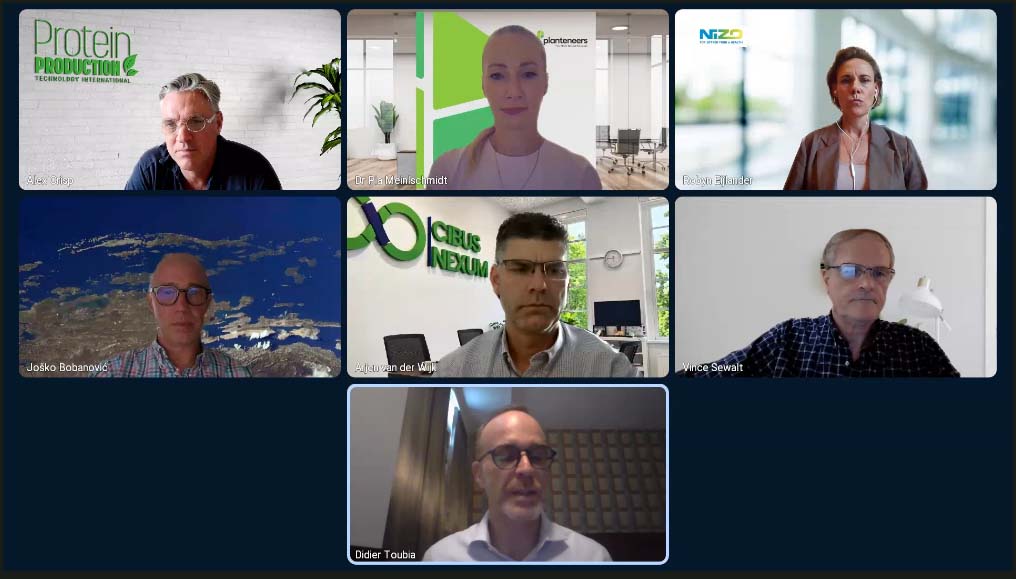
The panel brought together Joško Bobanović, formerly of Sofinnova Partners; Didier Toubia, Co-founder & CEO of Aleph Farms; Dr.-Ing. Pia Meinlschmidt, Head of Product Management at Planteneers; Arjen van der Wijk, Co-founder of Cibus Nexum; Robyn Eijlander, Program Manager & Science Innovation Manager at NIZO Food Research; and Vince Sewalt, Founder of Sewalt Bioconsulting.
For Bobanović, who spent more than 15 years investing in agri-food and industrial biotechnology at Sofinnova Partners, the exuberance that brought a wave of new investors into alternative proteins has largely disappeared.
“The key difference is that the tourists are gone,” he said. “The people who are left interested in investing understand the space and understand what the pros and cons are and what they should be looking at.”
Capital poured into plant-based food, cultivated meat and fermentation companies during the sector's investment boom, driving valuations higher and financing ambitious plans for new products and production capacity. Much of that money has since dried up.
“They've been there all along, but with the hype, many people came to the sector and paid high valuations, and all of these things have kind of washed out by now,” Bobanović said.
Investors still looking at the sector are digging much harder into the numbers.
“What remains as a focus is the ability to deliver, the ability to hit cost-of-goods targets – not just on paper and as wishful thinking, but through actual numbers and understanding what needs to be done to get there.”
Cost remains a difficult test for companies competing with mature food businesses operating at enormous scale.
“Today, investors understand that the companies that have a very strong cost position are the ones that will be able to play tomorrow because they can be flexible in what they can do,” Bobanović said. “When you are much more expensive than incumbents or your competing products, then you have another hurdle to climb beyond just the acceptance of the product.”
Technology alone has never been enough for experienced investors, Bobanović argued. Companies now face greater pressure to show evidence that the technology can support a business.
“Good investors have always looked beyond just technology,” he said. “Technology is a strong basis for building a business, but it's just a start.”
Customers provide some of the clearest evidence.
“The commercial side is extremely important because, at the end of the day, it validates that the direction the company is taking is the right one,” Bobanović said. “It shows that there is product-market fit because if nobody wants to buy, it's a hobby at the end of the day.”
For companies seeking capital in 2026, early revenues can carry considerably more weight than projections built around a future market.
“Investors these days are looking for companies that are on track or starting to generate their revenues and need financing to boost that, because they understand who wants to buy, why they want to buy, what their competitive advantage is in the market, and how that plays into customers' hands.”
Alternative proteins attracted substantial capital during a period of rapid technological progress and expectations that plant-based food, cultivated meat and fermentation would develop into major new food categories.
Didier Toubia, Co-founder & CEO of cultivated meat company Aleph Farms, saw the subsequent correction as familiar territory for an emerging industry. “What we've seen with what we call complementary proteins - sometimes called alternative proteins - is quite a normal cycle that we see with any new category or new industry,” he said.
Toubia compared the experience with the dot-com boom at the end of the 1990s, when money flooded into internet companies regardless of whether their underlying businesses were ready to support their valuations.
“At the end of the day, the internet sector went through a significant correction in 2000 and 2001,” he said. “The Nasdaq went down 70%, which is something difficult to imagine in today's world.”
The crash left a smaller group of businesses capable of turning internet technologies into sustainable companies.
“Companies with real business models, real products, and a real path to profitability, like Google, Amazon, Microsoft, and the like, emerged from the burst of the bubble as trillion-dollar companies.”
Toubia also pointed to cleantech, where an early investment surge in the 2000s ran into immature technologies and uncertain business models before renewable energy went on to achieve large-scale deployment.
He expected artificial intelligence to experience its own correction after the recent rush of capital into the sector.
“We will also see a correction with AI, and the companies with real products and a real path to profitability will emerge from that,” he said.
Alternative proteins, he believed, were already further along that cycle.
“That's what we see today in the alternative protein industry,” Toubia said. “Companies with real products, focusing on the fundamentals, reducing their costs, focusing on product-market fit and real positioning, are now starting to grow again as real businesses and not as a hype.”
The funding environment has also changed how companies think about manufacturing.
Arjen van der Wijk, Co-founder of Cibus Nexum, has watched manufacturing strategies change considerably since launching the company five years ago. Cibus Nexum works with startups, scale-ups and larger companies on manufacturing and routes to market.
“We've also seen the journey of CPG startups with great, promising journeys,” he said. “Then that focus shifted more to B2B solutions and ingredient suppliers - startups, for instance, aiming to launch and develop their own ingredients as suppliers.”
Building a dedicated factory was once a common ambition among well-funded food-tech companies. With capital scarcer and investors paying closer attention to risk, companies have increasingly explored other routes.
“Now we also see a shift towards a more leverageable and flexible model of licensed manufacturing, and that relates more to an asset-light approach than a couple of years ago,” van der Wijk said.
Manufacturing planning is moving earlier, too. Founders and investors are asking how a technology will reach industrial production before committing the capital that later stages can consume.
“The de-risking part in the beginning, both from the founders' point of view and also from the investors' point of view, is picking up,” van der Wijk said.
Some companies are working with manufacturers that already have the plants, people and industrial experience needed to produce at scale. Van der Wijk cited the collaboration between ADM and The EVERY Company as one example.
“There is also more interest in teaming up, like the example of, for instance, ADM and EVERY, to collaborate more on the manufacturing side, combined with collaboration on the commercial side, and then you can move along quicker.”
Regulation adds another calculation for investors. A company can have customers waiting and a credible production process but still face years before it can legally enter its intended market.
“This is one of the critical elements because it stage-gates access to the market,” Bobanović said. “If we see that the company doesn't understand, first of all, what the regulatory process is in the different geographies where they're active, or that the path is very long, it's typically a challenge to make an investment if you know that you will be challenged to get out into the market for X number of years.”
Food companies can spend considerable time and money securing regulatory clearance without receiving the valuation uplift that an approval might bring in pharmaceuticals or life sciences.
“Unfortunately, it's not always an inflection point in food, where it's considered a given that you get approval,” Bobanović said. “Well, it's a lot of work and sometimes a lot of effort, but it's something very important.”
Market selection can therefore have a direct bearing on the amount of capital a company needs before it can begin generating revenue.
“Investors do pay attention and look at where and how these timelines can be cut shorter,” Bobanović said.
Aleph Farms has already changed its own plans as market conditions, regulation and the economics of cultivated meat have evolved.
The company initially intended to move quickly into the US after raising a large funding round, with a more aggressive plan to build its own production facilities. By 2022 and 2023, it had changed course.
“In 2022, 2023, we decided to refocus on smaller countries where we can maximize the price and the margins to show market traction early, but also be able to demonstrate a clear path to profitability,” Toubia said.
Aleph Farms also used the additional time to work on costs and scalability before moving into larger-scale production.
“At the same time, we reduced our costs, improved our scalability, and took more time before scaling up to rebuild the foundations right,” he said.
The company is currently concentrating its regulatory efforts on Singapore and Switzerland and has already received clearance in Israel. Its planned Israeli launch was postponed amid the war in the Middle East.
Investors examining alternative protein companies are now asking increasingly practical questions: what does the product cost to make, who will buy it, where can it be sold, how will it be manufactured and how much money will be required before meaningful revenue arrives?
For Bobanović, the commercial test remained refreshingly simple. A company had to know who wanted its product and why they were prepared to pay for it.
Those questions will be picked up again at The Future of Protein Production Amsterdam on 4-5 November 2026, where Bobanović, Toubia, van der Wijk and the other webinar panelists will join more than 130 speakers from across alternative proteins and industrial biotechnology.
Around 1,000 attendees and more than 65 exhibitors are expected in Amsterdam. The exhibition and networking are free to attend, while a conference ticket provides access to both The Future of Protein Production and the co-located Cultured Meat Symposium.
Registration is now open for The Future of Protein Production Amsterdam on 4-5 November 2026. Delegates can book a conference ticket for access to both conference programs, while those who want to visit the exhibition, meet suppliers and take part in the networking can register for a free expo pass.
If you liked this, check these out...
• Aleph Farms reports cultivated steak matches conventional beef in blind taste test
• Planteneers targets clean label demand with new plant-based formulation systems
• NXW Nutrition from Water deepens PhycoFerm partnership with strategic strain investment

Join Us At One Of Our Upcoming Events

If you have any questions or would like to get in touch with us, please email info@futureofproteinproduction.com