

Engineering confidence: How Solaris Biotech is building the backbone of scalable alternative protein production

Magda Costa and Antonio Castagna on translating biological promise into industrial reality
The future of protein will not be decided at the bench but in the transition from milliliters to cubic meters, from laboratory success to industrial operation. Demonstrating that a yeast strain can express a protein is one thing. Reproducing that performance reliably under commercial constraints is another. This is the terrain Solaris Biotech occupies.
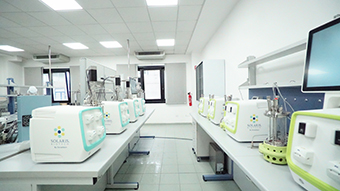
“We are a global provider of advanced bioreactors, fermenters, and bioprocessing technologies,” says Magda Costa, Product Manager. “As part of Donaldson Life Sciences, we support customers from early R&D through large-scale industrial production across sectors such as alternative proteins, food production, agritech, pharmaceuticals, and biomanufacturing. We combine engineering depth, intuitive software, and hands-on support to help teams scale their bioprocesses with confidence.” Confidence, in this regard, is not just marketing talk but a technical objective.
From early biology to engineered systems
The alternative protein sector has matured rapidly, but many companies still enter with biological expertise rather than process engineering depth. “Because the sector has grown rapidly, we frequently work with start-ups or companies just beginning their R&D journey,” Costa reveals. “Many approach us at a very early stage, when they are still exploring experimental setups or defining what their process could look like.”
That timing shapes system design. “This gives us the opportunity to support them from R&D through pilot scale, and in some cases into full industrial scale,” she says. “At the same time, being at such an early stage represents the greatest challenge in terms of configuration, as the equipment must evolve together with the bioprocess itself.”
In fermentation and cellular agriculture, parameters rarely remain static. Oxygen transfer, feeding strategies, and agitation profiles shift as systems develop. Designing equipment that can absorb that evolution without forcing costly redesign is an engineering discipline in its own right.
Designing for scale before scale exists
Scale-up remains the most fragile stage. Performance that appears stable at small volumes can collapse under larger hydrodynamic conditions.
“We guide the customer step-by-step,” adds Antonio Castagna, Manager Application & Field Service. “Our approach is collaborative. We sit together with both their technical team and ours to understand the biological process and translate those needs into engineering specifications.”
That translation requires anticipating variables early. “Several Solaris benchtop bioreactors replicate key characteristics of larger systems, such as pressure control and geometry,” Castagna continues. “This allows customers to develop a process that can scale reliably with additional control.”

Maintaining geometric similarity influences mixing patterns, oxygen transfer, and shear exposure. In high-cell-density fermentation, oxygen transfer often becomes limiting, particularly during exponential growth. At larger volumes, inadequate mass transfer can create gradients, localized hypoxia, and yield loss.
For cultivated cells, shear sensitivity becomes critical. Impeller selection, agitation strategy, and tip speed must balance mixing efficiency against cell viability. Excessive turbulence can damage cells, while insufficient mixing can create nutrient gradients.
The challenge is not reinventing the bioreactor, but ensuring early-stage development reflects industrial conditions. “Above all, we build trust by combining process understanding, engineering expertise, and strong post-sales support,” Castagna says.
Automation as a scaling discipline
Mechanical design alone does not guarantee reproducibility though. Increasingly, process intelligence determines whether a system performs consistently.
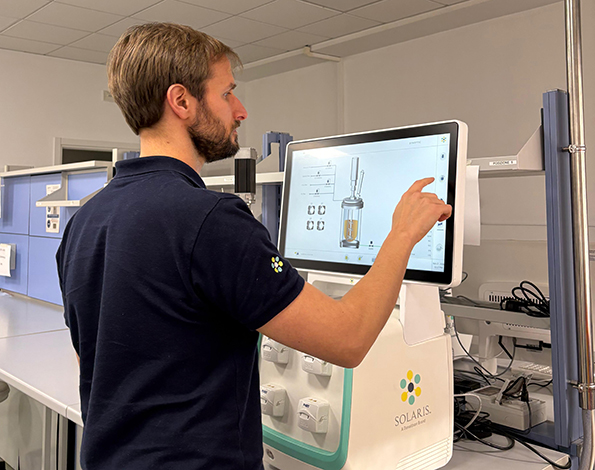
Solaris integrates automation platforms that centralize control over pH, dissolved oxygen, temperature, agitation, and feeding strategies. Real-time data acquisition allows continuous monitoring, while closed-loop systems adjust conditions dynamically.
In precision fermentation, feed profiles must align with metabolic state. Overfeeding can result in byproduct accumulation, while underfeeding limits productivity. Automated feed control reduces variability and supports batch-to-batch consistency.
Integration with process analytical technologies enables early detection of deviations. Changes in dissolved oxygen demand or pH can signal altered cellular behavior. Identifying these trends early reduces the risk of costly batch failures.
For a sector operating under capital pressure, this is critical. Failed pilot campaigns can consume months of runway. Data-driven scale modeling transforms scale-up into a structured engineering exercise.
Fermentation environments are inherently vulnerable. Warm, nutrient-rich conditions support both target organisms and contaminants.
“In any bioprocess intended for human use, the ultimate objective is consumer safety,” Castagna says.
Customization often increases investment significantly. For this reason, it is only justified when it leads to higher yield, improved product quality, or clear process advantages that provide ROI
Sterility extends beyond the bioreactor to utilities such as process water, steam, and compressed air. Each represents a potential contamination pathway. “While requirements are not always as strict as in pharma, segments like cellular agriculture demand careful attention to design, material selection, and cleanability,” he says. Clean-in-place systems, surface design, and sterile gas handling all play a role. Contamination can destroy batches, trigger extended sanitation, and undermine process validation. Sterility is therefore not just compliance. It is a financial safeguard.
Different biology, shared engineering principles
The alternative protein field encompasses different biological systems, but core engineering principles remain consistent.
“The fundamental performance requirements for bioreactors do not change dramatically,” Castagna says.
“The core principles of process control, sterility, and reproducibility remain the same. What differs is the type of process and its goals.”
In cultivated meat, the cell mass itself is the product, requiring careful control of shear and oxygen transfer. In microbial systems, higher densities introduce foaming, viscosity shifts, and heat removal challenges. In precision fermentation, metabolic burden alters growth dynamics and process design.
“These biological objectives shape parameters such as oxygen transfer, mixing, and control strategies,” he says, “but the engineering foundations mirror
those used in more traditional bioprocess industries.”
Customization, standardization, and cost
Unlike pharmaceuticals, alternative protein must compete on price. “The market must balance performance with cost efficiency,” Costa suggests.
Customization can quickly increase capital expenditure. “It is only justified when it leads to higher yield, improved product quality, or clear process advantages,” she says.
Standardized platforms offer predictable performance and lower upfront cost. Selective customization, applied where measurable advantage exists, preserves capital discipline.
“In food tech and alternative proteins, our mission is to make bioprocessing more accessible, scalable, and reliable,” Costa states. “Innovation is not only technical success. It is delivering meaningful value to producers, consumers, and the planet.”
The sector is shifting from early experimentation toward industrial maturity. “We’re seeing a shift toward greater stability,” Costa says. “Fewer new start-ups are entering the space, while existing companies are scaling and diversifying.”
That shift brings different priorities. Discussions increasingly revolve around uptime, throughput, traceability, and lifecycle cost rather than proof-of-concept.
Sustainability also moves from aspiration to requirement. “Bioprocessing plays a critical role in addressing global challenges,” Costa says. “Designing systems that are energy-efficient, durable, and adaptable helps customers make more sustainable products.”
Solaris operates between biological ambition and industrial execution. “Ultimately, partnering with us means having a committed, human-centered team supported by Donaldson’s global network,” says Costa.
As alternative protein moves toward commercial reality, engineering discipline becomes decisive. Scale-up will depend on systems designed with foresight, automation configured with precision, and infrastructure built to support growth. “We guide the customer step-by-step,” Castagna says. “Our approach is collaborative, translating biological processes into engineering specifications.”
Between idea and industry, that translation remains critical.
If you have any questions or would like to get in touch with us, please email info@futureofproteinproduction.com


