A platform for innovation

After years of building a modular, whole-food system, Kesha Stickland and Dan Gardner are showing what it can really do – extending The Mushroom Meat Co’s platform into whole cuts, driven by chef demand, real-world validation and a refusal to compromise on ingredients or process
On a cruise ship buffet, surrounded by familiar plant-based options, something unusual happened. Trays of mushroom-based meat disappeared almost as quickly as they could be replenished. Every 15 minutes, the kitchen staff returned with more. It wasn’t long before it was completely sold out. To the right, familiar plant-based offerings – burgers, chicken-style cutlets – remained largely untouched.
For Kesha Stickland, Co-founder, CEO & Chief Innovation Officer of The Mushroom Meat Co, those moments matter far more than internal milestones or product announcements. “We always collect feedback after every trial or event,” she tells Protein Production Technology International. Sometimes that comes informally, through conversations with chefs and guests; sometimes through emails and structured surveys. Either way, the patterns are hard to ignore.
“The mushroom meat disappeared in two hours flat!,” an executive chef told her after a recent cruise ship event. “The buffet chefs were very surprised – some in disbelief – when we told them it was made from mushroom. They felt the texture was extremely convincing.” What stayed with her just as much was the chef’s description of guest responses. “Guests obviously loved it, and commented beyond texture and flavor about being specifically pleased that it was made from mushroom as opposed to soy, wheat, pea, etc,” she adds, seeing it as validation that ingredients matter in the food-service sector just as they do in supermarkets.
It is this combination – performance, versatility and ingredient simplicity – that underpins the company’s latest move: extending its platform into whole-cut formats with the introduction of a cutlet. But to understand why that matters, it helps to start from a point she is quick to emphasize: this is not a company discovering new formats for the first time.
Platform proof
The Mushroom Meat Co has spent the past four years building and refining products for food-service, including formats that already diverge sharply from the industry norm.
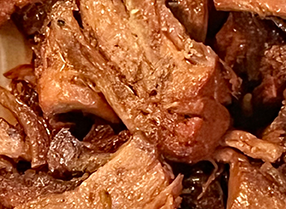
“Our PULLED product has a taste and texture many think is spot on for pulled pork,” Stickland explains, before drawing a clear distinction with the company’s BITES and BURGER formats. “Our BITES are modeled after sirloin steak bites. While our in-development burger features a look and texture that are strikingly similar to a beef burger. Completely different flavors, textures, colors and shapes.”
That variation is deliberate. Each product is designed to support common use cases, rather than forcing a single format across every application. This enables chefs to create familiar international dishes and new consumer experiences alike. Beneath that diversity sits a consistent foundation.
Everything, she stresses, is produced from a single scalable and economical system. “The core platform components are consistent,” she says, referring to TMP, UmamiBooster and MycoFat. “Our use of functional mushrooms, hemp seeds and other whole plant ingredients is consistent across every product we create.”
When it comes to the center of the plate, we’ve found that texture is even more important than flavor
This is where her background in software product development becomes more than an anecdote. It shapes how the company develops food. “Our platform approach was inspired by my background in software,” she says. “It’s based on component-based architectures (CBA) – think Lego blocks – the principle of reuse, and the concept of polymorphism, or tunability.”
Each component solves a defined set of design problems. TMP is a whole-food ingredient that provides a fibrous structural base, capable of taking on different shapes and textures. UmamiBooster is a proprietary mushroom extract that replaces the role of heme in flavor creation, delivering authentic meaty taste and a transparent label without relying on the use of “natural flavors”. MycoFat is a mushroom-based fat alternative that acts like marbling fat, contributing to browning, crust formation, mouthfeel and structure.
“We mix and match these flexible and reusable components to compose products,” Stickland explains, emphasizing that what appears to be vastly different
formats and experiences, is actually a repeatable approach to creating new innovations in a fraction of the time and at a substantially lower cost when compared to industry norms.
Next up: whole cuts
Innovative as it may be, the cutlet is more of an evolution than a pivot.
The industry often treats whole cuts as a separate frontier – a format that demands entirely new approaches. Stickland does not see it that way.
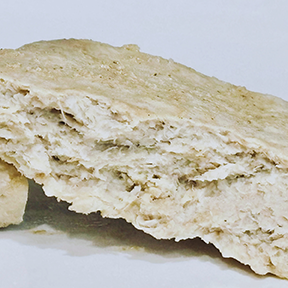
“This new product is less about pushing our boundaries in terms of texture or flavor,” she says. Instead, the focus is on form. “It’s about creating new shapes that enable additional use cases.”
That shift in emphasis is subtle but important. The company has already invested heavily in achieving dense, striated textures that move beyond ground formats. The cutlet builds on that foundation, but its primary purpose is to expand how the product can be used.
Formats that can be grilled and sliced, she notes, open up applications that go beyond what shredded or bite-sized products can deliver. “They can be grilled and served whole, sliced for fajitas, diced into curries,” she says, listing examples that come directly from chef feedback.
That feedback has been consistent. “They rarely push us for anything, with one exception,” she adds. “They want more formats. We’re now being asked for burger and chicken alternatives. While those formats exist in the market, no one has created a burger or chicken analog that is Top-9 allergen-free and made with whole superfoods.”
Innovation through iteration
Even with a platform designed for flexibility, new products are not simply switched on.
The cutlet is now in its third iteration, and refinement is happening across multiple fronts at once. “All of the above,” Stickland says when asked whether the focus is structure or flavor. “Appearance, cooking properties, texture, flavor, mouthfeel – every product requires multiple iterations.”
What the platform changes is not the need for iteration, but the speed at which it happens and the trade-offs it eliminates. “We have the advantage of starting with foundational ingredients which already solve many of the key challenges while adhering to core constraints,” she explains. “Our platform simply enables us to iterate faster without compromising on ingredients or processing levels.”
That iterative process is closely tied to real-world testing. Products move through stages – from internal development to chef feedback to consumers trials – with each phase introducing new criteria.
“‘Ready’ is more of a journey than a destination,” she says. “It means different things in R&D, in beta testing with a chef, and in commercial testing with a consumer.” At each stage, expectations tighten. Visual cues must align with texture. Texture must align with mouthfeel. Flavor must follow. And beyond that, the product must withstand the realities of food-service.
“Can it be seared, broiled, baked, braised and even stewed for hours without breaking down?” she asks. “Can a chef do all the things with it that they’d expect to do with meats that come in a similar format?”
Not a compromise—something that actually satisfies while providing nutritional benefits and bioactive compounds you can’t get from meat
Only when those conditions are met – and when both chefs and consumers respond positively – does the product move toward broader release. The company uses the same iterative, software-inspired approach with all of their products.
The power of texture
Across all of this, two factors consistently emerge. Ingredients as the driver or entry point while texture seals the deal.
“Most customers come for our simple, superfood ingredients, but they get hooked on the texture. When it comes to the center of the plate, we’ve found that texture is even more important than flavor,” Stickland says, a conclusion shaped by repeated chef and consumer responses.
Across trials, a clear pattern has emerged. Initial reactions focus on texture – its density, its structure, its resemblance to meat. Only after that does attention shift to flavor.
But texture, she argues, is not just about how something feels in the mouth. It is also about how the product looks.
“To be truly effective, texture must be visible, apparent and pleasing to the eye,” she explains. “Appealing textures set and even reset expectations.”
This is particularly important for mushrooms, which can often carry lingering preconceptions shaped by past experiences and expectations.
“One look at our products and expectations tend to shift,” she says. “Even for mushroom doubters. They expect it to be delicious, savory, and meaty. And we deliver.”
Contraints as a catalyst
Underlying the platform is a set of constraints that have been there from the beginning.
Whole foods. No additives. No reliance on extrusion or chemically modified ingredients. For Stickland, these are not obstacles to be worked around, but guardrails that keep product designs aligned with the company’s health-focused mission.
“When you take a constraint-driven approach, constraints become part of your foundation,” she says. “They’re the key to creativity for us. They force us to think outside the box.”
By removing certain options, the company was forced to develop entirely new solutions for familiar challenges. “I had to solve the same problems as any other meat alternative startup,” she reflects. “But because I was doing it all with whole foods, I had to invent entirely new solutions for every problem.”
That process took time – nearly three years of development. But once those solutions were in place, they became reusable.
Now, as the company moves into more complex formats, those constraints no longer slow development. If anything, they simplify it.
“There really are no new trade-offs to make,” she says. “Just like ground formats before them, whole cuts are about reusing what we have and extending it.”
Scalable and economical
Operating with limited capital has reinforced this focus on reuse. “This, our first whole cut product, represents the creation of something that others have spent tens to hundreds of millions of dollars to achieve,” says Dan Gardner, Co-Founder and COO of The Mushroom Meat Co. “Getting this far hasn’t been easy,” he adds. “But necessity, as they say, is the mother of invention.”
The result is a system where multiple products can be produced using the same ingredients, proprietary process and production line. “We’re raising funds to scale our production process for a number of high volume foodservice and white label opportunities,” says Gardner.
As the company moves from batch to continuous-flow production, further improvements in efficiency are expected to apply across the entire portfolio.
Every gain in throughput and economics benefit not just one product, but all of them.
Trade-offs: No longer an option
“It’s not about ingredients versus experiences,” Stickland says. “You don’t have the luxury of thinking in terms of trade-offs.”
In her view, the industry’s tendency to separate the two misses the point entirely. Products must deliver on taste, texture, price and accessibility. But beyond that, they must offer something more – benefits that matter to consumers and justify a change in behavior.
“Seventy-five percent of consumers want to eat healthier,” she adds. “None of them want to give up the experience.”
The Mushroom Meat Co’s solution to that problem? Whole-food ingredients, functional nutrition, and performance that meets or exceeds expectations set by meat.
Functional foods at the center of the plate
What the cutlet ultimately represents is not a shift in direction, but a demonstration of range.
It shows that a platform built on reusable components can move across formats without losing coherence. That whole cuts do not require a departure from core principles. And that development can be driven by market demand as much as ambition.
On a buffet, it might look like trays that empty faster than they can be filled. In a kitchen, it looks like a product that behaves exactly as a chef expects.
For Stickland, those outcomes point to a larger, longer-term strategic goal for the company. “I created our platform to do what meat does,” she says, returning to the idea that has guided the company from the start. “To deliver texture, flavor, and satisfaction in a variety of different formats,” she continues. “While offering something more. Mushrooms that eat like meat. Not a compromise – something that actually satisfies while providing nutritional benefits and bioactive compounds you can’t get from meat.”
The cutlet is simply the latest expression of that ambition – not an endpoint, but another step in their goal of elevating functional mushrooms and other whole superfoods from supplements to the center of the plate.
If you have any questions or would like to get in touch with us, please email info@futureofproteinproduction.com