


Protein Pioneer: Yvan Chardonnens
As precision fermentation edges closer to industrial reality, Lloyd Fuller meets Standing Ovation’s Yvan Chardonnens to explore how one company claims to have cracked casein – and what that means for scaling functional proteins
Across much of Europe, it is a public holiday. The kind of pause that briefly slows offices, empties inboxes, and resets the pace of the week. But that rhythm rarely applies to companies operating at the edge of industrial change – and it certainly does not apply to Yvan Chardonnens.
When Protein Production Technology International speaks with the CEO of the French biotech Standing Ovation, there is no sense of pause. The conversation moves with purpose – from molecular biology to manufacturing systems, from regulatory pathways to commercial strategy. It reflects a company working through how to deliver something difficult at scale, where scientific progress, industrial constraints, and commercial timelines all have to align.
At the center of that effort is a single protein. “If you take one liter of milk, you’ll find about 30g of protein, and 80% of that protein is casein,” begins Chardonnens. “Casein is what enables milk to become stretching, melting cheese, a perfect ice cream without emulsifier, or yogurt that holds.
“At Standing Ovation, we produce this via precision fermentation, meaning without touching a single cow or a gram of milk. That’s what we do.”
For those unfamiliar, casein sits at the core of dairy functionality, governing how products behave under heat, shear, and processing conditions. It is not simply present in dairy systems – it defines them. Replicating that behavior has remained one of the more complex challenges in alternative proteins, particularly when moving beyond the lab.
“We chose early on to take the ‘north face’ – to go after the toughest challenge,” reveals Chardonnens. “Today, we can say that we have cracked that code and have even managed to scale it at an industrial level.
Protein as infrastructure
“By 2050, humankind will need around 250 million tons of protein to feed itself, but it’s anticipated that about 25 million tons will be missing,” continues Chardonnens. “This protein gap represents a real risk to food sovereignty, much like gas or oil sovereignty has become critical.”
The comparison is deliberate. Protein is increasingly treated less as a commodity input and more as a strategic resource, tied to national resilience and long-term supply security. “Plant-based proteins have done a good job from a supply perspective, but from an organoleptic point of view – taste, color, rheology – there is still progress to be made,” he says. “These alternative proteins often need further functionalization, which makes ingredient lists longer and more complex. With casein, the protein does the job on its own.”
That distinction has practical consequences. When functionality is inherent to the protein itself, it reduces the need for additional stabilizers, emulsifiers, and processing aids. For manufacturers, that can simplify formulation while improving performance consistency across applications.
Engineering a controlled biology
“It all begins with a simple resource: sugar,” Chardonnens states. “Through our fermentation processes, these sugars are converted into proteins with advanced functionalities.”
Precision fermentation relies on microorganisms acting as production systems, converting sugars into specific target molecules under tightly controlled conditions. The process takes place in enclosed bioreactors, where variables such as temperature, pH, oxygen transfer, and nutrient availability are continuously regulated.
Rather than producing a broad mix of compounds, the system is tuned to generate a single protein with repeatable precision and consistency across batches. That level of control is what allows fermentation to move from small-scale demonstration into reliable industrial manufacturing.
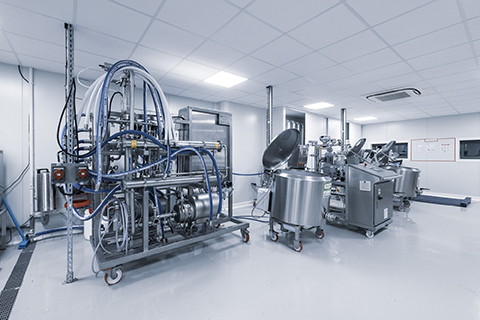
“The purification processes we have developed guarantee the highest purity of the produced proteins, ensuring impeccable sterility and the complete absence of traces of antibiotics, lactose, GMOs, and other contaminants.”
That downstream stage is where many processes are tested. Separating the target protein from the fermentation broth, removing residual biomass, and achieving consistent purity across batches are technically demanding steps. They also play a decisive role in determining cost and scalability.
Solving the scale problem
Standing Ovation was co-founded in 2020 by Romain Chayot, with early work focused on building the biological process behind fermentative casein. Scaling that process required solving a different set of challenges.
In 2024, support from France 2030 and Bpifrance accelerated the development of purification systems, targeting one of the key constraints in fermentation-based production. Improving recovery rates and reducing processing losses were essential steps toward industrial viability. From there, the company expanded its capabilities through partnerships.
Ajinomoto Foods Europe, the European arm of the Japanese food and biotechnology group, brought large-scale fermentation capacity, along with decades of experience in industrial biotechnology. Tetra Pak, a global leader in food processing and packaging systems, contributed expertise in downstream processing and system design, focusing on how proteins are separated, purified, and handled at scale.
“As a startup, you can’t do everything on your own,” Chardonnens admits. “So you need to build an ecosystem that gives you as much support as possible.”
Each partner addresses a specific part of the production chain. Together, they enable a coordinated approach where upstream biology and downstream processing are developed in parallel, rather than sequentially.
From byproduct to feedstock
“When you want to make 1kg of cheese, you need about 10 liters of milk,” continues Chardonnens. “The remaining nine liters are, at this point, either sent to pigs or to methanizers, and that comes at a cost.
If you take one liter of milk, you’ll find about 30g of protein, and 80% of that protein is casein
“What we do at Standing Ovation is buy these effluents from the same companies that need the proteins we produce and are also looking for solutions to manage those byproducts. That’s how we create a circular model.”
Acid whey and similar dairy side streams contain residual sugars that can be used as feedstock for fermentation. Redirecting these streams into protein production changes their role within the system, turning what was previously treated as waste into a functional input.
“It became core to how we think about both the performance of our proteins and the value we could bring to the wider dairy industry,” Chardonnens explains.
The approach also introduces flexibility. Feedstocks can be adjusted depending on availability and cost, without affecting the performance of the fermentation process or the quality and consistency of the final product.
In April 2025, the concept was demonstrated at pilot level with Bel, the French multinational dairy group behind brands such as Laughing Cow and Babybel. By October, it had been successfully validated at industrial scale. That progression clearly shows that the model can move beyond concept and into repeatable operation.
Working with the system
“Our proteins are not positioned in opposition to traditional casein,” Chardonnens is keen to highlight. “We’re not in a one-for-one replacement model. “Our proteins bring additional, consumer-perceivable benefits that help further functionalize the protein and open up new possibilities.”
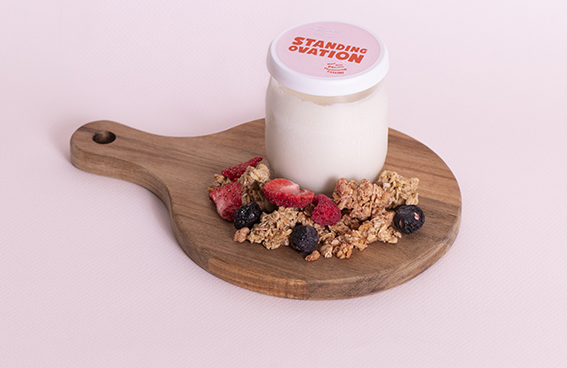
The approach is built around integration rather than substitution, working alongside existing dairy infrastructure and supply chains. “The relationship with Bel has been absolutely excellent from the beginning,” Chardonnens says. “They’ve been very good at balancing their role as both a customer and an investor.”
That balance has allowed technical development and commercial planning to evolve together. As the technology has progressed, so too has the understanding of how it
can be applied in real products.
Danone’s involvement extends that model further, adding scale and access to global markets.
Acceleration, not validation
“Capital is important,” Chardonnens emphasizes. “But we chose an investor syndicate that can help us accelerate in the direction we want to go.”
The huge Series B round announced at the of March 2026, totaling US$34.2 million, followed a fundraising process that began in early 2025 and unfolded over more than
a year. “It’s been tough, of course,” he says. “Mainly due to the broader geopolitical environment and the emergence of new investment priorities such as AI or defense.”
What sustained investor interest was a combination of technical differentiation and a clear path to industrialization. “Our patented technology is becoming the focal point
for an industry-wide shift toward sustainable, high-performance proteins.”
The investor group reflects that positioning, bringing together public funding, financial capital, and strategic partners from the food industry. With funding secured, the focus shifts now to commercialization – and to the question of where the company’s initial market entry will take place.
Entering the market
In that regard, the company’s first port of call will focus on the USA. “It’s mostly for regulatory reasons,” says Chardonnens. “We achieved our self-GRAS status a few weeks ago, which opens the door to the US market.”
The company’s commercial pipeline has been developing in parallel, with customers already testing applications and preparing for product launches. “It’s about focusing on applications with the greatest potential for differentiation, working with customers that can move quickly to market, and leveraging brand architectures that can support new claims and clearly justify added value.”
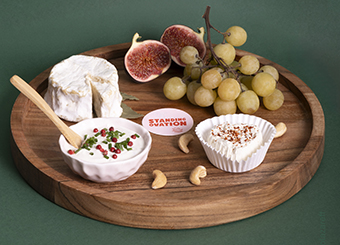
Hybrid products provide a practical starting point. “It’s a very convenient, almost stealth way for us to enter the market and gradually educate consumers about our technology and our proteins,” Chardonnens believes.
At the same time, attention is being paid to how products are presented. “We’re spending quite a bit of time defining the right ingredient nomenclature – both front and back of pack – to maximize consumer acceptance.
A changing landscape
“Food remains the great equalizer,” Chardonnens observes. “We can live without many things in society, but we can’t live without food. It sits at the center of everything we do, every single day.”
“It’s a continuation of processes that have been established for centuries. It’s not a revolution in that sense, and I think that makes it more reassuring,” says Chardonnens. In that sense, precision fermentation builds on processes already familiar within the food system, even as it extends what those processes can achieve and where they can be applied.
We chose early on to take the ‘north face’ – to go after the toughest challenge
That sense of continuity, combined with improving cost dynamics and growing industry confidence, has helped sustain momentum even in a more challenging investment environment.
A different position
“At the beginning, we were one of the few companies building something in this space,” says Chardonnens. “Today, I think we are seeing the emergence of a potential giant – and I choose those words carefully.”
That shift reflects both technical progress and the steady accumulation of partnerships, capabilities, and industrial validation over time. “We are the first and only company to have cracked casein through precision fermentation at industrial scale. We are also the only one able to offer a circular model through the recycling of dairy effluents.”
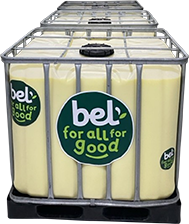
cheese whey
Around that foundation, an ecosystem has formed, bringing together expertise across the value chain and aligning multiple stakeholders around a shared objective.
“All of these elements have brought a wide range of stakeholders – financial, industrial, scientific, and consumer – toward us.”
What success looks like
As the conversation turns to what success ultimately looks like, the focus shifts beyond immediate milestones and toward how the technology scales over time and integrates into existing global food systems.
“I think success looks like a technology that has been fully proven to the point where we can license it, so we don’t have to build all the factories ourselves,” Chardonnens reflects. “It also means achieving maximum consumer acceptance, which is of course one of the biggest challenges for the industry.
“It’s about precision fermentation becoming established as a leading solution for food sovereignty and food safety.”
The emphasis is not just on technical validation, but on how the model can be replicated and adopted more widely across the industry.
Outside, it may be a public holiday. Inside companies like Standing Ovation, the pace is unchanged. For now, the priority is execution and delivering on what has been built so far. “The work really starts now,” says Chardonnens. “This Series B is about accelerating everything.”
If you have any questions or would like to get in touch with us, please email info@futureofproteinproduction.com

More Features

Protein Pioneer: Justin Kolbeck

Deep Dive: Breakout bets

Feeding change

Protein Pioneer: Kesha Stickland


