

Ones to Watch: Foresight engine
26 FOOD TECHS TO WATCH IN 2026
New Wave Biotech CTO & Co-founder, Nix Hall, wants biotechs to model tens of thousands of bioprocess scenarios in-silico before they ever touch a tank, helping companies cut cost, risk, and time from the journey to scale
Boprocessing is full of invisible tradeoffs. Every shift in feed strategy, residence time or DSP sequence reverberates through yield, cost and environmental performance, yet companies have often had no way to explore those dynamics without committing to expensive, slow and capacity-limited experimentation. In a field bottlenecked by infrastructure, New Wave Biotech is betting that the fastest route to scale begins on a screen, not on a stainless steel floor.
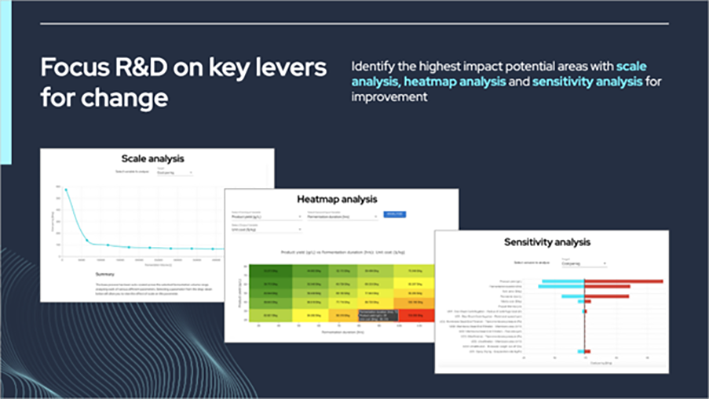
“We have developed Bioprocess Foresight, a software platform leveraging hybrid AI modeling to simulate and optimize bioprocesses in-silico,” explains Nix Hall, CTO & Co-founder. “This enables companies to evaluate yield, throughput, cost and sustainability in parallel, accelerating scale-up and de-risking R&D and investment decisions, allowing them to identify the biggest levers for improvement. With Bioprocess Foresight, customers can reduce physical experiments run by up to 92% versus conventional DoE approaches, increasing speed and reducing the cost burden of R&D.”
Hall maintains that developers of novel foods and materials should be able to test many hypothetical processes before committing to any physical workflow. For an industry defined by high CapEx, limited facilities and scarce data, the advantage is clear: more exploration, fewer blind alleys, and a more confident route to commercial viability.
Hybrid by design
For decades, modeling tools have been forced to choose between explainability and accuracy. Hall notes that this compromise has hampered the entire sector. “Modeling approaches in this field struggle to balance explainability with accuracy,” Hall states. Novel products typically have limited datasets, making it extremely difficult to model how they will behave under different process conditions.
“Traditional software uses mechanistic approaches. These offer explainability and are great for well-understood processes where the dynamics are clear,” Hall continues. “However, they struggle with the complex problems which are less well understood, very common in biological processes.” Pure machine learning sits at the opposite extreme. “Pure ML approaches require huge volumes of data, and the end result is a black box, potentially highly accurate but impossible to explain and reason about.”
New Wave Biotech’s hybrid architecture aims to bridge that divide. “We combine these two approaches, using a hybrid modeling technique that allows us to get the best of both worlds, creating an approach that is explainable while requiring only small amounts of data to produce highly accurate results,” Hall emphasizes.
But optimization is not only about reactor performance. “We also focus not only on the pure technical and process dynamics, but also zoom out and show the economic and sustainability impacts of processes,” Hall adds. “This allows users to understand all sides of the problem and tailor their processes to meet their specific needs from the very first steps in process development.”
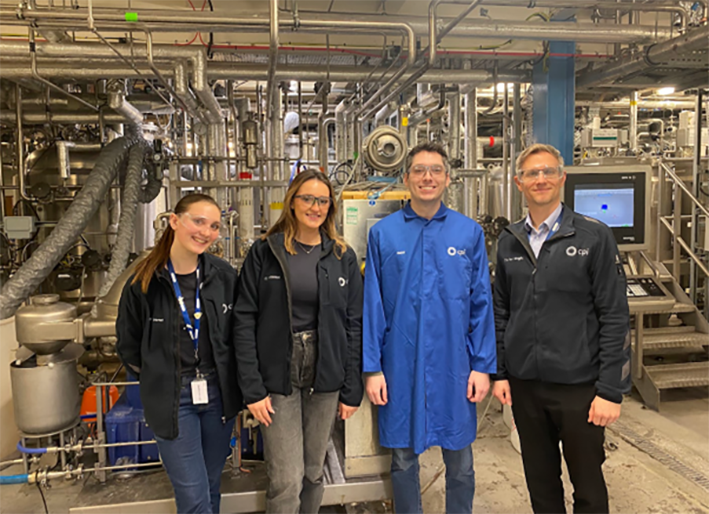
Validation has been essential. “2025 has been a massive year for us. We’ve secured several key pieces of validation of our platform from projects with Multus and CPI, demonstrating the accuracy of our modeling with just a single experiment’s worth of data, as well as showcasing the ability of our process optimization to halve costs while improving multiple key process metrics,” Hall reports.
Commercial momentum has followed. “That’s helped us gain traction, with a number of bioproducers, CDMOs, and even large corporates keen to work with us and help improve their process R&D,” Hall adds.
The platform also gained a major new module this year: a dedicated LCA engine built specifically for fermentation workflows. “It’s the first LCA tool that is truly bioprocessing-specific, and because it sits within our wider bioprocess modeling platform, it allows users to dynamically adjust process dynamics and understand
the tradeoffs between process performance, techno-economics, and sustainability all in one place.”
The UK company is now turning its attention to another application. “We’ve just started a project to help optimize lipid extraction, both for traditional solvent and non-solvent routes,” Hall says. With solvent methods under sustainability scrutiny and alternatives poorly understood, she sees “a great opportunity for us to help measure and optimize the performance of more sustainable processes.”
DSP is what defines success
Hall believes one critical area still receives far too little attention however. “The sheer complexity of bioprocessing, particularly DSP, is often overlooked,” she observes. “A
DSP process can have hundreds of different parameters and variables to adjust, and the number of possible processes is near infinite. It’s also the stage that really makes or breaks a process, determining scalability, sustainability and unit economics.”
For Hall, the spotlight on biology can distract from where commercial feasibility truly crystallizes. “Biology often grabs all the headlines, but bioprocessing engineering is what gives us the tools to make it all happen!”
This complexity meets an equally stubborn constraint: a shortage of scaling infrastructure. “In both the UK and across the world, there’s a real lack of scaling support for many biotech companies,” Hall laments. “There are a handful of organizations that can do this work, and a dearth of infrastructure. This is an area that both China and the USA are investing in heavily, and if the UK government is serious about supporting biotech, it needs to help get more infrastructure in place, which requires long-term, significant financial support.”
In such an environment, software becomes a force multiplier. “Being able to do more with less is key to being able to scale despite the restrictions in capacity and infrastructure,” Hall maintains.
Progress for New Wave Biotech has been boosted by early partners. “Innovate UK, via grant projects, has been helpful in supporting us to build our platform and key capabilities, as well as securing early validation,” Hall says. “We’ve also been fortunate in getting support from key industry players such as Big Idea Ventures and EIT Food, which have played a huge role in helping us get to where we are now.”
The long arc toward impact
For all the technical ambition, though, New Wave Biotech’s mission remains grounded in long-term food security. “Having a positive impact on the world is a thread that unites our team,” Hall reflects. “We see food security and sustainability as key challenges for the coming decades, and we want our platform to help as many vital innovations scale effectively and have real impact as possible.”
That mission continues to shape the company’s horizon. “It may sound grand, but if all goes well, we’d love to become the de-facto standard in bioprocess modeling, both in food and beyond!” Hall concludes.
If you have any questions or would like to get in touch with us, please email info@futureofproteinproduction.com

More Features

Protein Pioneer: Justin Kolbeck

Deep Dive: Breakout bets

Feeding change

Protein Pioneer: Kesha Stickland


