

Seeking alt-meat's product-market-technology fit

Innovation alone won't revive the alternative meat industry, writes Christie Lagally Bradburn. The real challenge is turning promising technologies into commercially viable, large-scale production capable of competing with conventional meat
Alt-meat advocates have put a lot of hope in innovation to change the direction of the industry, but executing on this promise will require prioritizing real-world deployments over visionary storytelling.
The alt-meat industry is facing a brick wall. Bellwether companies have shrunk, and attacks by the traditional meat industry over labeling or ultra-processed foods have reached a crescendo. Meanwhile, consumers have been asking for price and taste parity from alt-meat only to have had their needs inconsistently met. Advocates' response to this crisis of confidence has been to direct our attention to the promise of 'innovation' to bring alt-meat to consumers at volumes and prices on par with animal-based meat.
I am guilty of this charge as well. Innovation has often been successful in mitigating entrenched global problems ranging from the environmental to the democratic. But while we have plenty of cheerleaders and think tanks, our working knowledge of how to advance innovation in alt-meat is sitting in the hands of a few companies with limited resources and even more limited time.
The problem with advocating for just 'innovation' as the magical solution to alt-meat's problems is that the big ideas are largely useless without full-scale deployment
The problem with advocating for just 'innovation' as the magical solution to alt-meat's problems is that the big ideas are largely useless without full-scale deployment. A patent on the shelf is worth ... not a whole lot ... unless it is put into practice. This means that technological deployment is the one step that predicts the impact of our innovations. For example, Impossible Foods' heme for the hamburger has lasted decades on consumers' plates, despite its novelty and GMO production, because it made it to the market. Yes, it was revolutionary, but most importantly it was deployed.
In the 1970s, NASA introduced the Technology Readiness Levels (TRLs), which have since been adopted in various forms to guide technology development in every industry. Alt-meat should adopt this framework as well. The TRL scale spans from TRL 1: basic research to TRL 9: system launch in real-world deployments.
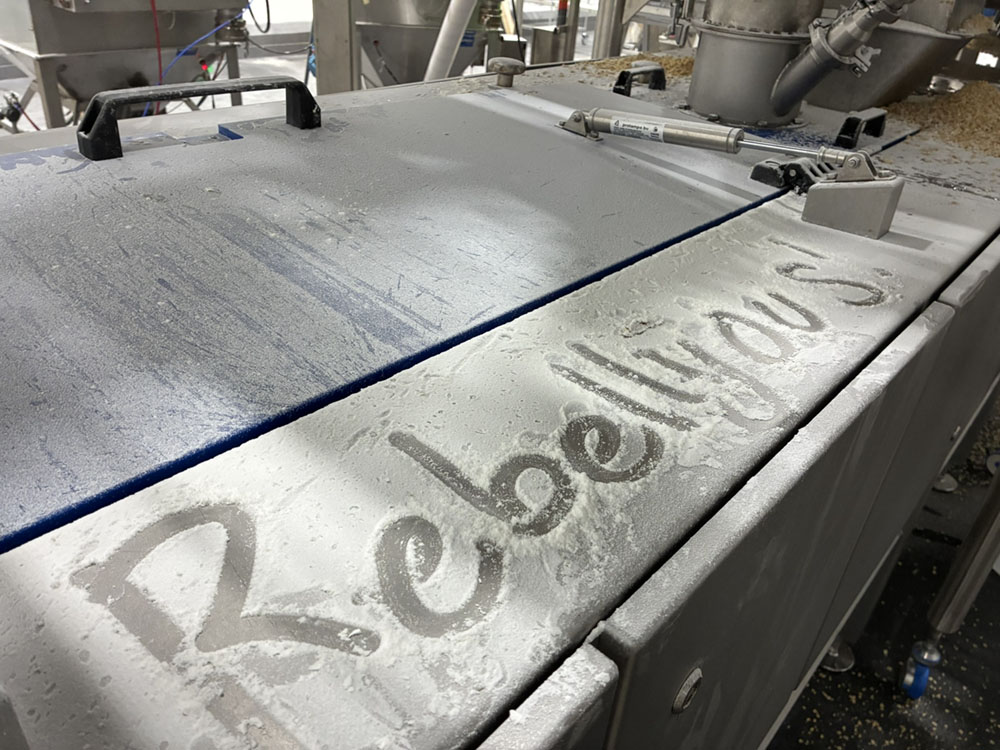
The chaotic nature of the last 15 years of alt-meat R&D saw some innovations reach TRL 9, while many promising ideas were truncated when companies ran out of money. Without sustained technical development culminating in full deployment, I fear the alt-meat industry will continue to lose momentum. We've already seen innovative companies close and their technologies lost in spite of great potential. This is not an indication that the R&D efforts were wrong, misguided, or unsuccessful. They were just not completed yet, which is more of an indication of our will to pursue alt-meat tech than any other market indicator.
So how do we reach full deployment? Like a Rubik's Cube, real-world deployments come in small but deliberate turns that must fully click in. TRLs 6, 7 and 8 – system demonstrations in simulated and then real-world conditions – are giant leaps for alt-meat, representing milestones necessary to reach TRL 9. These milestones describe the 'what' but not the 'how' to reach deployment, and in alt-meat the 'how' reveals a deeper understanding to guide us.
What actually moves the needle on alt-meat's main objective of meat replacement is when technology overcomes the major barriers of price, taste or production volume
Scaled commercialization of technology solutions to reach product-market fit is what I call the product-market-technology fit. What actually moves the needle on alt-meat's main objective of meat replacement is when technology overcomes the major barriers of price, taste or production volume. It's not one breakthrough but many sought over and over again, while navigating dead ends after achieving limited progress in order to connect moments of momentum on the road to full deployment. Each of these turns requires an evolving strategy that is refined by direct experience (not theory) combined with introspective observation, creative problem-solving, and persistence by boots-on-the-ground practitioners of our industry.
Product-market-technology fit is the point at which we see the market react to the shift in product acceptance resulting from the substantial benefit of a technology deployment. Fundamentally, this has been the multidimensional challenge of alt-meat to fit the product, the market and the technology together in the same time and space to start the flywheel towards company profitability. The timing and maturity of each of these components dictates success or failure. All three are needed simultaneously, which is not an easy feat to achieve when companies must make conflicting decisions about how to spend investment dollars, particularly in more recent years.
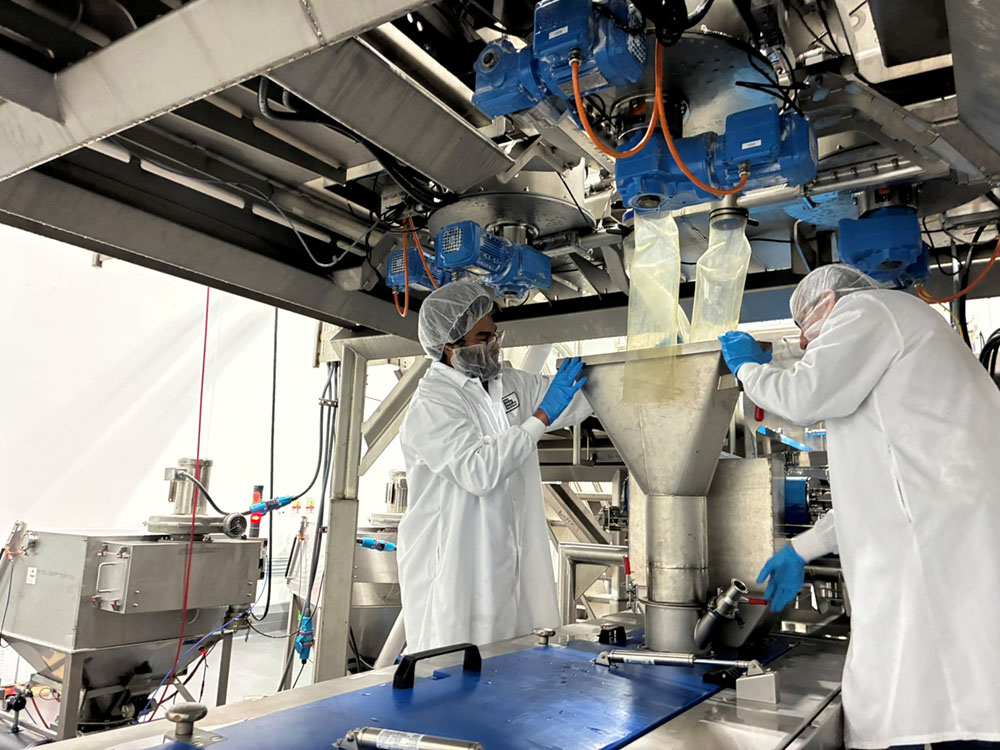
From our firsthand experience at Rebellyous Foods delivering tech-enabled price-parity plant-based meat to the market (now reaching over 6 million school kids), our deployment journey has been instructive. What seemed like bad luck in real-world deployments led us to optimize our production technology to lower the cost of our equipment deployments. This is now giving us more opportunities to deliver price-parity enabling technology and to reach more customers with price-parity plant-based meat.
At Rebellyous, while TRLs 1-5 took nearly half a decade to truly understand the problems, fundamental physics and design solutions, deployment moved our technology maturity past TRL 9 faster than all previous years of R&D. While TRLs 6-9 were the hardest, they were also the fastest and the richest in delivering operational and design insights. I now think of our engineering design as being at a new stage that I call TRL 10: redesign for capital expenditure optimization for expanded deployments for price-parity plant-based meat.
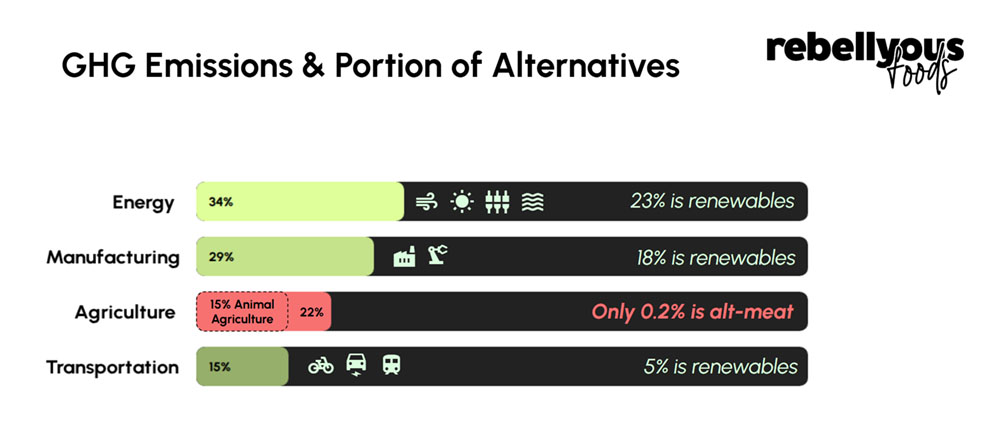
The alt-meat industry today is still far behind deploying innovations to replace meat at scale in contrast to other alt-solutions intended to mitigate climate change. In both energy and manufacturing, alternatives represent about 20% of resources and about 5% in transportation from electrification of cars, rail, buses and trucking. But alt-meat clocks in at just 0.2% by volume of global meat production even though animal agriculture contributes around the same GHG emissions as the entire transportation sector.
We don't just need more alt-meat... we need to get better and faster at deploying the technology necessary to deliver alt-meat to consumers
To bridge this gap, we don't just need more alt-meat – including plant-based and cell-cultivated – we need to get better and faster at deploying the technology necessary to deliver alt-meat to consumers. We need to ensure our companies' flywheels consist of the product-market-technology fit. This requires organizational and leadership development as well as technological development to reach real-world deployments. While painting the picture of innovation as the future-perfect solution is a worthy academic exercise, there has never been a more urgent moment to enable technologists to advance our technology readiness beyond the visionary stories of the future of meat.
Christie Lagally Bradburn is the Founder & CEO of Rebellyous Foods, a food production technology company working to make plant-based chicken price-competitive with conventional chicken to serve the most cost-sensitive markets with climate-friendly meat alternatives. Bradburn is a mechanical engineer who began her career in the aerospace industry working on testing, designing, and manufacturing commercial airplanes and spacecraft. Rebellyous Foods is focusing on designing novel manufacturing equipment that addresses the two most significant obstacles facing the plant-based meat industry – cost and quality-at-scale – and recently commercialized Rebellyous' proprietary Mock 3 Production System. Rebellyous serves nearly six million kids with 7 SKUs of plant-based chicken through the USDA National School Lunch Program

Join Us At One Of Our Upcoming Events

If you have any questions or would like to get in touch with us, please email info@futureofproteinproduction.com


