Enhancing plant-based protein production with smart near-infrared spectroscopy

Dr Johannes Busch of Evonik explores how smart near-infrared spectroscopy is enabling more precise control over protein quality, amino acid composition, and processing performance in plant-based food production.
As plant-based foods move from niche offerings to mainstream dietary staples, the industry is being forced to confront a familiar but unresolved challenge: consistency. Scaling production does not simply mean producing more protein. It means delivering ingredients that perform reliably across nutritional, functional, and processing dimensions, despite any variations in agricultural raw materials.
Plant-based protein production brings together biological variability, chemical composition, and increasingly sophisticated processing technologies. Cereals and legumes are biologically complex and influenced by geography, climate, seasonality, and post-harvest handling. Yet downstream processing and finished food products demand uniformity. Bridging this gap requires analytical precision that traditional quality control approaches were never designed to deliver at industrial speed.
Near-infrared (NIR) spectroscopy has emerged as one of the most powerful tools to address this challenge. Once confined largely to laboratory environments, NIR analytics has matured into a real-time, scalable technology capable of supporting decisions across decentralized supply chains. When paired with robust reference analytics and validated chemometric models, NIR enables food producers to move from reactive quality checks to proactive ingredient intelligence.
Evonik’s AMINONIR service represents one of the most established applications of this approach. Developed initially for agricultural and feed markets, the platform now offers a compelling blueprint for how precision analytics can support the next phase of plant-based protein innovation.
Plant-based proteins have nourished human societies for millennia. Cereals such as wheat, maize, barley, and oats, alongside legumes including soybeans, lentils, chickpeas, peas, and faba beans, form the backbone of diets across cultures and continents. These ingredients are consumed whole, milled, fermented, baked, and processed into countless food formats.
Many traditional dietary systems evolved around complementary plant proteins. Pairings such as rice and lentils or maize and beans emerged without scientific knowledge of amino acid balance, yet achieved it nonetheless. From a nutritional perspective, protein quality is determined by amino acid composition and digestibility. Proteins are assemblies of amino acids, some of which the human body cannot synthesize and must obtain from food.
These indispensable amino acids are critical to healthy growth, maintenance, and metabolism. While balanced intake is often taken for granted in industrialized food systems, it remains decisive in contexts ranging from infant nutrition and aging populations to regions affected by malnutrition. It is also increasingly relevant as plant-based foods aim to match or exceed the nutritional performance of animal-derived products.
Beyond nutrition: amino acids as functional building blocks
Amino acids influence far more than nutritional value alone. They play central roles in determining how proteins behave during processing and in finished food applications. Protein structure, solubility, water-binding capacity, and textural properties are all shaped by amino acid composition.
Cysteine contributes to structural strength through disulfide bonds between protein chains, affecting elasticity and firmness. Glutamic acid and glutamine influence water uptake and retention, shaping mouthfeel and juiciness. Other amino acids contribute to emulsification, foaming, and gel formation
Protein quality is not defined by crude protein alone, but by amino acid composition, digestibility, and how those proteins perform during processing
As plant-protein processing technologies advance, manufacturers must manage protein quality on two parallel fronts: nutritional performance and processing quality. Optimizing both simultaneously requires analytical tools capable of resolving subtle differences between raw material batches at the amino acid level.
The limits of traditional food composition data
Food composition databases have long served as reference points for ingredient selection and nutritional labeling. While valuable, they were never designed to support real-time production decisions. Agricultural raw materials vary significantly, and average values cannot capture batch-to-batch differences that affect processing outcomes. Relying solely on static data introduces risk, as formulations and processing parameters optimized for one batch may fail for another. As a result, experts are calling for more accurate and more frequent measurement of protein content and quality.
Translating analytical rigor into real-time insight
For more than 70 years, Evonik has developed analytical methods to determine protein and amino acid composition for feed customers worldwide. This experience has culminated in tools designed to combine laboratory-grade accuracy with industrial-scale speed. At the foundation of Evonik’s approach is AMINOLab, its reference laboratory for wet chemistry analysis. Nutritionally relevant parameters including proteins, amino acids, minerals, starches, fibers, fats, and fatty acids are determined using internationally recognized methods compliant with ISO, EN, and DIN standards.
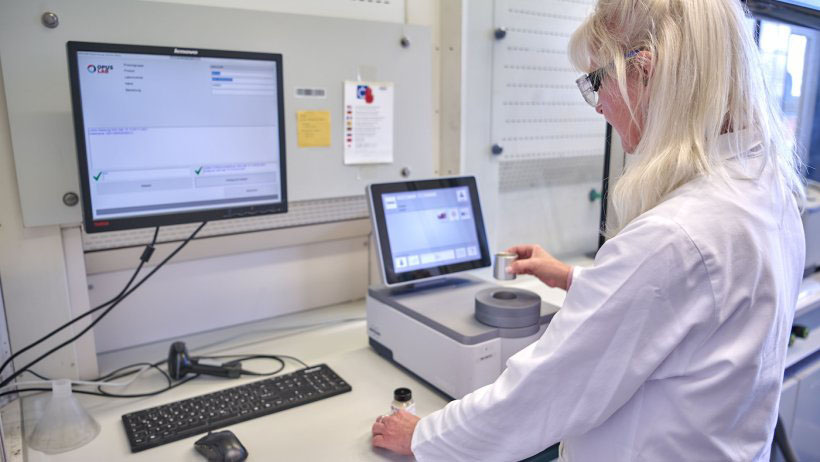
Once a robust dataset has been generated for a given raw material, it becomes the basis for NIR calibration. Using Fourier-transform near-infrared spectroscopy, spectral fingerprints are translated into predictions of ingredient composition through chemometric models validated against lab results.
The resulting calibrations enable non-destructive, real-time analysis on-site, with results available within minutes. Continuous validation ensures sustained accuracy in line with ISO 12099 standards.

Originally developed to optimize essential amino acid use in animal nutrition, AMINONIR now covers a broad portfolio of parameters, including indispensable and dispensable amino acids, dietary fiber fractions, starch digestibility, and fatty acid profiles. These capabilities are directly applicable to plant-based food production.
By measuring what matters at the point of use, producers can move away from averages and assumptions toward evidence-based optimization.
One of NIR analytics’ defining advantages is speed. Evonik customers have relied on AMINONIR systems for decades to support batch-by-batch optimization. Entire workflows, from measurement to result, take only minutes. This enables quality control strategies impractical with conventional lab testing. Raw materials can be evaluated upon receipt, during processing, and before blending. Variability can be identified early, allowing corrective actions before deviations propagate downstream.
Combined with anonymized benchmarking from the AMINODat database, producers gain context across regions, seasons, and suppliers. For decentralized supply chains, this capability supports consistent product performance even when inputs vary.
Precision analytics also contributes directly to sustainability goals. By enabling more accurate matching of raw materials to intended applications, NIR analysis helps reduce waste, improve yields, and optimize resource use. Instead of overengineering formulations to compensate for uncertainty, producers can tailor processes to actual batch properties.
Building confidence
The transition from static data to real-time analytics changes how quality is defined and communicated across the value chain. Farmers, processors, and manufacturers operate with greater transparency when ingredient composition is measured consistently and objectively.
For food producers, this supports stronger claims around nutrition, quality, and performance. For consumers, it underpins confidence in plant-based products that must meet high expectations for taste, texture, and health.
Evonik’s AMINO analytical services team positions itself as a partner in this transition, applying proven tools from agricultural and feed markets to human nutrition.
As the sector matures, the ability to measure and manage variability will increasingly define success. In this context, precision analytics is no longer a supporting tool. It is a foundational capability for the next generation of plant-based foods.
If you have any questions or would like to get in touch with us, please email info@futureofproteinproduction.com