

Ones to Watch: The whey we roll
26 FOOD TECHS TO WATCH IN 2026
Thabata Alvarez, Co-founder & CTO, shares how Updairy is turning filamentous fungi and Brazil’s biomass into a new kind of dairy protein that is affordable, shrinks footprints, and expands what food makers can do
“Updairy is the first Latin American startup harnessing precision fermentation to create sustainable, animal-free dairy proteins,” begins Thabata Alvarez, Co-founder & CTO. That phrasing is modest, but the ambition behind it rewrites the job description of a dairy cow. Dairy has always depended on cows, land, and transport-heavy supply chains, yet here is a company determined to produce the same proteins without any of that physical inheritance. “We aim to offer scalable and cost-effective solutions for the food and beverage industry,” Alvarez continues, summarizing a mission that blends biotechnology with economic pragmatism.
What makes Updairy’s vision compelling is not only its scientific ambition but the precision with which it targets a well-defined problem. “Traditional cow’s milk production requires intensive natural resources, such as water and land, placing significant pressure on the environment,” Alvarez says – a pressure that rises each year. At the same time, global dairy supply chains face increasing strain, from price swings to logistics disruptions and inconsistent quality.
Precision-fermented dairy is often framed as a sustainability solution, but its structural advantages run deeper. Local, modular production allows countries to manufacture ingredients without depending on long, fragile supply routes. For Alvarez, this is the heart of the issue. “The dairy supply chain is highly complex, leading to fluctuating prices, unstable supply, and challenges in maintaining high quality and traceability,” she reports. If the world wants dairy functionality without these systemic weaknesses, the answer, in her view, has to be microbial.
Updairy’s technology therefore centers on filamentous fungi, an organism whose natural machinery offers rare advantages for industrial protein production. “We are focused on developing a truly cost-effective product. We are doing this by engineering a strain of Aspergillus, with the goal of maximizing production while using low-cost substrates and simplifying downstream processes,” Alvarez says.
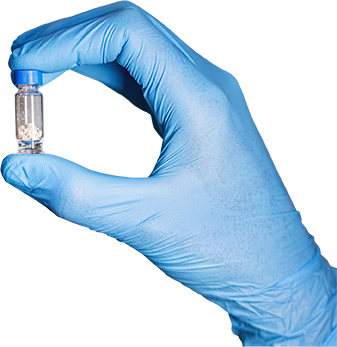
This simplicity is unusually important in precision fermentation. Some microbial hosts still require cell lysis to release their proteins, which adds time, contamination risk, and cost. Updairy has engineered its fungi to secrete whey protein directly into the extracellular medium. As Alvarez reveals, this is one of the platform’s biggest breakthroughs. By avoiding cell disruption, the team strips out an entire step, reducing impurities from intracellular proteins and accelerating purification. A cleaner broth is not just convenient. It is a cost reduction pathway at the heart of the technology’s competitive strategy.
The organism’s metabolic flexibility is another advantage. Filamentous fungi can metabolize low-cost carbon sources, including byproducts from agro-industrial streams. For a region such as Brazil – with its vast output of agro-industrial byproducts containing fermentable sugars – this becomes an economic engine hiding in plain sight.
Proving the model in 2025
The past 12 months have been a formative period for the company. “We have developed a new generation of fungi expressing the desired protein, joined the ProVeg Incubator cohort, and made significant progress in establishing the bioprocess,” Alvarez reveals. These early steps matter: fermentation companies rise or fall on their ability to validate both biology and economics simultaneously.
Alongside technical progress, Updairy also began anchoring its technology in industrial reality. “We have formed a partnership with a major food conglomerate that is supporting our progress in developing and optimizing the bioprocess,” Alvarez says. For a young company, this kind of collaboration offers more than validation: it brings scale-relevant data, operational insight and a clearer pathway toward becoming a supplier rather than just a technology story.

Funding, meanwhile, has followed a steady trajectory. “We launched the company with a pre-seed investment from Gridx, followed by funding from an angel investor and ProVeg. Our seed round is now open, and we are actively engaging with potential investors,” Alvarez says. Ultimately, the team is building momentum just as precision fermentation begins to accelerate globally.
Competing with commodity whey sets a high bar on both productivity and cost. “The main technical challenge is balancing productivity and cost, considering that whey protein is a commodity,” Alvarez says. This is where fungal fermentation offers leverage. By improving expression levels, optimizing secretion, and simplifying downstream purification, Updairy can target a cost curve that many microbial platforms struggle to reach.
The clarity of the protein itself matters, too. “One of the biggest misconceptions about our technology is the belief that the proteins we produce are genetically modified or not identical to their animal-derived counterparts,” Alvarez continues. “The technology changes how the protein is made, not what the protein is.” In other words, precision fermentation does not alter the molecule. It alters the production logic, stripping out the environmental load of cows, land, methane, and feed.
“Our production process requires significantly less energy, land, and water compared to traditional dairy protein production,” Alvarez says. By relying on fermentation rather than livestock, Updairy avoids many of the most resource-intensive stages of dairy farming, reducing greenhouse gas emissions, water use, and overall energy demand while enabling more efficient, localized production.
“We are focused on using sugar sources derived from agro-industrial residues, which further reduces our environmental footprint and minimizes reliance on conventional agricultural inputs,” Alvarez says. Rather than importing whey into a dairy-dependent market, the technology enables local production anchored in locally available biomass.
When brands can buy a better-performing, climate-smart protein for less, animal-free becomes business-as-usual
This regional footprint is part of the company’s long-term vision. “Five years from now we expect to have our proteins already on the market, being used in the formulation of sustainable and nutritious foods,” Alvarez predicts. More significantly, she wants Updairy’s ingredients to show that biotechnology can deliver environmental and nutritional benefits at industrial scale.
Where the next wave is heading
The momentum behind precision fermentation is accelerating fast. “Next year [2026] may be the year we see precision fermentation finally take off,” Alvarez believes. As companies secure regulatory approvals in key markets, commercial activity is expanding. “We expect precision-fermented ingredients to become increasingly visible in mainstream food products, setting the stage for a new generation of sustainable and functional alternatives.”
But Alvarez emphasizes that technology alone is not enough. “The industry needs a balanced combination of capital, regulation, and consumer education,” she says. Investment powers scale. Regulation builds trust. Education helps consumers understand the science behind the products. Without these three supports working together, in unison, the category cannot mature.
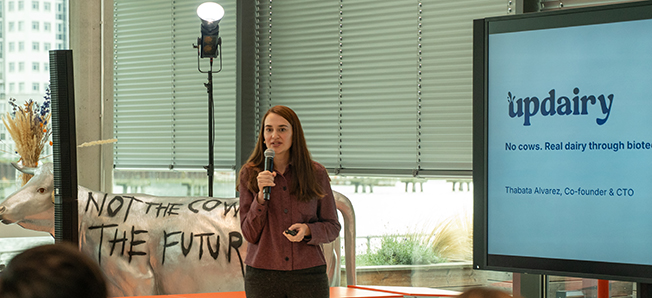
Even the company’s origin story signals the adaptability needed to navigate this landscape. “We were founded during the pandemic with a fully remote team spread across Asia, Europe, and South America,” she says. Despite the inevitable constraints and fragmented working conditions, they achieved milestones normally associated with far larger and more centralized teams at an unusually early stage.
What motivates Alvarez today is community. “It was truly inspiring to be surrounded by such a remarkable group of people committed to building a better food system,” she says of the ProVeg Incubator. “Their passion and dedication have been a powerful source of motivation for our work.”
And as the company looks ahead, the ambition grows with it. “We would like to be recognized as pioneers of this field in South America and as a company that helped shape the future of sustainable nutrition by 2030,” she concludes. It is a future rooted in science, equity, regional strength, and a belief that fungi can help rewrite how the world thinks about dairy.
If you have any questions or would like to get in touch with us, please email info@futureofproteinproduction.com

More Features

Protein Pioneer: Justin Kolbeck

Deep Dive: Breakout bets

Feeding change

Protein Pioneer: Kesha Stickland


