

Ones to Watch: The texture makers
26 FOOD TECHS TO WATCH IN 2026
With Corjan van den Berg at the helm, Revyve’s yeast proteins are rewriting structure, stability and clean-label design
The food industry has spent decades training itself to treat texture as something that is added, adjusted or optimized. Proteins lift. Hydrocolloids bind. Emulsifiers stabilize. Gums keep everything in line. It is a system built from panels of functionality, each carefully engineered to create structure that consumers ultimately experience in a single bite.
Revyve, the Dutch food-tech company born from research at Wageningen University & Research, approaches this problem differently. Instead of assembling texture from multiple additives, it starts with a single raw material that already contains the architecture of stability. “We develop and produce sustainable, natural protein ingredients from baker’s yeast,” reveals Corjan van den Berg, Co-founder. It’s an approach that flips convention. Instead of relying on the usual lineup of gums and emulsifiers, the ingredient itself becomes the source of texture.
And in an era when clean-label requirements are mounting and egg prices remain unstable, this mindset is gaining traction. But Revyve’s ambitions run deeper than solving scarcity or removing E-numbers. The company wants to fundamentally shift how manufacturers think about food structure, starting with the most ubiquitous texture-maker of all: the egg.
Revyve’s technology actually traces back to an early research effort aiming to extract rubisco. “Our technology was originally developed on microalgae,” van den Berg says. “The pivot to yeast came later, once the team recognized that its structural properties could be unlocked with a process far more scalable and modular.”
That insight grew into a technical platform capable of delivering aeration, emulsification and gelling without blends, gums or synthetic stabilizers. The mechanism isn’t precision fermentation however. “When we explain that we make an egg replacer using microbes, people immediately think we are a precision fermentation company,” van den Berg says. “This is obviously not the case. We use non-GMO microbes as our raw material.” That distinction matters because it removes major regulatory barriers that have slowed adoption of other microbial ingredients.
Yeast, it turns out, contains much of the architecture that food manufacturers struggle to recreate synthetically. Revyve’s proprietary process isolates and unlocks those structures while maintaining a neutral, allergen-free profile. It is this combination of functionality and simplicity that gives the company its commercial edge.
A first-of-a-kind facility that changed the company’s trajectory
Revyve’s path to scale accelerated dramatically once its first-of-a-kind commercial facility in Dinteloord came online. Commissioned in 2024 and validated at industrial scale, the plant became the proof point investors and customers were looking out for. By late 2025, it had been running for more than a year with full certifications and a growing roster of multinational customers.
That progress laid the foundation for the company’s €24 million (US$25.6 million) Series B round in September 2025, co-led by ABN AMRO Sustainable Impact Fund and Invest-NL. For a company still considered early-stage by many industry benchmarks, the size and diversity of the syndicate signaled a shift in perception. Revyve was no longer just a promising technology platform. It was an emerging ingredient supplier with reliable industrial throughput.
Van den Berg regards the raise not simply as capital but as validation. “We will use this investment to scale up our first-of-a-kind facility in Dinteloord, broaden our product portfolio, and accelerate customer collaborations,” he says. “This funding ensures we can meet commercial demand on a global scale while reaching positive unit economics.”
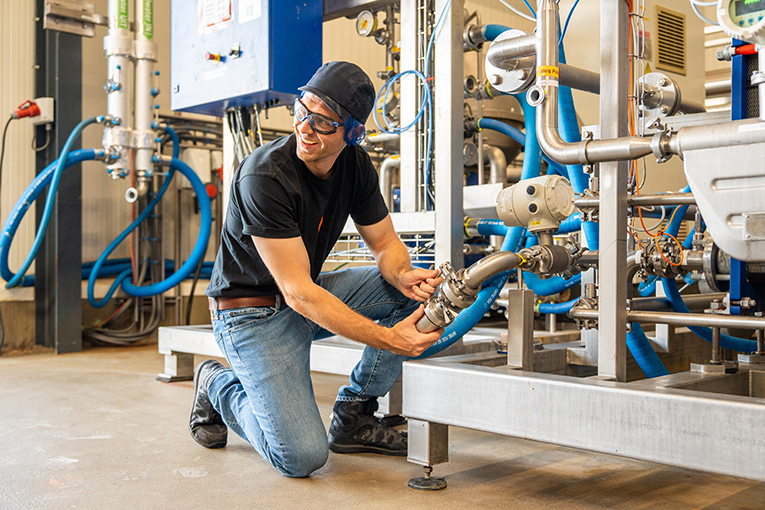
The FOAK facility is designed for modular replication. Because Revyve’s process uses standard food-industry equipment rather than specialized fermentation lines, new production sites can be established next to feedstock partners or in high-demand regions without heavy CapEx. It is a manufacturing model built for rapid multiplication, which is increasingly important as egg alternatives shift from niche to system-level ingredients.
Where clean label meets cost stability
In 2025, food manufacturers recalibrated their priorities. Sustainability remained important, but only when paired with performance and cost parity. This is where egg alternatives have struggled historically. Their blends were functional enough to support partial replacement, but not consistent enough to remove eggs entirely, and almost never cost-competitive at scale.
Revyve’s value proposition intersects all three pressures at once. “Eggs are among the biggest CO₂ contributors in many bakery recipes, so replacing them has an outsized impact on sustainability metrics,” van den Berg feels. But the decision rarely starts with climate targets. For commercial teams, volatility is the louder problem. Yeast-derived proteins offer a predictable cost base, and because they operate as a single ingredient rather than a blend, they simplify sourcing, labeling and production.
Functionally, they also widen what is possible. Revyve’s proteins can deliver structure, lift, foam stability and binding without gums or chemical emulsifiers. This allows manufacturers to cut multiple additives at once, creating cleaner, shorter ingredient lists. Taste neutrality ensures broad compatibility across categories, from brioche and Bavarois cakes to snacks, sauces and dairy alternatives.
Our proprietary process delivers the most functional yeast proteins on the market, truly mimicking egg performance
Clean label, however, is only part of the shift. The bigger opportunity lies in rebuilding the entire architecture of foods for a new generation of industrial product design.
For manufacturers pursuing E-number reduction or looking to eliminate methylcellulose from plant-based meats, yeast proteins provide a fundamentally different toolkit – one that enables structure, binding, and texture to be engineered without relying on synthetic scaffolds. This opens the door not just to cleaner ingredient lists, but to products built on more resilient and functional design principles.
“We achieve egg-like functionality with a single ingredient,” van den Berg continues. The statement sounds simple, but for formulation teams used to solving texture with four or five separate components, it represents an entirely different way of working.
A company growing into its global role
With industrial supply now available and GRAS status confirmed in the USA, Revyve has begun strengthening its presence across Europe and North America, with APAC
on the horizon. Partnerships with Cosun and Lallemand have been particularly influential in shaping scale, operational readiness and market reach. The company has also expanded its commercial and applications teams, building the internal capacity required to support customers through reformulation and industrial onboarding.
The impact metrics are also coming into focus. “We reduce carbon footprint over 80% compared to eggs,” van den Berg says. That figure is part of a broader pattern as manufacturers run lifecycle analyses across their portfolios. Eggs repeatedly rank among the heaviest contributors to Scope 3 emissions, and Revyve’s customers are beginning to see the knock-on benefits in their sustainability reporting.
Despite fast growth, the company is aware of the structural challenges facing the sector. Scale-up capital remains available, but debt financing for new facilities is still difficult. “Capital and more precisely debt financing” is what the industry needs most, van den Berg believes, ideally “ones with government guarantees”. FOAK builds may unlock equity, but to reach mainstream volumes, companies require infrastructure-style financing tools that food tech has not yet fully secured.
As for Revyve’s own future, that could extend beyond yeast. “We aim to broaden our product portfolio, expand global partnerships, and continuously innovate with yeast proteins and beyond,” van den Berg says. The company is evaluating other microbial sources, including spent biomass from precision fermentation. Its modular process gives it room to adapt as these new feedstocks become viable.
For van den Berg, technological progress is only half of the journey. He finds inspiration in entrepreneurs who leave traditional careers to build sustainable food ventures. Their persistence, he says, is a reminder that transformation rarely begins with certainty. It starts with conviction and grows through the disciplined engineering of solutions that work at scale.
If Revyve’s trajectory is any indication, the next five years will see microbial-derived texture become a standard tool in the industrial pantry. And as van den Berg puts it, that future is already materializing. “We develop and produce sustainable, natural protein ingredients from ordinary baker’s yeast.” The architecture of tomorrow’s food may start with a microbe, but its impact could reshape the most familiar products on the shelf.
If you have any questions or would like to get in touch with us, please email info@futureofproteinproduction.com

More Features

Protein Pioneer: Justin Kolbeck

Deep Dive: Breakout bets

Feeding change

Protein Pioneer: Kesha Stickland


