

Ones to Watch: The new fat frontier
26 FOOD TECHS TO WATCH IN 2026
ÄIO Co-founder & CEO, Nemailla Bonturi, believes the world’s fats and oils can be rebuilt from the ground up using circular feedstocks, precision fermentation and a yeast platform designed for industrial residues rather than farmland
The modern food system relies on surprisingly few fat sources. A small group of dominant oils shapes everything from baked goods and confectionery to skincare and household products. These supply chains – stretched across continents – are increasingly exposed to ecological pressure, climate instability and geopolitical volatility.
ÄIO proposes a fundamentally different origin story for fats. “We are a deep-tech biotechnology company that uses precision fermentation to turn low-value industrial side streams into high-value ingredients, fats and oils,” reveals Nemailla Bonturi, the Estonian company’s Co-founder & CEO. “We work with a specialized yeast strain to convert residues such as sugars from sawdust and agricultural by-products into functional lipid ingredients for food, cosmetics and other applications. In practice, we are building a new, circular way to produce the world’s fats and oils that is not dependent on land-intensive agriculture or animal production.”
Turning residues into resources
The story of ÄIO is perhaps best understood through what it enables: shifting fat production toward materials the world already discards at scale. “The global food system relies heavily on palm oil, animal fats and a narrow set of vegetable oils,” Bonturi notes. “These supply chains are linked to deforestation, biodiversity loss, high land and water use, and strong exposure to climate and geopolitical risk. At the same time, side streams from agriculture, wood processing and food-industry operations are underused or simply treated as waste.”
For ÄIO, those constraints create opportunity. “We provide a way to reduce fat and oil production from fragile ecosystems and land expansion, while turning existing side streams into valuable ingredients,” she continues. The environmental advantages are substantial. “Our process can reduce land use by 97% and water use by tenfold compared with conventional palm oil production, which has direct implications for climate, nature and long-term food security.”
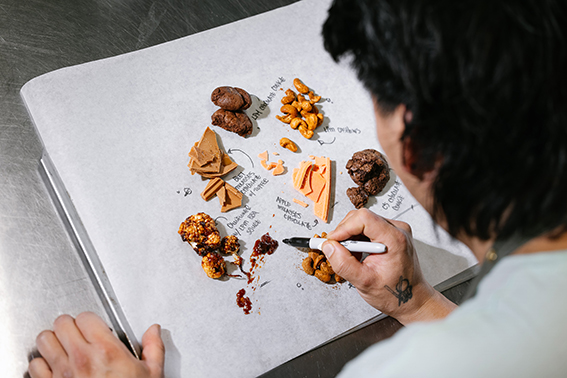
Behind this impact sits a combination of biology and engineering. “Our proprietary yeast platform efficiently converts industrial side streams into lipids. Instead of relying on food-grade crops or highly refined sugars, we design our process around real industrial residues.” That choice shapes the entire platform. “We have built a scalable, high-cell-density fermentation and downstream process that allows us to produce several ingredient formats – Encapsulated Oil, RedOil and ZymaLipid Complex – for applications in food, cosmetics, feed and household chemicals. This multi-product approach gives customers more flexibility than a single oil replacement and helps us compete on function as well as sustainability.”
From pilot to production scale
As with any industrial bio-process, scale is where the theory becomes real. For ÄIO, 2025 marked a pivot point. “Scaling up to 10,000 liters and proving that it works,” is how Bonturi describes one of the company’s biggest milestones. “This gave us one ton of ÄIO ingredients produced in CMOs. We continue to scale up to 100,000 liters.”
Progress at this level requires external validation, and both regulators and customers expect it. A major public grant strengthened this effort. “We secured €1 million in public funding from the Estonian Applied Research Programme to accelerate the development of fermentation-derived lipids and derivatives for cosmetics and chemical applications,” Bonturi says. “This three-year project allows us to deepen our application work, build more data on performance and safety, and prepare for commercial supply to personal care brands.”
Momentum has also expanded ÄIO’s footprint. “We strengthened our positioning and network in both food and cosmetics,” she continues. “That includes new development collaborations with brands and ingredient companies, increased international visibility through media and events – TechCrunch Disrupt, Web Summit, a visit by the President of Estonia, conferences and fairs.”
The year ahead
In 2026, momentum becomes execution. “We will scale to 100,000-liter production in CMOs,” she says. “We will also grow our cosmetics ingredient business from pilot scale into commercial agreements, using the R&D work funded by the public grant to validate performance in real formulations.”
Food applications are more complex but strategically essential. “We plan to advance food applications of our fats and oils, including work related to novel food dossiers in key markets and joint development with food manufacturers.”
Funding will support these efforts. “We have raised a mix of equity and non-dilutive funding,” Bonturi notes. “On the equity side, we closed a seed investment round in 2024, led by Voima Ventures, Nordic Foodtech VC, SmartCap and 2C Ventures.” The next step is clear: “We are focusing on Round A investment in Q3 2026.”
Creating fats from residues is elegant in theory and difficult in practice. Fermentation behaves predictably on refined sugars; residues are a different challenge. “On the technical side, the hardest challenge was bringing lab-scale fermentation into a robust, cost-competitive process at industrially relevant scale while using complex side-stream feedstocks,” Bonturi says. “Fermentation with known substrates – molasses, glucose – is relatively straightforward. Running consistent, high-productivity fermentations with variable industrial residues is far more demanding.”
ÄIO’s solution is to integrate biology, process control and feedstock preparation. “We address this by co-developing strain engineering, process control and feedstock preparation, and by investing in pilot-scale hardware so that we can discover problems before full scale.”
With the right feedstocks, yields, and process integration, microbial fats can target cost levels compatible with mainstream uses
The commercial path mirrors this complexity. “Large food and cosmetics companies plan product lines several years ahead and run multi-step validation on new ingredients, while deep-tech hardware and facility projects also follow multiyear timelines,” she says. Bridging these timelines requires discipline. “Careful selection of early partners, clear prioritization of applications and a staged go-to-market strategy help ensure that regulation and formulation cycles align with our development stage.”
Impact measured in hectares, water savings and material flows
The company’s impact framework is refreshingly concrete. “Our primary impact lens is environmental,” Bonturi explains. “We track the land, water and greenhouse gas footprint of our process compared with conventional fats such as palm oil and animal fats. External and internal assessments indicate our approach can cut land use by about 97% and water use tenfold compared to palm oil production.”
Circularity metrics are equally important. “We measure how much side-stream material we valorize in pilot and later at full scale, as each ton of residues converted into useful lipids represents avoided waste and a step toward more circular industrial systems.”
Regional resilience matters too. “We look at how we contribute to local innovation ecosystems, high-skilled jobs and knowledge creation in the world, and how we work
with partners to support more resilient supply chains.”
Five years from now, Bonturi hopes to see these impacts embedded in everyday products rather than innovation decks. “We would be supplying significant volumes of our fats and oils to both cosmetics and food manufacturers, with our ingredients present in everyday products on store shelves in several regions,” she says. A fully scaled system would make the environmental case unavoidable. “We would be able to show that we have meaningfully reduced land and water use relative to a business-as-usual fats and oils mix for a portion of our customers’ portfolios.”
If you have any questions or would like to get in touch with us, please email info@futureofproteinproduction.com

More Features

Protein Pioneer: Justin Kolbeck

Deep Dive: Breakout bets

Feeding change

Protein Pioneer: Kesha Stickland


