

Ones to Watch: Bubble Effect
26 FOOD TECHS TO WATCH IN 2026
Bob Jacobs reveals how Hydrosome Labs is using ultrafine bubbles to transform fermentation efficiency and food innovation
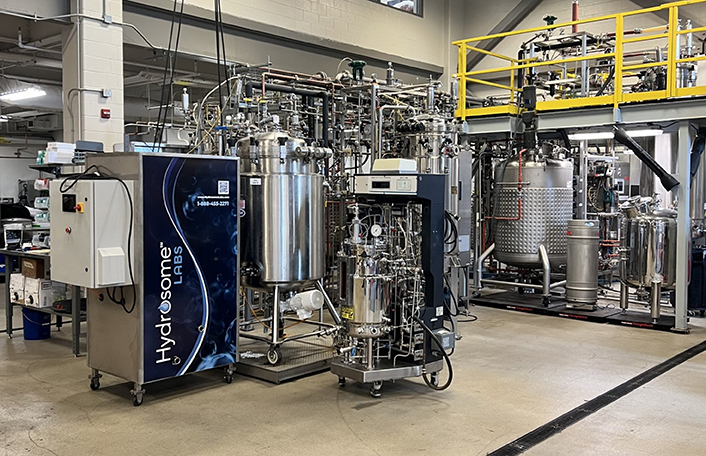
Fermentation has become a core engine of modern food technology, underpinning everything from biomass protein to precision-designed molecules. Yet while investment has poured into strain engineering and downstream processing, the bioreactor itself has seen comparatively little innovation. Hydrosome Labs is challenging that status quo. Led by Bob Jacobs, President, the company applies ultrafine bubble science to improve mass transfer inside fermentation systems, accelerating production while opening new sensory and functional possibilities for food and beverage applications.
“We harness ultrafine bubbles to improve mass transfer in living systems,” Jacobs explains. “Our technology can reduce the cost and carbon footprint of fermentations by increasing yields and shortening fermentation times.” Beyond fermentation, the same approach can enhance emulsions, flavor delivery, and texture in consumer products.
The timing is deliberate. Fermentation capacity is projected to grow more than 40% year on year as companies develop new proteins, specialty ingredients, and functional compounds. Scaling that capacity cost-effectively has become one of the sector’s defining pressures. Jacobs believes ultrafine bubble technology directly addresses this constraint. “Our technology allows companies to increase output from existing infrastructure by 20 to 50% while reducing production costs,” he says.
Ultrafine bubbles, sometimes called nanobubbles, behave very differently from the bubbles seen in carbonated drinks. Hydrosome’s bubbles are so small that, as Jacobs puts it, “we can fit one trillion of our bubbles in one of those soda bubbles”. Rather than rising to the surface, they remain suspended in solution, where their charged surfaces improve the delivery of gases and nutrients to cells.
That behavior translates into biological performance. “Our ultrafine bubbles dramatically improve nutrient utilization and oxygen uptake in yeast and bacteria,” Jacobs says. “They drive 20 to 50% increases in biomass and titers while reducing fermentation times by up to 25%.” Where much of the industry has focused innovation upstream or downstream, Hydrosome is applying it squarely at the center of the process: the bioreactor itself.
In 2025, the company replicated these gains at 5,000-liter scale with multiple commercial partners. It is now preparing to move into bioreactors of 100,000 liters and beyond as customer demand accelerates.
Proof from the lab and beyond
Scaling the science has required rigorous validation alongside engineering. One of Hydrosome’s longest-standing collaborations is with the Integrated Bioprocessing and Research Lab at the University of Illinois. The company has also installed its technology at Pow.bio, allowing customers to test it directly in fed-batch and continuous fermentation systems. Work with Biocell Energetics, a University of Birmingham venture, helped quantify increases in oxygen uptake rate, clarifying a key mechanism of action.
Hydrosome has also explored consumer-facing applications. In 2025, the company completed a 12-week pre-clinical trial on Hydrosome H2O, showing significant improvements in the gut microbiome and reductions in inflammatory markers of up to 80%. The study was published in Nanomaterials, and discussions around future human trials are underway.

To date, Hydrosome has raised more than US$13 million through friends-and-family and seed rounds, securing foundational IP and advancing early commercial installations. A Series A is planned to support the next phase of scale-up.
One of the company’s defining technical tests has been proving what is almost impossible to see. “What has held us, and much of the ultrafine bubble industry, back is the ability to measure the bubbles,” Jacobs says. Because they are smaller than 100 nanometers, even advanced lab systems struggle to detect them reliably. Hydrosome worked with the University of Illinois to measure bubbles below 20 nanometers, linking functional results with physical evidence. That scientific grounding has shaped the company’s discipline. “We are not your typical start-up,” Jacobs says. “Our leadership team brings more than 100 years of combined experience across consumer products, beverages, and finance, helping us stay focused on a few key opportunities.”
Looking ahead, Hydrosome expects fermentation and bioprocessing to continue expanding as companies search for scalable food solutions, even as capital remains tight. On that front, Jacobs is confident that technologies delivering measurable cost reductions and performance gains will endure. “Our goal is for Hydrosome technology to become standard equipment in fermentation operations,” he says. “Because it can be retrofitted, it works in both new and existing facilities.”
If you have any questions or would like to get in touch with us, please email info@futureofproteinproduction.com

More Features

Protein Pioneer: Justin Kolbeck

Deep Dive: Breakout bets

Feeding change

Protein Pioneer: Kesha Stickland


