
Ones to Watch: Brewed to go
26 FOOD TECHS TO WATCH IN 2026
Nosh.bio Co-founder & CEO Tim Fronzek discusses turning Koji-grown mycelium into affordable everyday protein
At Nosh.bio, stainless steel tanks once used for beer now cultivate fungi capable of standing in for animal protein in burgers, gyros, sauces, snacks, and more. For Tim Fronzek, Co-founder & CEO, the starting point is aligning biology with real-world expectations. “We are developing animal-free ingredients from mycelium – the fungi naturally found in soil,” he says. “Our solutions are designed to be tasty, nutritious and affordable for the average household.”
Nosh.bio grows its Koji-based mycelium through biomass fermentation inside retrofitted breweries. As the process parallels beer brewing, the fungi multiply rapidly and can be harvested in hours. The resulting ingredient is highly versatile: it can be used in wet form for hybrid meats and analogs, or dried to enhance functionality in products such as chocolate, cheese, bakery products, and even protein shakes. “By leveraging this approach, we aim to transform the food industry,” Fronzek says.
The problem Nosh.bio is addressing is enormous. “Climate change is our greatest challenge, with the food industry driving more than 30% of greenhouse gas emissions and nearly 80% of deforestation,” Fronzek explains. “Animal-free products can cut emissions by 50% and land use by 75%.” For him, scalable alternatives are not desirable – they are necessary.
The company’s fungi can grow on agricultural side-streams, require no sterile conditions and thrive in existing brewery infrastructure. “We focus on the sustainability of our process and the affordability of our ingredients to drive scalable impact,” he says. By using low-value substrates and avoiding new construction, the company reduces costs, energy use and environmental footprint. “By combining sustainability, scalability and affordability, we are transforming how food is produced and consumed,” he says.
Nosh.bio’s innovation lies in combining organism, process and technology. The company uses a robust, non-GMO, GRAS-certified strain that simplifies production and regulatory pathways. “Market-ready solutions, rapidly scalable via retrofitted breweries,” is how Fronzek puts it. And the platform is circular by design. “Our biomass fermentation can use agricultural side-streams to produce protein with minimal CO₂ and resource use,” he says. The fungi’s resilience enables decentralized production across existing brewery infrastructure.
We are developing animal-free ingredients from mycelium – the fungi naturally found in soil
On the ingredient side, Nosh.bio is built for breadth. “We have already developed applications in meat and seafood, convenience and confectionery, dairy, bakery and health and well-being,” Fronzek reveals. The mycelium naturally forms long fibers that mimic muscle texture without mechanical or chemical processing. “Unlike plant proteins or other mycelium, our product has a neutral, mild umami taste with no off-notes and grows in long fibers that replicate muscle texture and provide collagen-like functionality.”
A breakthrough year
The past 12 months have been pivotal. “We secured a funding round and a seven-digit grant to support our market launch and build our own production facility in a former brewery near Dresden,” Fronzek says. The company hired a senior CFO, reduced production costs by over 60% and added Tönnies and Barilla as both partners and investors – an unusual vote of confidence from major incumbents.
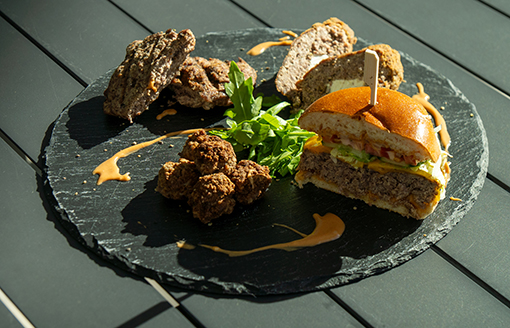
Product development accelerated, too. Nosh.bio created a Koji-beef hybrid that reduces carbon footprint, enhances nutrition and lowers cost without compromising on taste and texture. When trialed in a Berlin canteen, the response was decisive. “We received overwhelming feedback from both the operator and consumers,” Fronzek recalls. “More than 80% couldn’t taste a difference from pure meat, and 87% said they would eat it regularly.”
.jpg)
The next step is market expansion. “We aim to launch products with our partners in German supermarkets, ensuring affordability and taste consistency,” he says. Food service remains equally important. “We will extend our presence in that sector so more partners can benefit from a better and cheaper meat.”
Cost competitiveness underpins the entire strategy. “We’ve already achieved price parity with beef, and we expect to be competitive with pork and chicken soon,” Fronzek predicts. Retrofits keep CapEx low, and the fungi’s robustness reduces processing steps while maintaining natural fibrosity. “Together, this smart strain selection and innovative processing create a clear advantage in product quality,” he adds.
Consumer understanding remains a final hurdle though. “Ongoing education is essential for both our direct customers and end consumers,” Fronzek admits. “We explain that our Koji fungi–based ingredients are made through a simple, natural process: fermentation.” A dedicated development team, meanwhile, supports co-creation and consumer communication to ensure clarity across channels.
Collaboration is central to Nosh.bio’s path to scale. “Our primary focus is working with food manufacturers who can bring products to market,” Fronzek says. Partnerships with groups such as ZMG and Barilla have provided early technical validation, with pilots highlighting the ingredient’s strong fibrosity and juiciness in applications such as gyros.
Impact metrics reinforce the scale of the opportunity. “Our LCA shows that Nosh reduces water use by 90%, CO₂ emissions by 98%, and land usage by 99% compared to conventional beef,” Fronzek says. For a sector under pressure to decarbonize, such reductions redefine what protein production can look like in a resource-constrained world.
The wider horizon
For Fronzek, the mission is as urgent as it is ambitious. “Our purpose drives everything we do, and our vision is clear: a world where food is no longer harmful to the planet, to animals, or to people,” he says.
Commercially, over the next five years, he expects Nosh.bio to be profitable and operating across Europe, North America and Asia, anchored by partnerships already in motion. The headline he hopes to see captures the goal succinctly. ‘Nosh.bio: The enabler for sustainable, healthy, delicious and affordable food products worldwide.’
If you have any questions or would like to get in touch with us, please email info@futureofproteinproduction.com

More Features

Protein Pioneer: Justin Kolbeck

Deep Dive: Breakout bets

Feeding change

Protein Pioneer: Kesha Stickland


