

Ones to Watch: Bioeconomy builders
26 FOOD TECHS TO WATCH IN 2026
Mark Warner takes us inside Liberation Bioindustries‘ efforts to turn precision fermentation into an industrial reality
The promise of precision fermentation has outpaced the capacity to produce it. Breakthrough ingredients continue to emerge, but the world has lacked the dedicated, industrial-scale facilities needed to move them from pilot runs to global supply chains. Mark Warner, CEO of Liberation Bioindustries, is changing that reality by building purpose-designed fermentation plants for the companies creating tomorrow’s essential proteins and bio-based materials.
“We are a contract manufacturer building the next generation of industrial-scale precision fermentation facilities,” Warner details. His team produces critical ingredients for customers in food, pharma, specialty chemicals and beyond, operating commercial-scale fermentation capacity that biotech companies can access without the burden of constructing their own plants. The model fills a structural gap that has slowed the deployment of innovation across multiple industries.
A platform built for the scale the sector has been missing
Warner has spent his career in industrial fermentation, and the Bio³ Platform encapsulates that experience in a pragmatic Design-Build-Operate model. The approach allows Liberation to deploy advanced biomanufacturing capacity rapidly, designing each facility around the needs of specific product classes, from dairy proteins to biomaterials. The company owns and operates these plants under long-term partnerships, offering what Warner calls ‘Biomanufacturing-as-a-Service’: a capital-light route for customers who need reliable fermentation and purification at commercial scale.
Momentum accelerated in 2025. Liberation announced its first commercial manufacturing partnership with Vivici to produce Vivitein BLG, signaling that its facilities can meet the demands of global ingredient companies. A strategic partnership with Topian, NEOM’s food company, followed shortly afterward to develop a precision fermentation facility in Saudi Arabia. The company also completed its rebrand from Liberation Labs to Liberation Bioindustries, marking its shift from early-stage developer to active operator.
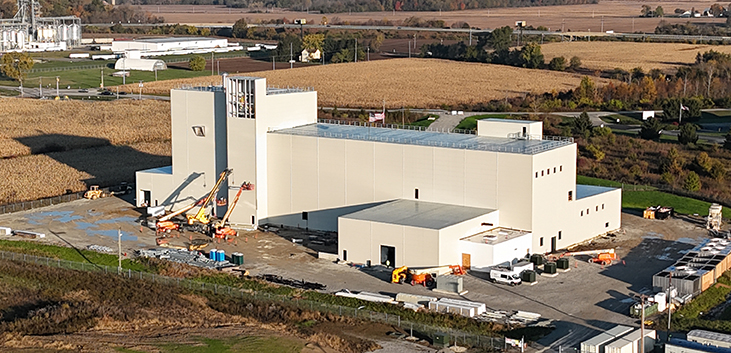
The centerpiece of this transformation is the Richmond, Indiana facility. Now in late-stage construction, it will launch with 600,000 liters of fermentation capacity and integrated downstream processing. Richmond was not an obvious choice, but Warner recalls the moment the team found the site. “Google led us to Richmond, and it was immediately clear that it was the site for Liberation.”
Liberation’s investors reflect the breadth of industries counting on that gap to close. Siddhi Capital, Galloway Limited and Meach Cove Capital join Agronomics, New Agrarian Capital, the NEOM Investment Fund and several individual backers. Their support enabled Richmond to advance from design to construction and kick-start planning for the Saudi Arabia plant.

“The biggest challenge, unsurprisingly, is funding,” Warner notes, emphasizing the patience of investors who have backed the timeline required to build commercial-scale infrastructure. The technical challenge is equally significant. Constructing the first facility of its kind demands precise engineering, pragmatic design choices and an ability to move faster than traditional industrial projects. Liberation counters this with a ‘build with speed’ approach that demonstrates readiness to customers who plan purchases 12 to 18 months ahead.
Liberation measures impact through reshoring, supply security and the creation of domestic capacity. Warner sees this as essential for reducing reliance on fragile global supply chains and enabling the production of bio-based materials with strong environmental advantages. For many customers, access to consistent, high-purity ingredients is the difference between commercial launch and indefinite delay.
Success in five years means a global network of precision fermentation facilities, Richmond operating at full capacity, the Saudi Arabia site supplying regional food and materials markets, and new plants under construction. Warner envisions Liberation as the partner that allowed dozens of biotechnology companies to reach market scale.
A broader movement inspires that ambition. “We’re most inspired right now by the resurgence of US industrial production,” Warner says. Energy, chips, advanced manufacturing: all are being rebuilt. Liberation plans to ensure biomanufacturing is part of that story.
If you have any questions or would like to get in touch with us, please email info@futureofproteinproduction.com

More Features
Protein Pioneer: Justin Kolbeck

Deep Dive: Breakout bets

Feeding change

Protein Pioneer: Kesha Stickland


