


Who should own the factory? Cultivated meat searches for its next business model

From shared infrastructure to licensing and strategic partnerships, the old rules of cultivated meat commercialization are being tested
With venture capital harder to secure and industrial scale-up demanding serious money, cultivated meat companies are experimenting with licensing, shared infrastructure, strategic partnerships and new sources of capital. The question is how much of the old model still makes sense.
.png)
For cultivated meat, the investment numbers from Europe in the first half of 2026 made uncomfortable reading. Alternative protein companies raised €236 million (US$274 million) in private investment. Precision and biomass fermentation took €199 million (US$232 million), around 84% of the total. Cultivated meat attracted €18 million (US$21 million).
It would be easy to read those numbers simply as investors losing interest. The reality is more complicated. Money is still going into cultivated meat. Meatly raised £10.4 million (US$14 million) in May toward a 20,000-liter production facility in London. SuperMeat secured US$6 million as part of a targeted US$10 million raise for its cultivated chicken business.
But raising another venture round is no longer the assumed next step for every company, particularly when the next step involves moving from laboratory or pilot production into expensive industrial infrastructure.
That problem has already claimed casualties. Meatable, once among Europe's highest-profile cultivated meat companies, was dissolved in December 2025 after failing to secure further funding from existing or new investors. Agronomics had invested £7.9 million (US$10 million) in the business.
Others are taking a different route. Aleph Farms established Singapore as its Asia-Pacific hub earlier this year through a partnership with Cell AgriTech. Rather than build a new production facility of its own, Aleph is using Cell AgriTech's pilot and scale-up infrastructure through a contract development and manufacturing organization arrangement. It is an asset-light approach to a distinctly asset-heavy problem.

SuperMeat is putting licensing at the heart of its commercialization strategy, alongside collaborations with Ajinomoto and Switzerland's Micarna. Mosa Meat, meanwhile, secured €875,000 (US$1.03 million) in repayable development capital from Invest International in July to support regulatory approvals, manufacturing and supply-chain partnerships, and international market development.
None represents a universal blueprint. What they do show is that the assumption that a cultivated meat startup develops the technology, raises venture capital and eventually builds and operates its own factory is being tested.
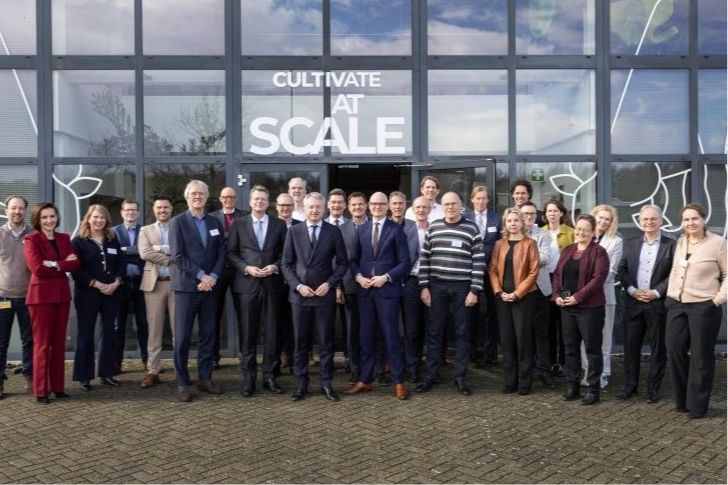
Perhaps nowhere is that more obvious than in manufacturing itself. At Cultivate at Scale in Maastricht, cellular agriculture companies can access equipment from bench scale to 1,000L without first having to create that infrastructure themselves. Managing Director Jaco Van Der Merwe has previously told PPTI that access to expertise and hardware is a key factor in helping companies reach the next level of scale.
It poses a fairly fundamental question for a sector in which capital remains scarce: if somebody else can provide the tanks, people and know-how, does a startup really need to own the factory? For some companies, the answer will still be yes.
Meatly's new London facility is expected to support continuous production for the UK pet-food market from 2027. The company has raised £17.4 million (US$23.5 million) to date and has worked extensively on reducing media and bioreactor costs before committing to larger-scale manufacturing.
Owning production can bring control over process, intellectual property, quality and supply. It also puts the cost of building, commissioning and operating that capacity firmly on the company's own balance sheet.
There is another option: stop trying to do everything yourself. When Fork & Good, Extracellular and Nutreco announced a partnership spanning cell lines, media, bioprocessing and supply-chain capabilities, Fork & Good's Gabor Forgacs put it rather more succinctly.
“It is just damn difficult to make cultured meat economically alone.”
Increasingly, that looks less like an admission of weakness and more like a commercial strategy.
The capital entering the sector is changing, too. Public funding has long supported cellular agriculture research, but some programs are moving closer to the difficult territory between successful science and commercial deployment.
The Bezos Centre for Sustainable Protein at Imperial College London has more than 100 research projects underway and is bringing researchers, startups, investors, regulators and policymakers together around commercialization and scale-up. Its Sustainable Food Accelerator offers selected ventures up to £100,000 (US$135,000) in equity-free funding, access to pilot opportunities with Cargill, Danone, Kerry and Mars, and the possibility of follow-on investment.
The European Innovation Council backed ProFuse with €2.43 million (US$2.8 million) to develop technology intended to make cultivated muscle production faster and cheaper. That work included industrial testing with SuperMeat, while ProFuse is now preparing licensing models and customer proof-of-concept programs.
The emerging picture is not one in which venture capital disappears. It is one in which fewer people expect venture capital to pay for everything.
A cultivated meat company might own its cells and process while somebody else supplies media. Production could take place in shared infrastructure or through a CDMO. Technology could be licensed into established manufacturing networks. Corporate partners can bring production expertise, distribution and customers. Governments and other sources of patient capital can support infrastructure or absorb some of the risk involved in crossing from R&D into industrial deployment.
The difficult part is deciding where the boundaries should sit. That is what four very different participants will tackle at the Cultured Meat Symposium in Amsterdam on November 4.
Jaco Van Der Merwe brings the perspective of Cultivate at Scale and the shared-infrastructure model. Lauri Reuter, Partner at Nordic Foodtech VC, sits on the investment side. Petra Vossenberg of AtVenture Platform brings an angel investor's view of backing companies much earlier in their development, while John-Felipe Murphy, Scale-Up & Regulation Manager at the Bezos Centre for Sustainable Protein, works where research, commercialization, regulation and scale-up meet.
The conversation comes at a useful moment. Companies are having to decide what they genuinely need to own, what they can license, what they can share and which partners can do something better or more cheaply than they can.
And underneath all of that sits the question investors increasingly need answered before committing more capital: what exactly are you asking us to pay for?
Investment, Partnerships and the Next Business Model takes place at the Cultured Meat Symposium, co-located with The Future of Protein Production Amsterdam, from 11:30am-12:15pm on Wednesday, November 4, 2026, at RAI Amsterdam. Click here to book your conference pass or to register for the free-to-attend exhibition ticket

Join Us At One Of Our Upcoming Events

If you have any questions or would like to get in touch with us, please email info@futureofproteinproduction.com


