

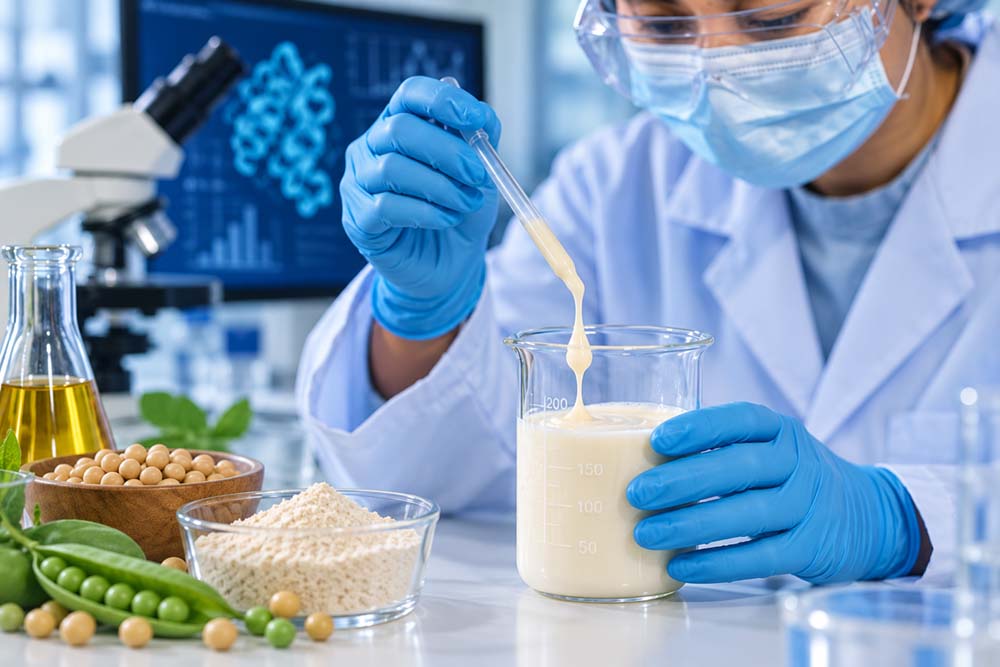
University of Leeds AI search uncovers nearly 800 plant proteins with emulsifier potential

University of Leeds researchers have identified nearly 800 plant proteins that could potentially function as emulsifiers, using a combination of artificial intelligence and statistical physics to search for candidates that might otherwise have remained unexplored.
The work, carried out by scientists involved with the National Alternative Protein Innovation Centre (NAPIC), addresses a significant challenge in ingredient discovery: finding proteins with the right functional properties among millions of possible candidates without having to test each one experimentally.
• University of Leeds researchers developed a computational approach combining statistical physics and machine learning to predict the emulsification potential of plant proteins.
• The model identified nearly 800 potential plant protein emulsifiers, including many proteins that had not previously been investigated for this function.
• Experimental work with commercially available pea and potato proteins supported the model's predictions, demonstrating effective emulsification properties.
Emulsifiers help oil and water combine and remain stable, making them important functional ingredients in products ranging from sauces, mayonnaise and ice cream to cosmetics and pharmaceuticals.
Proteins can perform this role by attaching themselves to the interface between oil and water and helping stabilize the resulting mixture. Animal-derived proteins, including milk proteins such as caseins and whey, are already widely used for their functional properties, but researchers are looking for plant-derived alternatives.
The problem is scale. With millions of plant proteins potentially available for investigation, conventional experimental screening can require considerable time and resources, while relying heavily on trial and error.
The Leeds team instead developed a data-driven pipeline intended to identify the proteins most likely to display useful emulsification behavior before researchers take them into the laboratory.
The research was led by Dr Simha Sridharan and supervised by Professor Anwesha Sarkar, NAPIC Co-Director at the University of Leeds. Professor Nik Watson, NAPIC Deputy Co-Director, and NAPIC early career researchers Maryam Afzali and Thomas Hazlehurst also contributed to the work. The team collaborated with Dr Rik Sarkar, a machine learning specialist at the University of Edinburgh.
Researchers initially used a simulation model based on statistical physics to examine how proteins interact with oil-water interfaces. That behavior is central to emulsification because an effective protein emulsifier must be able to adsorb at the interface and contribute to the stability of the mixture.
Machine learning was then used to identify sections and characteristics within proteins associated with that behavior. Bringing the two approaches together allowed the researchers to predict plant proteins that could display emulsification properties similar to those offered by animal proteins.
The resulting search produced a sizeable pool of candidates.
"The model identified nearly 800 plant proteins that could potentially act as emulsifiers, many of which had never previously been considered for this purpose," said Sarkar.
The researchers subsequently tested several commercially available proteins to assess whether experimental results corresponded with the computational predictions. Pea and potato proteins demonstrated effective emulsification properties, providing experimental support for the approach.
The significance of the method lies partly in its potential to change the earliest stages of ingredient discovery. Rather than experimentally screening large numbers of proteins individually, researchers could use computational tools to reduce the candidate pool before committing resources to laboratory testing.
That could be particularly useful in alternative protein development, where functionality can be as important as nutritional composition. Proteins used in formulated foods may need to provide properties such as emulsification, foaming, gelation or water binding if they are to replace established animal-derived ingredients successfully.
The Leeds research specifically focuses on surfactant behavior and emulsification, but its combination of physical modeling and machine learning demonstrates how computational screening can be used to search biological diversity for proteins with particular functional characteristics.
It also opens up the possibility of investigating proteins from plant sources that have received relatively little attention from food ingredient developers. Many commercial plant protein products currently originate from a comparatively narrow group of crops, while the model's results suggest there could be a substantially broader pool of proteins worth investigating.
Importantly, the computational predictions are intended to guide rather than replace experimental research. Candidate proteins still require laboratory validation and further assessment before their suitability for food applications can be established.
For ingredient developers, however, being able to prioritize the strongest candidates could reduce the amount of experimental work required during the initial discovery process and allow research teams to investigate a wider range of potential protein sources.
If you liked this, check these out...
• LBB Specialties and Ruby Bio team up ahead of launch for fermentation-derived emulsifiers
• Pureture launches emulsifier-free casein alternative with commercial scaleup
• National Alternative Protein Innovation Centre launches at the University of Leeds

Join Us At One Of Our Upcoming Events

If you have any questions or would like to get in touch with us, please email info@futureofproteinproduction.com


%20-%20Photo%20Credit%20Matt%20Qu%C3%A9r%C3%A9e.jpg)

