

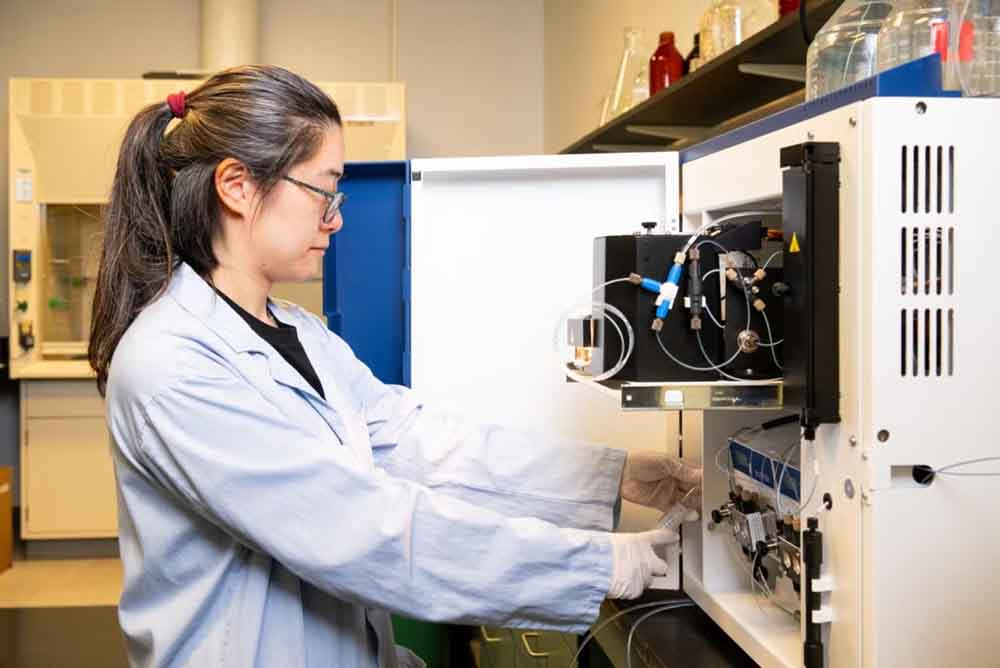
Tufts Launches Food Innovation Hub to support cellular agriculture, bioprocessing and scale-up

Tufts University has launched a new Innovation Hub for Food and Materials in Massachusetts, creating shared infrastructure for cellular agriculture, bioprocessing, food formulation and scale-up as developers work to move emerging technologies from research toward commercial products.
• Tufts has launched an Innovation Hub for Food and Materials, with a fully equipped 17,000ft2 facility scheduled to open in fall 2026.
• The Hub will provide cell culture, bioprocessing, formulation and scale-up capabilities alongside test kitchens, sensory analysis and a large cell bank.
• Tufts has invested US$4.6 million in shared research infrastructure, while a US$2.1 million MassTech grant has supported the food and materials technology core.
Located in Medford, the Innovation Hub has been designed for startups, established companies, entrepreneurs, academic researchers and nonprofit organizations developing new food technologies, biomaterials, novel ingredients and processing systems.
Interim space is available immediately, while the fully outfitted 17,000ft2 facility is scheduled to begin operations this fall.
The Hub brings together infrastructure spanning early research, prototyping, characterization, processing, culinary development and early-stage consumer testing. Its food and materials technology core will include capabilities in cell culture, bioprocessing, food and material formulation and scale-up production.
“The Innovation Hub for Food and Materials reflects Tufts’ long-standing commitment to advancing technology in food, health, and materials science,” said Bernard Arulanandam, Vice Provost for research at Tufts University. “Tufts’ capabilities in nutrition, biomedical sciences, and engineering create a collaborative environment where Hub participants have one resource to tap into a broad range of expertise.”
The facility will work closely with the Tufts University Center for Cellular Agriculture, which conducts interdisciplinary research into producing meat, alternative proteins, novel materials and other animal-derived products from cells rather than whole animals.
Its work also extends to plant-derived biomaterials and hybrid plant-animal cell systems.
Among the Hub's resources will be an extensive cell bank containing animal and insect cells as well as a plant cell repository covering more than 2,000 species.
For food developers, the facility will include a fully equipped test kitchen and sensory analysis suite, allowing products to be evaluated under conditions closer to those encountered by consumers. Chef and consumer testing can be incorporated throughout the product development process.
Tufts has also included a “technology sandbox” aimed at companies developing equipment used during R&D and production.
Bioreactor manufacturers, extrusion technology developers and suppliers of materials characterization equipment will be able to test and improve their systems within an integrated development environment rather than evaluating individual components in isolation.
“We’ve consistently heard from both researchers and industry that there is a need for shared infrastructure to move ideas forward,” said David Kaplan, Stern Family Endowed Professor of Engineering.
“The Innovation Hub for Food and Materials is designed to meet the needs of academics looking to commercialize a new innovation, small companies that may not have the resources to test manufacturing capabilities, larger companies focused on production that would like to explore new products or technologies, or anyone that might be missing even a small part of the process to bring a product from idea to market,” he added.
The Hub will also house a BioLabs-operated incubator at 200 Boston Avenue in Medford, providing 46 laboratory benches alongside dedicated desks, private offices, meeting rooms and shared working facilities for early-stage life science and biotechnology companies.
Its food and materials technology core has been supported in part by a US$2.1 million grant from the Massachusetts Technology Collaborative.
Tufts itself has committed US$4.6 million to expanding shared research infrastructure and product development capabilities. The university reported that the investment, combined with Massachusetts state and philanthropic support, was intended to help translate research into new products, businesses and jobs.
The facility will extend beyond food into biomaterials for applications including medicine, textiles and agriculture, with expertise available in material design, characterization and application.
It will also be integrated with the Tufts Food & Nutrition Innovation Institute at the Friedman School of Nutrition Science and Policy. The institute connects food industry and nonprofit organizations with university researchers working in areas including bioactive compounds, sustainable food systems and novel ingredients.
For cellular agriculture companies in particular, the combination of specialist cell resources, bioprocessing equipment and product development facilities provides access to capabilities that can be expensive for early-stage businesses to build independently.
The Hub will be open to qualified commercial, academic and nonprofit partners.
If you liked this, check these out...
• Schipper Bosch acquires Food Innovation Park to expand European food and protein innovation hub
• Germany’s High-Tech Agenda backs alternative proteins with planned innovation hub
Pure Mylk and Tetra Pak launch Malaysia Innovation Hub to scale US$39.7 billion plant-based beverage opportunity | PPTI News

Join Us At One Of Our Upcoming Events

If you have any questions or would like to get in touch with us, please email info@futureofproteinproduction.com


%20-%20Photo%20Credit%20Matt%20Qu%C3%A9r%C3%A9e.jpg)

