
The resilience revolution

Food resilience has traditionally been viewed as an insurance policy for catastrophic events. Juan García Martínez of ALLFED argues that the same technologies capable of feeding populations during global crises could also deliver more sustainable, efficient and productive protein systems every day
The modern food system has become remarkably efficient. It produces more calories than at any point in human history, moves ingredients across continents with astonishing speed, and has helped turn once-seasonal foods into everyday staples. That success has also created a dangerous assumption – that tomorrow will look much like today.
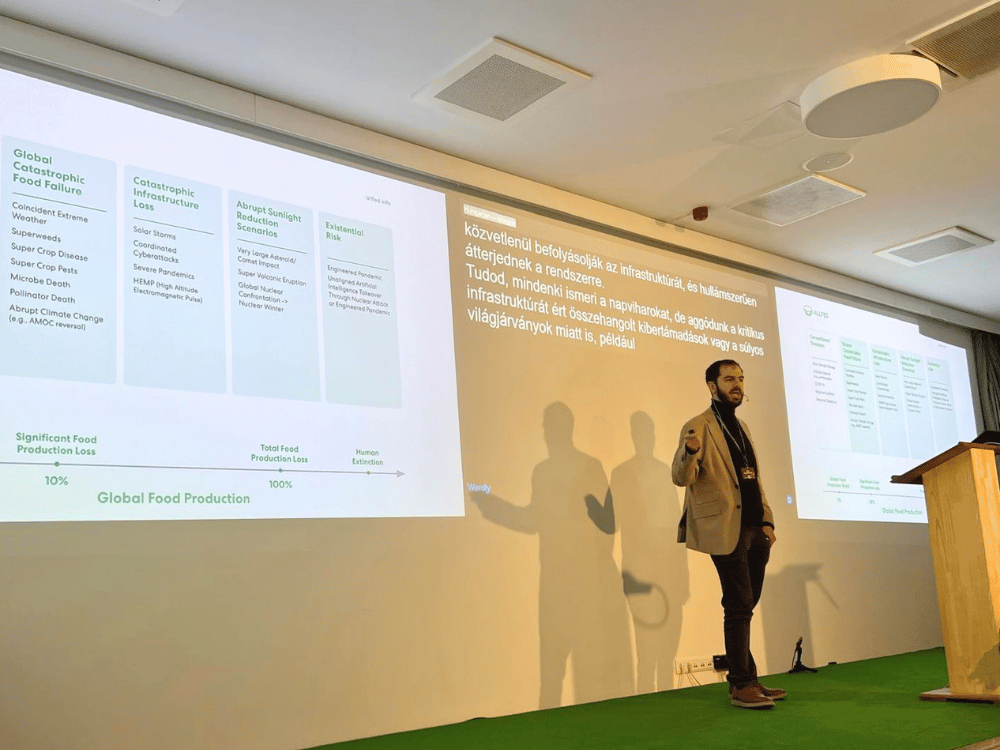
For Juan García Martínez, Research Manager at the Alliance to Feed the Earth in Disasters (ALLFED), questioning that assumption has become his life’s work. Rather than asking how to feed a growing population under normal conditions, his research explores a far more uncomfortable question. What happens if the systems that underpin global agriculture suddenly stop functioning?
His answers have taken him well beyond the technologies that usually dominate discussions around alternative proteins. Cost, taste and sustainability still matter, but they become secondary if the objective is feeding populations after a global catastrophe. Using resilience as the measure, one seemingly unlikely raw material keeps emerging as an exceptionally practical source of nutrition: leaves.
Progress in this area has been much more rapid than I and even most field experts expected... This makes food resilience work more urgent today than it has ever been
“My motivation came from studying the numerous threats to the global food system, understanding they are very real, and seeing how neglected they are by the public and private sector,” he explains.
“After meeting the ALLFED team for the first time as a student, I vividly remember thinking ‘I’m so glad someone is really working on these important issues, and doing serious science to address them’. That’s what prompted me to join ALLFED first as a volunteer and then as a full-time researcher.”

The scenarios his team studies are not designed to frighten people. They are intended to expose vulnerabilities before they become crises. Nuclear conflict, climate-altering volcanic eruptions, severe pandemics, solar storms and widespread infrastructure failures all feature within ALLFED’s work. Increasingly, however, another factor has risen rapidly up the agenda.
“Over my approximately seven years working on food security against global catastrophic scenarios, the main change in my view is how worrying trends in artificial intelligence are increasing the risk to the global food system,” García Martínez says.
“Progress in this area has been much more rapid than I and even most field experts expected. AI capabilities may continue to progress at this rate, which makes my colleagues and me take very seriously the concern that AI could further destabilize the geopolitical situation, increase conflict, disrupt the delicate nuclear balance, enable large-scale cyberattacks against critical infrastructure, and facilitate the creation of novel biological weapons such as crop diseases or powerful human pandemics capable of disrupting supply chains. This makes food resilience work more urgent today than it has ever been.”
It is a perspective that immediately changes how food technologies are evaluated. Most ingredient developers optimize for cost, taste, functionality and environmental performance. ALLFED begins with an entirely different question. Would this technology still work if conventional agriculture was severely compromised?
.jpg)
That shift in thinking leads researchers towards solutions that often receive relatively little attention elsewhere. “It makes sense that we would end up focusing on different technologies than most in the alternative protein sector, because we care about how resilient the technology is over other factors,” García Martínez says.
When we use the fiber part of the plant to make microbial protein, alfalfa can produce more protein per unit of land than any conventional crop, even soybeans
“This is why we have researched topics such as leaf proteins, lignocellulosic sugar, proteins from methane, or fats from CO₂, which are rarely the focus in alt protein. In particular, leaf proteins are a way to get more nutrients out of grasslands that are not a good fit for economically growing staple crops.”
At first glance, leaves appear an unusual place to look for human nutrition. Agriculture has spent thousands of years selecting crops for their grains, fruits, seeds and roots rather than their foliage. Yet every harvest leaves behind vast quantities of plant material that is rich in valuable proteins.
The more García Martínez's team investigated, the more one assumption kept being overturned. Leaves are not simply an overlooked source of nutrition – in the right production system, they can become one of the most productive sources of protein available.
“It’s how leaf protein production is a great fit for grasslands where food crops are not economical, but in the vast majority of current cropland, staple crops are still a more efficient source of food,” he explains.
“Even super-efficient alfalfa cultivation would struggle to beat the protein output of soybeans where soybeans can grow well. But both are solutions that work well for different types of lands. However, we also learned that when we use the fiber part of the plant to make microbial protein, alfalfa can produce more protein per unit of land than any conventional crop, even soybeans.”
That finding highlights an important distinction. Leaf protein is not intended to replace conventional agriculture. Instead, it extracts far greater nutritional value from landscapes already devoted to biomass production, particularly grasslands where growing staple crops makes little economic or agronomic sense.
Perhaps the most striking comparison comes when leaf proteins are measured against livestock production.
“Leaf protein does not compete against grains, fruits, and seeds, but against grazing, and the comparison is not even close,” García Martínez says.
“Our research shows using leaf proteins achieves several times more protein than using grasslands for milk production, and over 10 times more food and protein than grazed beef.”
The concept itself is straightforward. Rather than harvesting only seeds or grains, producers collect the entire above-ground portion of crops such as alfalfa while leaving the perennial root system intact to regrow naturally.
“For alfalfa, what you’d do is simply gather the entire part of the plant that is aboveground, which includes the leaves and the stem,” García Martínez explains.
“You leave the roots underground untouched so they can simply grow another crop of alfalfa, because it is a perennial plant unlike wheat which you have to sow every year.”
Once harvested, the plants are mechanically processed to separate valuable components.
“The harvested alfalfa plants are taken to the production plant, where they are pressed to make an extract that can be dried into a ‘green protein’ and consumed directly, with a bitter, grassy taste.
“Alternatively, the extract can be further refined into a rubisco product with a neutral taste, which can be used to make plant milk or plant-based meat. The other part of the plant, the fiber, can be used as animal feed or converted into alternative protein sources via fermentation.”
This is where the concept becomes considerably more powerful than simple protein extraction. Instead of treating the remaining fiber as a low-value by-product, it becomes the feedstock for microbial fermentation, creating additional protein from material that would otherwise have limited value. The result is a production system that extracts substantially more nutrition from the same hectare of land.
Processing also determines where leaf proteins are likely to find commercial success. Less refined green protein retains much of the plant's natural color and flavor, making it suitable for some applications, while purified rubisco offers a neutral, highly functional ingredient that is far easier to incorporate into mainstream food products.
“Purified rubisco has a balanced amino acid profile containing all the essential amino acids in its composition,” García Martínez says. “It is a non-allergenic, highly digestible, plant-derived protein, present in all plants in high abundance.”
The science is already well beyond the laboratory. Industrial-scale production of green leaf protein has been demonstrated in Europe, although largely for animal feed applications. The challenge now is not proving that the technology works, but making products consumers actively want to buy.
“We know the technology works for producing ‘green protein’ at industrial scale, as this has been demonstrated at approximately 7,000 tons per year in Denmark and in France, at least for animal feed,” he says.
“That said, there remain significant challenges for the sector, such as achieving product-market fit for the current price points. This will probably require optimizing the process to produce white protein at economical costs, or formulating green protein products with improved taste.”
Those hurdles are familiar across the wider alternative protein industry. Technical feasibility is only one part of commercialization. Cost, functionality, processing performance and consumer acceptance ultimately determine whether an ingredient succeeds.
Yet García Martínez believes leaf proteins have another advantage that extends beyond nutrition. They represent an opportunity to extract significantly more value from agricultural systems that already exist.
“In a way, it could enable us to make a much better use of crops we already grow,” he says. “Its excellent sustainability could make a big difference in greenhouse gas emissions, pesticide use, land use, and nitrogen pollution, especially compared to animal proteins.”
That creates an interesting overlap between resilience and sustainability. Technologies originally investigated as emergency food sources increasingly appear capable of delivering commercial and environmental benefits under normal operating conditions.
I’m excited to try out the plant-based milks that companies are already starting to develop based on leaf proteins. And if it works well in those markets and people start growing more and more capacity for leaf protein extraction, our food system will be all the more resilient for it
García Martínez is already seeing that transition begin. “I’m excited to try out the plant-based milks that companies are already starting to develop based on leaf proteins,” he says. “And if it works well in those markets and people start growing more and more capacity for leaf protein extraction, our food system will be all the more resilient for it.”
Not every crop offers the same opportunity. ALLFED’s analysis points towards perennial forage crops, particularly alfalfa, as the strongest candidates for large-scale deployment.
“Grassy legumes like alfalfa have a high yield per hectare, easy harvest, and can be harvested multiple times every year without sowing, making them the best fits for economical production,” García Martínez explains.
“Sugar beet leaves and other crop residues are interesting because they are already produced but underused. Wheat or grass leaves may be useful in some systems, but they are less obvious first choices unless they fit into existing rotations or use biomass that would otherwise be wasted.”
Leaf proteins also occupy just one position within a much broader portfolio of resilient food technologies. Rather than searching for a single solution, ALLFED evaluates complementary systems capable of responding to different resource constraints and disaster scenarios.
“Our analysis indicates that leaf protein production is one of the most promising resilient food production methods that are factory-intensive, together with microbial protein from methane like Calysta does or synthetic fat like Savor does, though leaf protein is not as resilient as these.”
“It’s hard to compare leaf proteins to other solutions like growing seaweed, relocating staple crops, deploying simple greenhouses or expanding cropland, because they all use different resources for production. They can all make very significant contributions to diets in global disaster scenarios. The key is to have a robust portfolio of solutions to draw from, and apply them in the right contexts by region.”
The same philosophy applies to disaster preparedness more broadly. No single technology can eliminate food insecurity during an extreme global shock, but failing to prepare leaves societies with far fewer options.
“These events may be unlikely in any one year, but the risk accumulates over a lifetime,” García Martínez says. “They should not be dismissed one-by-one as unlikely, because the combined risk from multiple hazards appears to be substantial and the consequences could overwhelm normal food-system coping capacity.”
He points to the COVID-19 pandemic as a reminder that low-probability events can still reshape global supply chains almost overnight.
It is well known that reaching 1% of the market is the hardest part, but if we get there it would become much easier to reach 10%, and it would unlock massive sustainability, resilience, biodiversity, national security, and animal welfare gains
“ALLFED also focuses on food-system shocks that may not directly lead to loss of life, but could disrupt 5% or more of global calorie production or access. That threshold is serious enough to justify preparation, because even smaller overlapping crises can push millions into hunger.
“The lesson from COVID-19 is that rare global disruptions do happen, and societies should prepare before they are forced to improvise. The right response is not panic, but foresight: building flexible food-system resilience before an abrupt, multi-year shortage forces improvised action.”
That foresight, he argues, also needs to extend into government policy. While many countries routinely assess risks ranging from terrorism to flooding, catastrophic food shortages remain largely absent from national planning.
“I think a first step would be to incorporate food system tail risks into their national risk assessments,” García Martínez says. “These documents contain the risks that the governments consider necessary to address, and oftentimes important risks to food systems don't make it.
“The ones that are public don’t address major global food shortage scenarios, and only rarely do they address large-scale risks to the food system such as a large nuclear war, climate-changing volcanic eruption, climate-changing tipping points, bioengineered pandemics, AI disruption, or solar storms.”
Meanwhile, the research continues to expand. Alongside leaf proteins, ALLFED is investigating rapid methods of increasing food production through expanded irrigation, responsible cropland expansion, bivalve cultivation and microalgae.
Looking further ahead, García Martínez hopes resilience technologies will no longer be viewed as specialist contingency plans, but as commercially successful parts of everyday food production.
“It’s impossible to know, but by that time I would hope that resilient food technologies such as proteins, and fats made from leaves, agricultural waste, CO₂, and biogas have claimed a significant portion of the global food market,” he concludes.
“It is well known that reaching 1% of the market is the hardest part, but if we get there it would become much easier to reach 10%, and it would unlock massive sustainability, resilience, biodiversity, national security, and animal welfare gains.”

Join Us At One Of Our Upcoming Events

If you have any questions or would like to get in touch with us, please email info@futureofproteinproduction.com

More News