The Protein Brewery: Why biomass fermentation’s next challenge is commercial execution

Fresh from securing new funding and authorization for Fermotein as a novel food in the EU, The Protein Brewery believes biomass fermentation has reached an important turning point – one where execution matters more than proving the technology
The Protein Brewery has spent years proving that biomass fermentation can work. Fresh from securing the European Commission's authorization to sell Fermotein in the EU, extending its Series B funding round by €18 million (~US$21 million), and selling out its 2026 production capacity to US customers, the Dutch company believes it has entered a different phase of its development.
The scientific questions that once dominated discussions around biomass fermentation haven’t disappeared. But for CEO Thijs Bosch, they are no longer the questions that matter most.
“The story shifts from ‘can it be made’ to ‘here is the tonnage, on spec and on time’,” he says.
It's a distinction Bosch returns to repeatedly. Producing a novel ingredient is one milestone. Becoming a supplier that food manufacturers can rely on is another.

From technical promise to commercial proof
The additional investment announced by The Protein Brewery this week was notable not simply because of its size, but because the company deliberately expanded the round beyond its original target after attracting stronger-than-expected investor interest.
Bosch believes that reflected a business that had reached an important inflection point. “I think it was de-risking and demand arriving at the same time,” he explains. “EU authorization removed the single biggest question mark over our European future, and by the end of 2025 our 2026 capacity had sold out, with customers telling us that Fermotein’s nutritional profile is genuinely different from anything else available. Investors could see the commercial pull was real, so increasing their commitment was less a leap of faith than a response to evidence.”
For Bosch, that changing investment landscape is no bad thing. “Investors have rightly become more selective after a few exuberant years, and that selectivity is why the companies raising now tend to be the ones with real commercial maturity: solving a genuine consumer need, with revenue and regulatory clearance to show for it.”
Sustainability is a ticket to the table, not in itself a reason consumers will buy. Taste comes first, then nutrition and health benefits
He believes the same shift is influencing how companies think about product development. “The wider lesson the sector has absorbed is that sustainability is a ticket to the table, not in itself a reason consumers will buy. Taste comes first, then nutrition and health benefits – these attributes ultimately drive purchase.”
That thinking now underpins The Protein Brewery’s commercial strategy.
Execution becomes the competitive advantage
While scale-up is often described as one of food technology’s greatest challenges, Bosch actually believes the industry sometimes underestimates what happens after successful scale-up. Building capacity is one achievement. Becoming a dependable supplier is another altogether.
Customers come to see you as an industrial supplier once you have shipped consistent, on-spec volume
“We’re expanding production capacity beyond 2,000 tons, but reliability is earned by delivering on time and on spec, again and again,” he says. “It builds with routine deliveries, so even with our first US customer we are working hard to earn that trust, and we are confident we can do so well before we reach 2,000 tons. Customers come to see you as an industrial supplier once you have shipped consistent, on-spec volume, which is precisely why this round prioritizes capacity and continuous production.”
The same question is beginning to confront many biomass fermentation companies. Many fermentation businesses have demonstrated that they can manufacture proteins at commercial scale. The next competitive advantage may lie in something less visible: process robustness, production consistency and the ability to deliver repeatedly without compromising quality.
That thinking also shapes how The Protein Brewery approaches its own manufacturing expansion. “The next 12 months are about discipline in production and quality control,” Bosch says. “In practice that means commissioning new fermenters with our engineering partner Vandoren, proving continuous production at the new scale, and converting our European pipeline into supply agreements.”

Choosing where to compete
Another notable aspect of The Protein Brewery’s strategy is where it has chosen to enter the market. Rather than attempting to compete immediately across mainstream food categories, the company is focusing first on active nutrition , notably ready-to-mix powders and nutritional bars. Bosch believes those applications allow Fermotein’s nutritional profile to create greater value.
“Because that is where our nutritional profile is most valuable to customers and commands a premium,” he explains. “In active nutrition, protein, fiber, micronutrient and bioactive quality are the product, so customers pay for exactly what makes Fermotein distinctive.”
Equally important, he argues, the ingredient’s naturally integrated composition simplifies product formulation. “And because those nutrients sit together in a single cellular matrix, a whole food rather than a blend of isolates, Fermotein reduces formulation complexity and supports a cleaner label.”
Only after establishing itself in those higher-value segments does the company intend to broaden into larger food categories. “Mainstream categories, by contrast, are heavily commoditized and compete largely on price. We would rather earn the premium segments first and broaden from a position of strength, into better-for-you foods, beverages and dairy alternatives.”
It's a strategy seen across food technology, where companies establish themselves in higher-value applications before expanding into larger, more price-sensitive markets.

Looking beyond protein alone
The Protein Brewery also appears to be positioning Fermotein differently from many next-generation protein ingredients. Protein remains central, but Bosch and his colleague, Dr Yvonne Dommels, Nutrition & Regulatory Affairs Director, consistently describe the ingredient as a complete nutritional package rather than simply another protein source.
Manufacturers are looking for ingredients that solve more than one problem. Rather than adding separate protein concentrates, fiber ingredients and micronutrients, whole-food biomass ingredients have the potential to deliver several nutritional benefits within a single ingredient.
That thinking is also shaping The Protein Brewery’s research priorities. “This round lets us build ahead of demand,” Bosch explains. “We can install the additional fermentation capacity and bring on the operators to run it continuously, so that when European customers come to us after sales begin this summer, we can serve them at the volumes they need.”
We are funding the next phase of our nutrition research, from gut health to metabolic health and markers of healthy aging
Yet production expansion represents only part of the investment. “Equally important, it lets us keep investing in the science behind Fermotein. We are funding the next phase of our nutrition research, from gut health to metabolic health and markers of healthy aging, because we believe a whole-food ingredient should be able to demonstrate these benefits.”
The investment isn’t only increasing production capacity. It’s also funding research designed to understand how whole-food biomass ingredients influence health beyond basic nutrition. Companies are no longer simply demonstrating that fermentation can produce protein. Increasingly, they are seeking to understand how whole-food fermentation ingredients interact with human health in ways that extend beyond basic nutrition.
Healthy aging enters the conversation
Production capacity is only one part of the company’s investment strategy. The Protein Brewery is also building the scientific evidence around where whole-food mycelium could have the greatest nutritional impact, including healthy aging. Longevity is not a topic traditionally associated with biomass fermentation, yet Dommels believes whole-food mycelium offers an opportunity to explore nutritional questions that conventional protein ingredients may not address.

“We focus on longevity nutrition because the needs of an aging population are where a whole food like Fermotein can make the most impact, and because we are committed to building it into a science-backed ingredient,” she explains.
Importantly, the company is careful not to overstate the science. “Our work so far is preclinical, with encouraging early signals in gut health, including the production of important short-chain fatty acids and greater microbial diversity, and our next studies look at measurable markers of metabolic health and biological age.”
Rather than positioning longevity as a marketing concept, Dommels sees it as a research program designed to generate robust evidence. “What we hope to show in the future is that an all-in-one nutritional ingredient like Fermotein can support heathier years as people age.”
The language is deliberately measured, but it points toward a broader trend within food innovation, where ingredients are increasingly expected to contribute to overall nutritional quality rather than simply increasing protein content.
The harder and more interesting questions are no longer about feasibility but about manufacturing reliably, winning customers and executing commercially
A new phase for biomass fermentation
For years, discussions centered on whether the technology could succeed at all. Increasingly, Bosch believes the questions have become more practical and considerably more demanding.
“At The Protein Brewery, certainly, biomass fermentation and mycelium have moved into production reality. Now that a handful of companies have shown it can be done, the harder and more interesting questions are no longer about feasibility but about manufacturing reliably, winning customers and executing commercially.”
Bosch already has a clear picture of what success would look like as The Protein Brewery moves through its next stage of growth. “Success would be measured in production and fulfilment: new capacity commissioned and running continuously, our European launch translated into repeat commercial orders, and the next set of nutrition and scientific results in hand.”
Ultimately, however, his ambition is surprisingly straightforward. “If by then customers regard us as a dependable supplier of whole-food mycelium across active nutrition and longevity nutrition, this round will have done its job.”
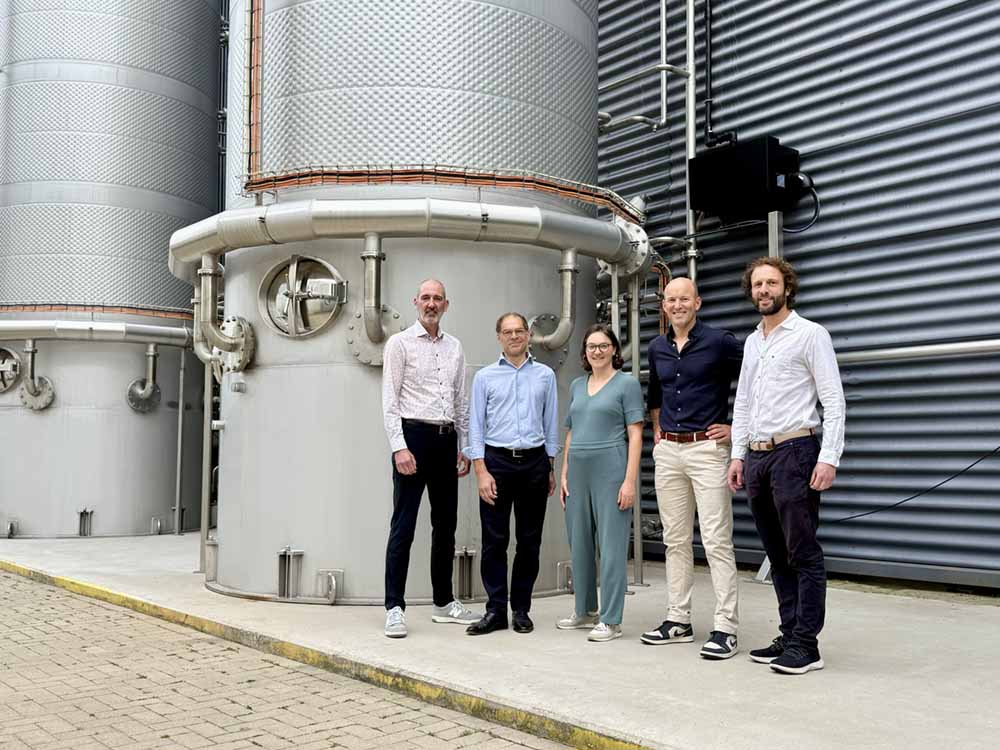
(Main photo shows, from left to right, Gilbert Verschelling, CTO, Jan Hendrik van Gilst, CFO, Yvonne Dommels, Regulatory & Nutrition Director, Thijs Bosch, CEO and Bas Jürgens, COO)

Join Us At One Of Our Upcoming Events

If you have any questions or would like to get in touch with us, please email info@futureofproteinproduction.com

More News