

FluxBio targets fermentation bottleneck with Harvard-developed gas transfer technology

FluxBio has emerged from Harvard University to commercialize a gas-transfer technology designed to overcome one of biomanufacturing's most persistent scale-up challenges by increasing the gas-carrying capacity of fermentation liquids rather than modifying reactor hardware.
• FluxBio commercialized Harvard-developed microporous water technology designed to improve gas transfer in fermentation and other gas-fed bioprocesses.
• The company reported up to a four-fold increase in biomass in early gas-fed experiments and around a two-fold increase in a 2-liter bioreactor.
• The startup said its drop-in additive could reduce compressed gas use, agitation energy and capital costs without requiring changes to existing bioreactors.
A Harvard University spinout has set its sights on one of industrial biotechnology's most stubborn engineering constraints: efficiently transferring gases into fermentation broths.
FluxBio is commercializing a technology known as microporous water, developed in the laboratory of Jarad Mason, Professor of Chemistry & Chemical Biology at Harvard University and an associate faculty member at the Wyss Institute. Rather than relying on larger compressors, higher operating pressures or more powerful agitators to increase oxygen or other gas availability, the technology increases the gas-carrying capacity of the liquid itself.
The approach addresses a longstanding limitation in gas-fed bioprocesses used across pharmaceuticals, alternative proteins and other biotechnology applications, where microorganisms require oxygen or gases such as carbon dioxide or hydrogen to grow and produce target compounds.
"We became aware of challenges associated with efficiently transporting gases through aqueous environments, which are ubiquitous across a wide range of biomedical and energy technologies," Mason said. "We familiarized ourselves with technologies that had been developed to address these challenges, and none of them had really caught on because they did not work well enough."
The technology originated from Mason's broader research into porous materials and phase-change solids. His team investigated whether microporous solids containing nanometer-scale pores could be dispersed in water while preventing the pores from filling with liquid. The resulting suspension acts as a carrier for dissolved gases.
"You can think of microporous water as a kind of gas buffer; not a one-way storage vehicle, but more like a transport agent," Mason said. "The particles increase the intrinsic gas-carrying capacity of the aqueous media and play two roles: they enhance the rate at which gas is transferred from the bulk gas phase into solution, and they facilitate distribution of that gas throughout the entire solution."
Marika Ziesack, Founder & CEO of FluxBio, said her experience scaling Circe Bioscience's carbon dioxide-to-fats platform highlighted how gas transfer becomes an increasingly significant constraint as fermentation moves from laboratory to industrial production.
"Circe brought its process from milliliters to thousands of liters, and that's when I really saw what it takes to get biology from lab scale to industrial scale," she said. "Both in traditional aerobic fermentation and in our custom reactor, the infrastructure just seemed not scalable to me, which was a mechanical problem."
According to Ziesack, today's industrial fermentation facilities typically respond to gas-transfer limitations by adding larger compressors, increasing gas flow rates, installing more powerful agitators or building larger reactors.
"As an industry, we keep building power-hungry compressors, pushing more gas, stirring with powerful agitators, and then building larger reactors requiring more steel," she said. "This is what the industry has been doing for decades - no real change. All of it adds cost and complexity, and it's just not working."
FluxBio instead developed its technology as a drop-in additive that can be introduced into existing bioreactors without modifying installed equipment.
"There are nanobubble systems, hollow-fiber membranes, and new reactor designs, but all of them are still capex plays - you have to add or change equipment," Ziesack said. "We're the only scalable solution I know of that's a true drop-in additive for existing tanks, which makes it much easier to test and deploy."
The company reported encouraging early performance data during laboratory testing.
"In our first gas-fed experiments, we saw about a four-fold improvement in biomass," Ziesack said. "I've never seen that kind of jump in all my biomanufacturing experience. If we had this technology at my last company, it would have made a pivotal difference. That's not an incremental optimization - that's a game changer."
The researchers said that when the technology was evaluated in a 2-liter bioreactor, biomass approximately doubled while energy consumption declined.
Mason said the potential benefits extended beyond productivity gains.
"The technology can significantly reduce the amount of compressed gas that has to be fed into the bioreactor and reduce the energy that needs to be put into the reactor to keep it well stirred," he said, "so you get operating-expense savings and, more importantly, capital-expense savings by boosting the space-time yield from your bioreactor."
FluxBio's commercialization efforts were supported by several Harvard programs and external funding organizations. The technology received backing from Harvard's Blavatnik Biomedical Accelerator beginning in 2021, alongside support from the Sustainable Futures Initiative and funding from the Defense Advanced Research Projects Agency, the Office of Naval Research, the Department of Energy and the National Science Foundation.
The project also benefited from support from Harvard professors Daniel Nocera and Pamela Silver, who contributed to technology translation and validation as the company prepared for commercialization.
Curtis Keith, Chief Scientific Officer of the Blavatnik Biomedical Accelerator, said the program was designed to help promising university technologies bridge the gap between academic research and commercial investment.
"By providing relatively modest amounts of money – often a few hundred thousand dollars, up to about half a million – we can move Harvard's biomedical technologies to a stage where they're ready for industry investment," Keith said. "The overarching goal of the accelerator is to increase the chances that we can launch startup companies or, in some cases, license technologies to existing biotech and pharma."
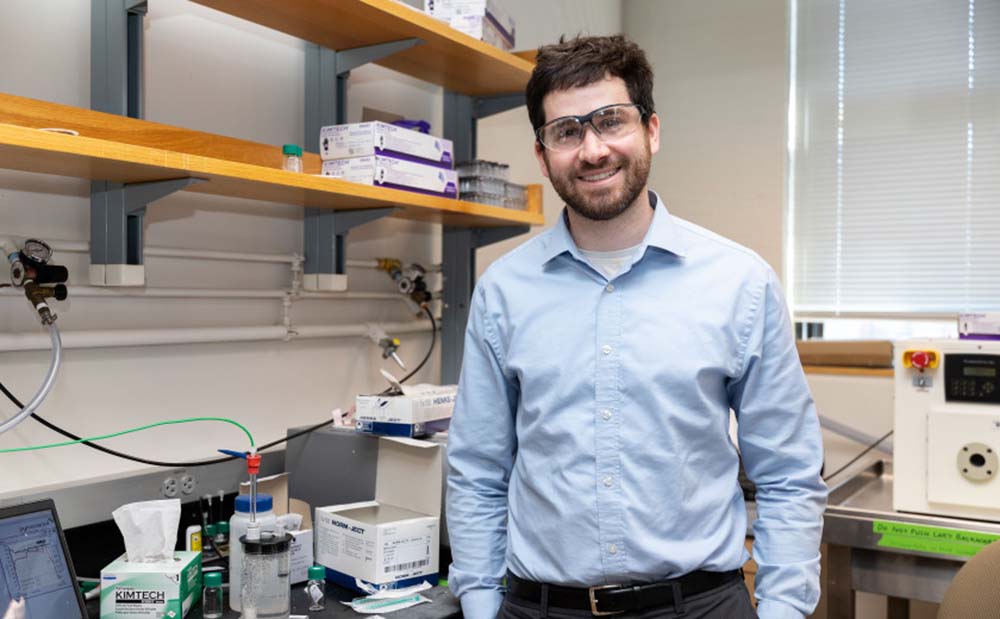
(Main photo shows Jarad Mason, Professor of Chemistry and Chemical Biology in the Department of Chemistry & Chemical Biology and associate faculty member at the Wyss Institute)
If you liked this, check these out...
• Tetra Pak expands into industrial fermentation with new bioreactor platform
• The Protein Brewery: Why biomass fermentation’s next challenge is commercial execution
• Ayana Bio and Brevel secure US$1.25 million BIRD grant to scale plant cell bioactives through illuminated fermentation

Join Us At One Of Our Upcoming Events

If you have any questions or would like to get in touch with us, please email info@futureofproteinproduction.com


