

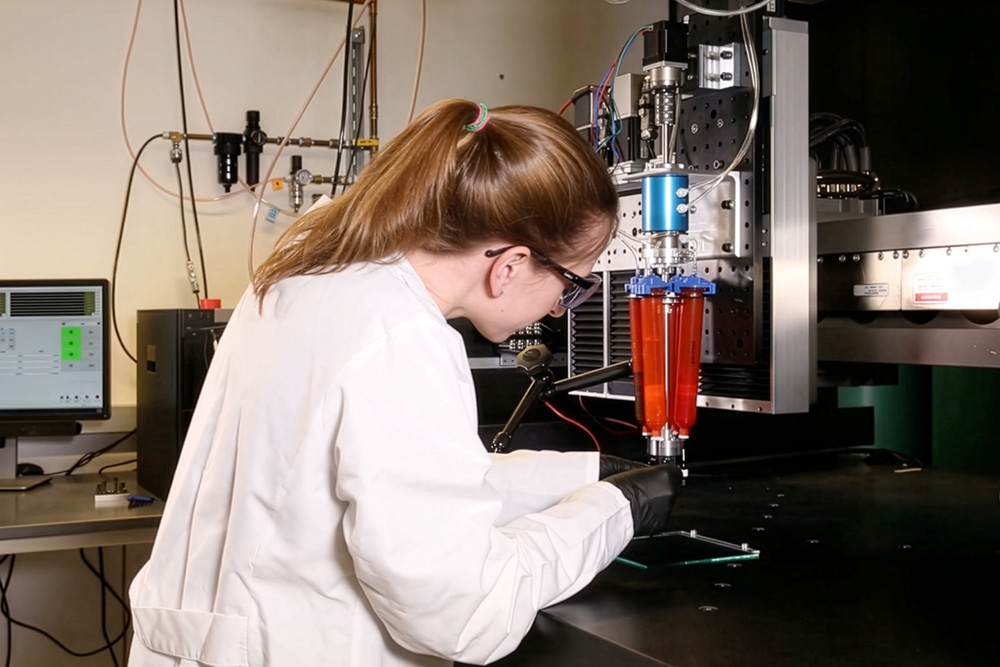
Stanford’s Natalie Larson targets whole-cut cultivated meat with subvoxel 3D bioprinting

Stanford University researchers are developing a new multimaterial 3D bioprinting process designed to produce complex, thick cuts of cultivated meat, with precise control over the placement of muscle, fat and channels needed to support cells during cultivation.
The work is being led by Natalie Larson, assistant professor of mechanical engineering at Stanford’s School of Engineering, whose laboratory specializes in multimaterial 3D printing. The cultivated meat project brings together researchers from four Stanford laboratories and is supported by the Stanford Sustainability Accelerator.
• Stanford researchers are developing a multimaterial 3D bioprinting process aimed at producing complex, thick, steak-like cultivated meat with more appealing textures.
• The approach can simultaneously extrude muscle and fat bio-inks alongside sacrificial materials designed to create open channels for nutrient delivery during cell culture.
• The interdisciplinary project combines expertise in renewable bovine cells, engineered protein biomaterials, sensory characterization and multimaterial printing across four Stanford research laboratories.
Larson's team is particularly interested in addressing one of the more difficult manufacturing challenges facing cultivated meat: moving from relatively simple structures toward thick, whole-cut products that reproduce the internal organization and texture of conventional meat.
“3D printing offers a whole new way of thinking about how we make things,” Larson said. “I think it's incredibly exciting that it's become so accessible that people can design and build diverse parts and assemblies in their own homes or local hobby spaces. It's a massive field with many applications, and it creates a common language that people can get excited about.”
In cultivated meat, the attraction of additive manufacturing is its ability to arrange different biological materials within a three-dimensional structure rather than simply growing cells as an undifferentiated mass.
Larson described the process as beginning with a small sample of animal cells, which are multiplied before being patterned into meat-like structures using 3D printing. The resulting structure is then cultured, allowing the cells to mature and form tissue.
However, producing substantially thicker pieces of tissue introduces additional difficulties. Larson identified sustainable material sourcing, scalability and consumer appeal among the challenges still facing cultivated meat production.
Her laboratory is therefore developing what it calls multimaterial 3D bioprinting with “subvoxel” control. A voxel can be considered the three-dimensional equivalent of a pixel, while subvoxel control allows researchers to organize multiple materials within the individual filaments deposited by the printer.
For cultivated meat, the system is being designed to extrude several materials simultaneously through a single large nozzle.
These include muscle and fat bio-inks as well as sacrificial inks. The sacrificial materials are intended to create open channels through the printed tissue, providing routes for nutrient delivery while the cells are cultured.
“By patterning these materials using a single large nozzle, we aim to create meat with the right size, shape, and internal structure to provide an appealing alternative to whole-cut steaks,” Larson said.
The project draws on expertise beyond printing technology.
Stanford professor Helen Blau's laboratory is leading development of renewable, non-GMO bovine cell sources, while professor Sarah Heilshorn's group is responsible for producing and characterizing engineered protein biomaterials. Professor Ellen Kuhl's laboratory is leading sensory characterization of the resulting cultivated meat tissues.
PhD student Sofia Madrigal Gamboa is serving as the project's central integrator across the four laboratories.
The research also illustrates how advances originally developed for broader multimaterial manufacturing could find applications in food production. Larson previously pioneered a rotational multimaterial 3D printing platform capable of subvoxel control within extruded filaments, research published in Nature in 2023.
Her Stanford laboratory is now investigating the technology across applications ranging from cultivated meat and soft robotics to structural batteries, metamaterials and antennas.
In food production, however, the ability to control several materials at very small scales could be particularly relevant to recreating the heterogeneous structure of meat. Muscle and fat need to be arranged appropriately, while thicker tissues also require a means of delivering nutrients to cells located away from their external surfaces.
The researchers have not provided a commercialization timetable for the cultivated meat technology, and the work remains focused on developing the underlying materials and manufacturing process.
For Larson, the wider objective is to push additive manufacturing beyond simply printing objects with a single material and toward functional structures in which different materials are deliberately organized at increasingly fine scales.
“With our advanced printers and automation techniques, we aim to make it possible to create functional and living materials that we can currently only dream of,” she said.
If you liked this, check these out...
• EU meat naming rules become law as plant-based and cultivated brands face 31-term ban
• What comes after the cultivated meat hype? Didier Toubia is finding out
• Europeans warm to food innovation but appetite for cultivated meat and precision fermentation falls

Join Us At One Of Our Upcoming Events

If you have any questions or would like to get in touch with us, please email info@futureofproteinproduction.com


%20-%20Photo%20Credit%20Matt%20Qu%C3%A9r%C3%A9e.jpg)

