

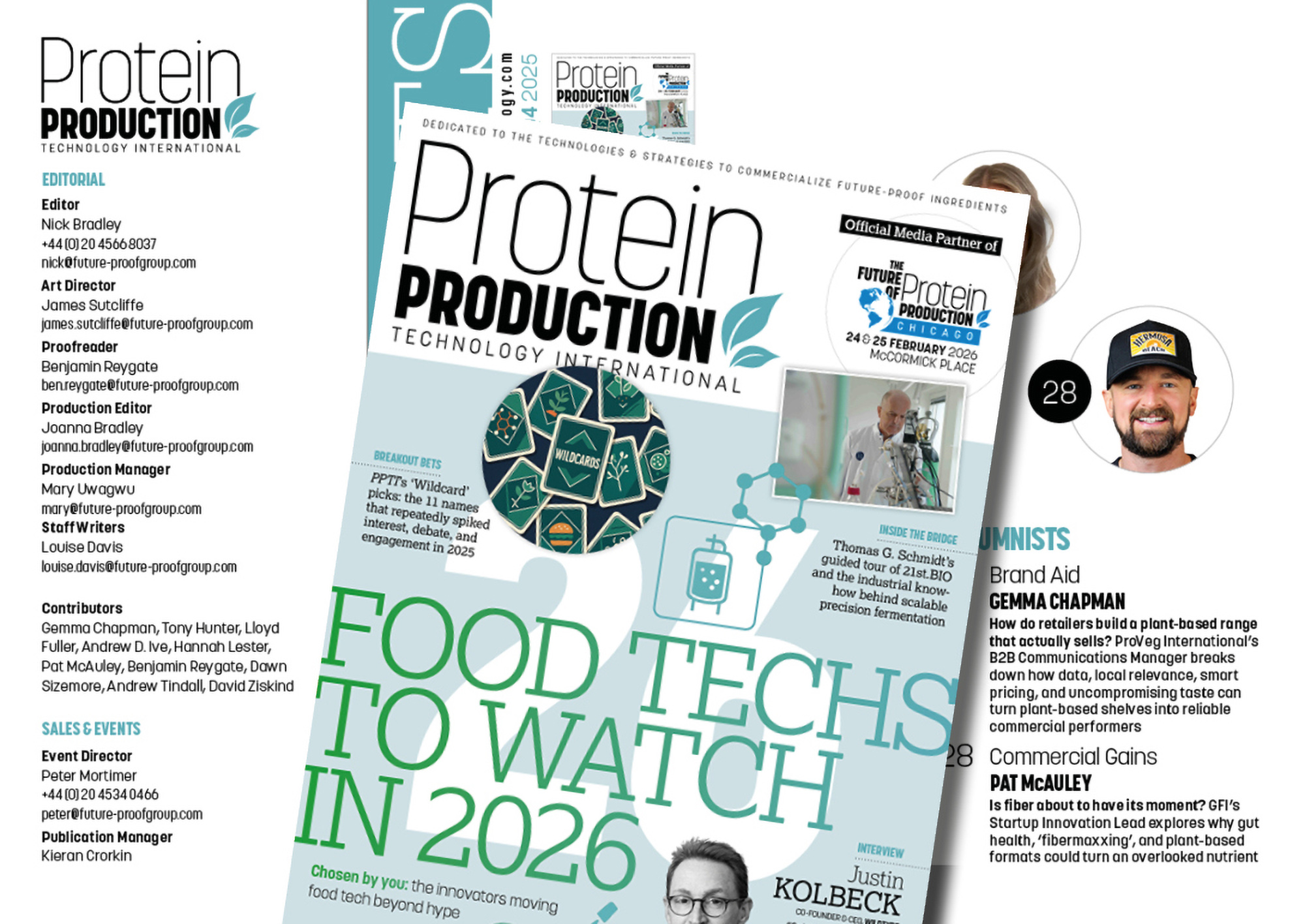
Protein Production Technology International releases Q4 2025 edition focused on scale, realism, and next-stage innovation

Protein Production Technology International (PPTI) has released its Q4 2025 edition, bringing together in-depth reporting, technical analysis, and industry insight at a moment when the alternative protein sector is increasingly defined by execution rather than ambition. You can read the latest issue free of charge here.
The new edition reflects a clear editorial throughline: as capital tightens and timelines lengthen, progress across plant-based, fermentation-enabled, and cultivated protein systems depends less on novelty and more on manufacturability, cost discipline, and performance at scale.
At the center of the new 140-page edition is 26 Food Techs to Watch in 2026, one of the most extensive editorial projects undertaken by PPTI to date. The feature applies a structured, research-led approach to identifying companies shaping the future of protein production, drawing on technical readiness, manufacturing relevance, and demonstrated momentum rather than hype.
Editor Nick Bradley said the project was deliberately demanding by design. “This wasn’t about who had the loudest announcements or the biggest funding rounds,” he said. “It was about sitting down with the data, the reporting we’ve done all year, the conversations we’ve had off the record, and asking a simple question: which companies are actually moving the industry forward in practical ways?”
Bradley added that the process surfaced several unexpected names. “There were a few companies on the list that, if I’m honest, I might not have commissioned as full features under my own steam,” he said. “But that’s exactly why this exercise was valuable. When you look at readership data, traffic patterns, and the companies that consistently generate engagement and debate, you start to see signals you might otherwise miss.”
Recognizing that innovation rarely fits neatly into rankings, the issue also includes a companion Wildcards feature, highlighting companies that narrowly missed inclusion in the main list but repeatedly surfaced through audience behavior and industry discussion. Together, the two features aim to capture both established progress and emerging momentum.
“For us, this wasn’t about declaring winners,” Bradley said. “It was about reflecting what the industry itself is paying attention to. Presenting something that’s shaped by readers, rather than purely by editorial instinct, felt like the right thing to do at this stage of the sector’s development.”
Manufacturing and scale-up realities are a recurring focus throughout the Q4 edition. A Guided Tour feature on 21st.BIO examines how precision fermentation platforms are being built to bridge the gap between laboratory success and industrial production, with attention to strain development, pilot infrastructure, and repeatable scale-up pathways.
The issue also includes a Protein Pioneer interview with Justin Kolbeck, Co-founder & CEO of Wildtype, offering a candid reflection on the long arc of cultivated seafood development, regulatory progress, and the operational discipline required to move toward commercialization.
Beyond the headline features, the Q4 issue places strong emphasis on data, analytics, and process control as foundational capabilities. Coverage explores advances in fermentation infrastructure, real-time quality analytics, functional ingredient performance, and the growing role of partnerships in managing variability and reducing scale-up risk.
Regulation and market access remain central themes, with multiple articles examining evolving frameworks in key regions and the implications for commercialization timelines. Interviews throughout the issue reflect a sector adjusting to more cautious customers and investors, and a growing emphasis on proof points over promises.
According to Bradley, that shift in tone was intentional. “There’s a lot of very serious work happening across protein production right now,” he said. “Our job is to document it honestly, without overselling it, and to give readers something they can actually use.”

Join Us At One Of Our Upcoming Events

If you have any questions or would like to get in touch with us, please email info@futureofproteinproduction.com


