

Protein Diversification Academy sets out a new vision for protein

The Protein Diversification Academy is seeking to bring greater clarity to one of the food industry’s most widely used concepts. In its first position paper, Diversify to Navigate Complexity, the educational organization argues that the future of food systems should be built around diversification rather than replacement. It also proposes what the Academy describes as the first formal definition of ‘protein diversification’ and argues that the industry should move away from the term ‘alternative proteins’ in favor of a broader, systems-based view of how existing and emerging protein sources can coexist.
The paper reflects a change in how the sector is approaching protein diversification. Policymakers, researchers and companies are increasingly discussing protein diversification in the context of food security, resilience and economic competitiveness, rather than viewing novel proteins simply as substitutes for conventional animal agriculture. The Academy hopes it will provide a clearer framework for what protein diversification actually means – and why education will ultimately determine whether it succeeds.
“While the term protein diversification is gaining popularity, to our knowledge, there was no clear definition of the concept yet,” says Pericle Raverta, Secretary General of the Protein Diversification Academy. “We also found there is a lack of educational courses introducing people to the topic.
“Our members come from all parts of the world and a wide range of industries, but share a common concern: the question of how to feed future generations in a sustainable way. We believe that education is an important part of the solution, and the PDA is actively committed to promoting accessible education and opportunities in this field.”
That educational mission distinguishes the Academy from many of the organizations already operating across the protein landscape. While trade associations, research institutes and advocacy groups all play important roles, Raverta says the Academy was established to help both industry professionals and newcomers build a structured understanding of an increasingly complex field.
“We saw that the existing educational efforts were often fragmented and without a systematic, structured approach,” he says. “We created the Protein Diversification Academy to fill this need: to provide accessible, structured, and high-quality educational opportunities for anyone curious about the topic and potentially interested in a career that helps protein diversification take a step further.”
Education was not always the Academy's primary focus. Established in 2022 as APPatEIT, a chapter of The Good Food Institute within the EIT Food ecosystem, its activities initially ranged from awareness campaigns and podcasts to educational courses and student engagement.
“Over time, we realized that if we wanted to create meaningful impact, we had to focus more on education,” Raverta says. “On an individual level, we had experienced the lack of educational opportunities in the field of protein diversification. For most of us, this meant we had an incomplete view of the future of the food system. We did not want future students to face a similar lack of structured training and opportunities.”
Early demand suggests the Academy is meeting a clear demand for structured education. When applications opened for the first edition of its Fundamentals Programme in late 2025, it received 340 applications for just 30 places despite promoting the course through only two LinkedIn posts and a handful of emails.
“One thing is becoming increasingly clear to us: the demand among younger generations for accessible education and training opportunities in this field is significant,” Raverta says. “People want to learn more about protein diversification, but we believe organizations in the field may not always be aware of this demand, or respond properly.”
Defining diversification
One of the paper’s central aims is to establish a common language for protein diversification. While terms such as protein diversification, protein transition and alternative proteins are now widely used across industry and policymaking, Raverta argues that they are often interpreted in different ways.
“If we are serious about educating and training the general public and the next generation of professionals, we must make clear what we talk about and define the terms,” he says. “The term protein diversification is often used as an umbrella term that covers all types of different ideas.”
The Academy argues that establishing a common language is the foundation for everything that follows, from education and policymaking to wider discussions about how food systems should evolve.
“How can we support initiatives or policies around protein diversification if we have not first clearly defined what we mean by it, and explained our way of thinking behind it?” Raverta asks.
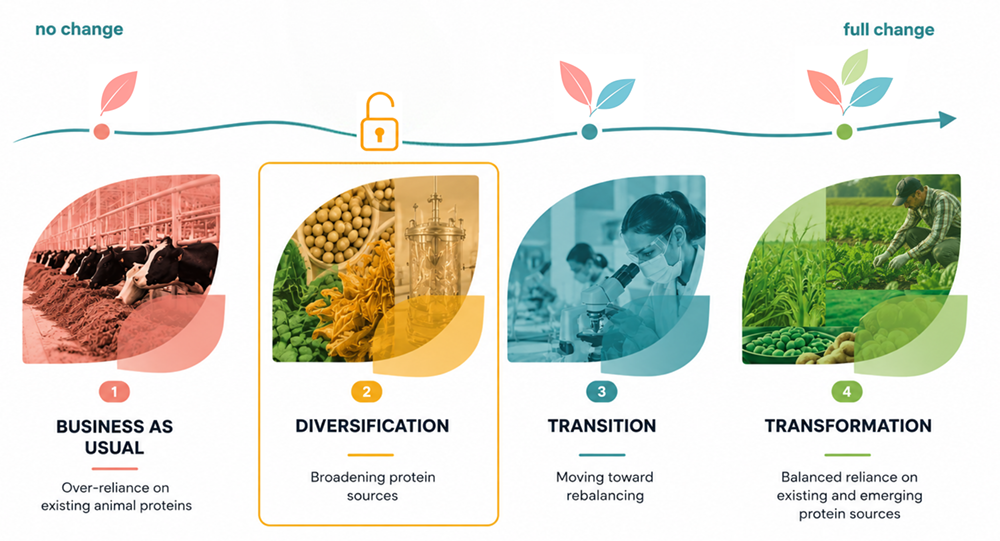
The definition proposed in Diversify to Navigate Complexity deliberately moves the discussion away from simple replacement. Rather than asking which proteins should replace conventional animal products, the Academy describes diversification as expanding the range of protein sources available to society to create a food system that is more balanced, resilient and adaptable.
“Our world depends too much on proteins from animals,” Raverta says. “Some people say we should just replace them with other types of protein, but we think there is no easy solution for this difficult challenge.”
“To make our food system stronger and more resilient, we need to add sources of protein, instead of only replacing existing products. Diversification, not substitution, has often been the better long-term strategy. Why should it work differently here?”
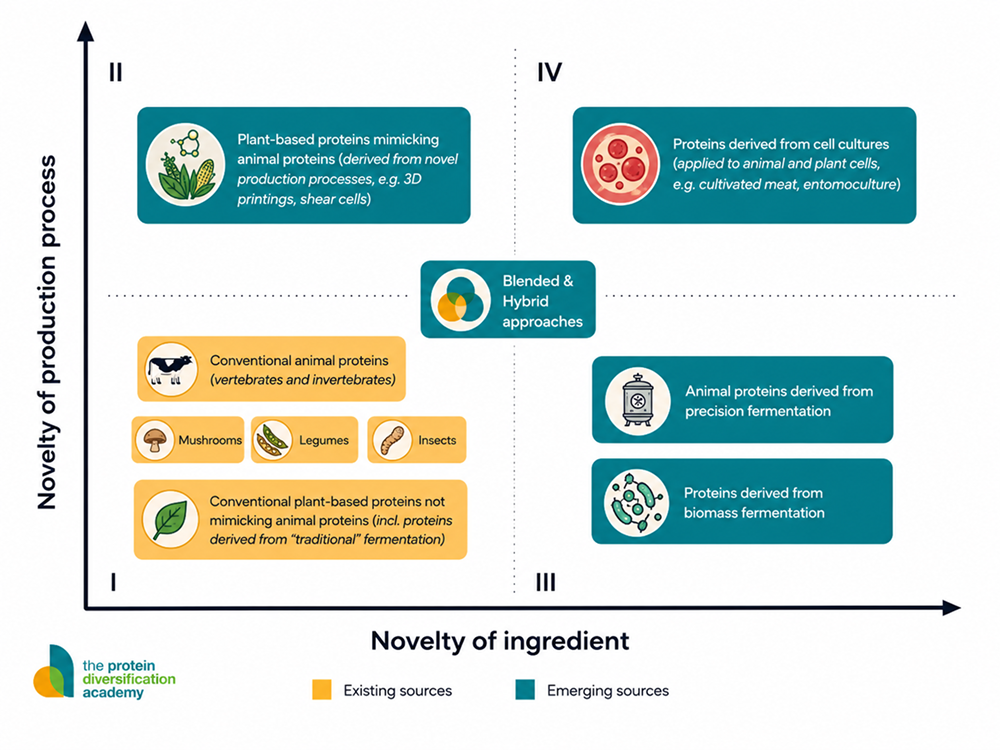
The approach extends well beyond the technologies that typically dominate industry headlines. While precision fermentation and cultivated meat remain important parts of the picture, Raverta says they represent only part of a much broader protein landscape.

“Protein diversification is more than precision fermentation and cultivated meat,” he says. “There is a risk of gaining a limited understanding of the field.”
Instead, the Academy has developed a framework that considers both how novel a production process is and how novel the resulting ingredient may be, allowing long-established protein sources and emerging technologies to be viewed within the same conceptual space.
“It is important to realize that protein diversification does not begin with new technologies,”Raverta says. “It begins by rebalancing the protein sources we already have.”
The framework spans conventional animal proteins, legumes, mushrooms and other familiar plant proteins, while also accommodating fermentation-derived ingredients, cultivated proteins, novel plant-based foods and blended approaches.

Helping participants understand how these different approaches fit together is central to the Academy’s educational model.
“Many participants have heard about individual technologies or protein sources, perhaps cultivated meat, precision fermentation, or novel plant-based foods, but they struggle to place them within a broader food systems context,” he says.
“Our goal is not simply to explain what each technology does, but to help participants understand how the different pieces fit together and the role each can play within a more diverse and resilient protein system.”

Join Us At One Of Our Upcoming Events

If you have any questions or would like to get in touch with us, please email info@futureofproteinproduction.com

More News