

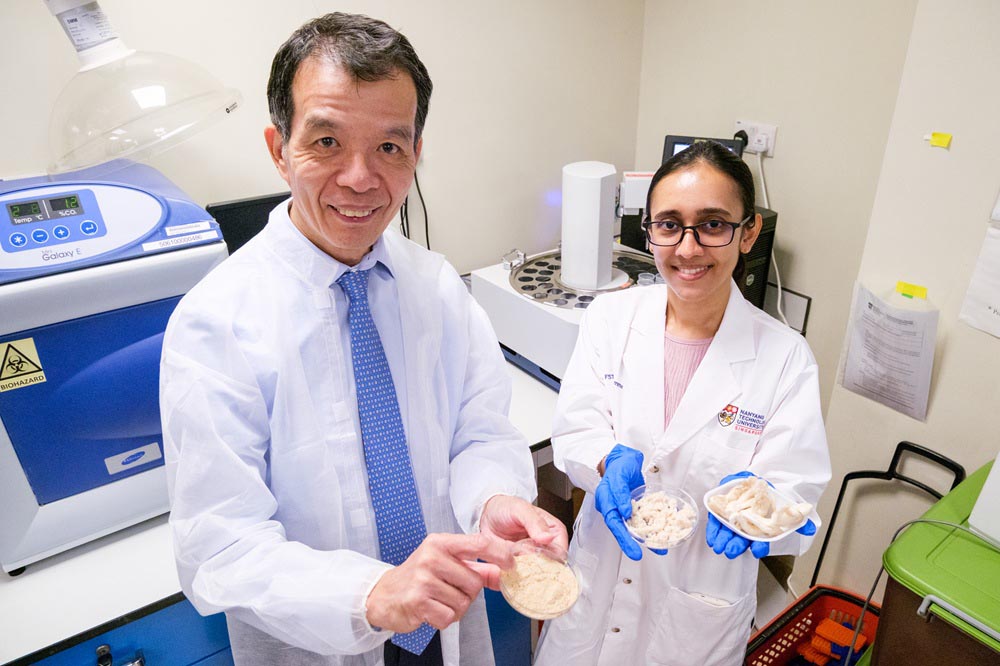
NTU mushroom fermentation gives soy by-product a protein and flavor boost

Scientists at Nanyang Technological University, Singapore (NTU Singapore) have used oyster mushroom mycelium to improve the protein content and flavor of okara, a soybean by-product that is commonly discarded or used as low-value animal feed.
• NTU researchers used solid-state fermentation with oyster mushroom mycelium to increase the protein content of okara to 27.7-30.2% by dry weight.
• Fermentation increased free amino acids by 2.2-6.6 times and reduced sourness while strengthening umami and overall taste richness in laboratory analysis.
• The proof-of-concept study remains at lab scale, with work still required on food safety, energy use, sensory performance, economics and commercial scale-up.
Produced during tofu and soymilk manufacturing, okara retains valuable nutrients but presents food manufacturers with a difficult raw material. Its high moisture content gives it a short shelf life, while insoluble fiber, coarse texture and a relatively sour taste restrict its use in foods for human consumption.
Researchers at NTU Singapore have now shown that solid-state fermentation could provide another route for using the material.
Working with Japanese food manufacturer Ichimasa Kamaboko, the team fermented okara using oyster mushroom mycelium, the root-like fungal network from which mushrooms grow. The findings were reported in the journal Food Chemistry: X.
Several formulations were tested, including fresh and dried okara and combinations with conventional mushroom-growing materials such as wheat bran and sawdust.
Fresh okara supported dense mycelial growth, with the fungus fully covering the material during an 11-day laboratory incubation period. As it grew, fungal enzymes broke down complex plant fibers and released simpler sugars and amino acids.
Analysis found that protein content reached 27.7-30.2% by dry weight following fermentation. Glucose concentrations also increased by 2.8-6.4 times from low initial levels as complex carbohydrates were broken down.
“Okara is a soybean by-product that is rich in nutrients, but its high fibre content, short shelf life and less appealing flavour have long limited its use in food products for people,” said Professor William Chen, Director of NTU’s Food Science and Technology Programme at its School of Chemistry, Chemical Engineering and Biotechnology.
“Our findings show that oyster mushroom mycelium can naturally improve okara by changing its composition and producing compounds that give it a savoury, umami taste. In addition, a separate study by my team also showed that oyster mushrooms grown on a substrate containing okara have enhanced nutritional value. Together, these findings create an opportunity to make better use of both okara and mushrooms as sustainable food sources in the future.”
The researchers also examined how fermentation changed the material’s taste profile, using an electronic tongue equipped with chemical sensors. The analysis recorded lower sourness alongside higher umami and overall taste richness.
Free amino acid concentrations increased by 2.2-6.6 times compared with unfermented okara. Glutamic acid and aspartic acid, both associated with umami flavor, rose by as much as 4.1 times, while concentrations of 5′-nucleotides increased by 3.2-6.3 times.
Succinic acid became the predominant organic acid following fermentation, increasing by up to 14.9 times in some formulations. Citric acid, which contributes sourness, generally declined.
The results were not uniformly positive from a sensory standpoint. Researchers recorded increased bitterness and dryness in some fermented samples, indicating that further optimization will be needed before the process can produce a consistently balanced flavor profile.
Chen stressed that the work remains a proof of concept rather than a commercially ready process.
“This proof-of-concept approach offers a promising way to turn okara into more valuable food ingredients instead of discarding it, though further research is needed to evaluate pre-treatment requirements, energy efficiency, scale-up feasibility and production economics alongside food safety and consumer acceptance,” he said.
Those questions will form part of the team’s next stage of research. NTU plans to examine energy requirements, food safety, storage stability and aroma, as well as carry out human sensory evaluation. Fermentation parameters and the economics of potential commercial production will also be assessed.
“Rather than treating okara solely as a waste stream, our research demonstrates that mushroom fermentation can create new, high value opportunities to use this soybean by-product in food applications, contributing to a more circular and sustainable food system,” said first author Dr Malsha Samarasiri, Research Fellow at NTU’s School of Chemistry, Chemical Engineering and Biotechnology.
If you liked this, check these out...
• Mars selects fermentation and functional protein startups for Unreasonable Food cohort
• FermBase launches standardized trace element blend after 3,300 yeast fermentation trials
• Ferm Labs raises €3 million to scale high-yield fermentation platform

Join Us At One Of Our Upcoming Events

If you have any questions or would like to get in touch with us, please email info@futureofproteinproduction.com


