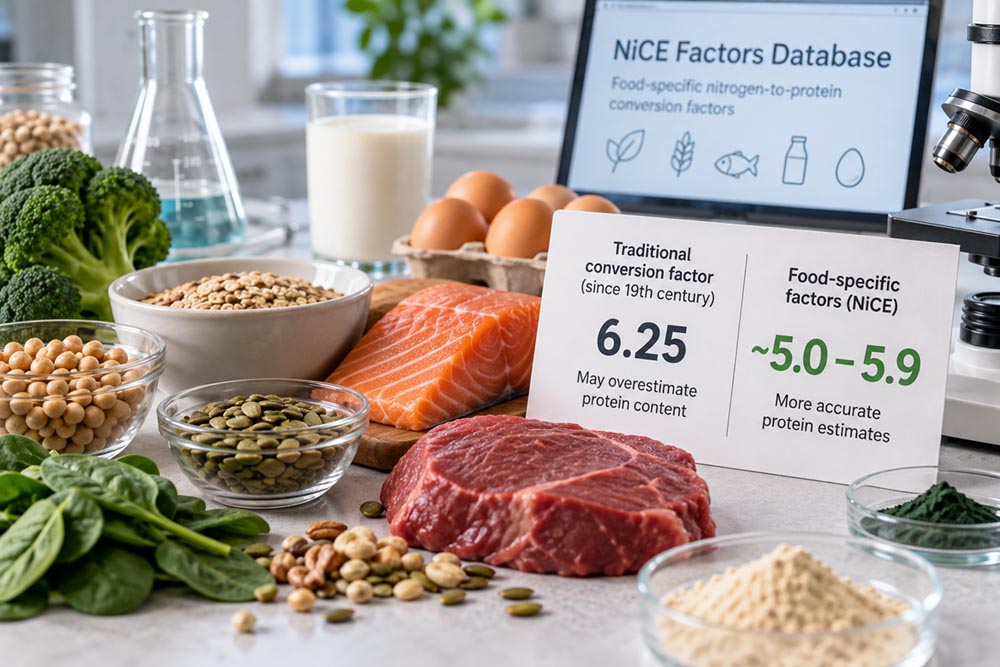
NiCE database challenges 200-year-old formula used to calculate food protein

A European research team has developed a database of food-specific nitrogen-to-protein conversion factors that could provide more accurate protein estimates than the widely used factor of 6.25, which dates back to the 19th century.
Published in Food Chemistry, the NiCE Factors Database covers 4,532 food items and draws on more than 2,600 data points collected from scientific literature. Its developers found that updated conversion factors were consistently below 6.25 across the major food categories examined, with implications for food composition databases, nutrition research and protein labeling.
• Researchers have developed the NiCE Factors Database to replace the conventional 6.25 nitrogen-to-protein conversion factor with food-specific values based on empirical evidence.
• The database covers 4,532 food items, with mean conversion factors ranging from 5.02 for vegetables and vegetable products to 5.86 for dairy.
• Using updated factors could substantially reduce calculated protein values for some foods, including meat, eggs, cereals and newer protein sources such as algae.
Protein content is commonly estimated by measuring the nitrogen in a food and multiplying it by a nitrogen-to-protein conversion factor, or NCF. The standard factor of 6.25 assumes proteins contain an average of 16% nitrogen.
The problem, according to the researchers, is that protein composition varies between foods, while nitrogen can also come from non-protein compounds. Applying 6.25 across different food matrices can therefore overestimate their actual protein content.
That issue has become increasingly relevant as the range of protein sources entering the food system expands. Legumes, algae and other emerging sources can differ considerably from conventional animal proteins in both amino acid composition and non-protein nitrogen content.
The NiCE, or Nitrogen Conversion Estimate, Factors Database was developed through a European collaboration involving EuroFIR AISBL. The researchers systematically compiled published and calculated conversion factors, assessed the quality of the underlying studies and organized the resulting data using the European Food Safety Authority's FoodEx2 food classification system.
The initial database contained 2,667 data points drawn from 111 publications spanning 1967 to 2026. After applying quality checks and removing unsuitable records, the researchers selected an intermediate filtering approach that retained 1,820 values while reducing methodological inconsistencies and extreme results.
Those values were then aggregated and propagated through the FoodEx2 hierarchy, allowing the team to assign factors to foods for which direct experimental data were unavailable.
The final database contains three types of conversion factor. These include kA, based on the amino acid composition of purified protein, and kP, which also accounts for non-protein nitrogen within the food matrix. A combined k value is calculated from the two.
Across the broadest FoodEx2 categories, mean k values ranged from 5.02 for vegetables and vegetable products to 5.86 for milk and dairy products. Grains and grain-based products had a value of 5.56, meat and meat products 5.41, fish and seafood 5.28, and legumes, nuts, oilseeds and spices 5.25.
All were below 6.25.
The difference can have a direct effect on reported protein content because reducing the conversion factor produces a proportional reduction in the protein calculated from a given nitrogen measurement.
For mammals and birds, for example, reducing the factor from 6.25 to 5.31 would cut the calculated protein content by 15%. The researchers also found NiCE Factors for whole eggs approximately 13% below both the conventional 6.25 value and older food-specific Jones factors.
Differences were particularly noticeable in some cereal products. Mean NiCE values for wheat germ and wheat bran were around 5, representing reductions of 15% to 21% compared with the conventional factor and existing Jones values.
The work could also be relevant to sustainable protein developers. Algae and prokaryotic organisms had a NiCE value of about 5.05, while the database produced values of 5.09 for green algae, 4.95 for red algae and 4.96 for brown algae.
The authors noted that reliable factors are also needed for processed foods, including plant-based dairy and meat alternatives. Fermentation, extrusion, enzymatic modification and heat treatment can affect nitrogen recovery or non-protein nitrogen levels, making ingredient-based calculations insufficient when the finished product is analyzed directly.
Data coverage remains uneven. Eggs, cereals and dairy products are comparatively well represented by original measurements, while fruit, starchy roots, composite foods and some processed products have fewer direct data points. For foods without sufficient measurements, the database uses values inherited through the FoodEx2 hierarchy, with metadata allowing users to assess their origin and reliability.
The first version of the NiCE Factors Database has been made openly available through Zenodo. The researchers envisage it as a living resource, with future work including new measurements for underrepresented foods, a Europe-wide data call, greater automation and a web-based interface.
If you liked this, check these out...
• Accurate protein measurement could reshape nutrition and agriculture, say University of Pretoria researchers
• Xylem and Gerhardt present the N-REALYZER: setting a new standard in Dumas protein analysis
• Dumas – a well-established method for N/protein analysis

Join Us At One Of Our Upcoming Events

If you have any questions or would like to get in touch with us, please email info@futureofproteinproduction.com

More News