BIV's Andrew D. Ive: "Innovation is not the problem. Execution is"

Turning promising technologies into real-world industries depends on more than scientific progress. It requires alignment across capital, infrastructure, regulation, and demand, something Andrew D. Ive argues remains the sector’s biggest challenge
The bioeconomy does not have an innovation problem. The technologies exist. The science is advancing. The pipeline of startups is deep and increasingly global.
And yet, progress toward real commercial scale remains uneven.
Somewhere between proof and adoption, things stall. Not dramatically, not always visibly, but consistently enough to shape the trajectory of the entire sector.
Andrew D. Ive, Founder & Managing General Partner at Big Idea Ventures, has spent the past decade working in that gap. Not just as an investor, but as a builder of the systems required to make innovation work in the real world.
“Startups, corporates, governments, and capital are all moving, but not in the same direction,” he says – a disconnect that, in his view, ultimately determines what scales and what does not.
The question is no longer whether new technologies can be developed. It is whether the conditions exist to deploy them.

From investor to infrastructure builder
Big Idea Ventures operates across the full system, from startup creation and university partnerships to corporate adoption and government engagement, effectively building the infrastructure required for the bioeconomy to function.
“We operate as both an investor and the coordination layer of the global bioeconomy,” he explains, outlining a model focused on orchestrating and commercializing innovation into real-world impact.
In that context, the role of investment shifts. “Our role is to bring those forces into execution so innovation does not just exist, it scales.”
Breakthroughs alone are not enough. What matters is whether the environment around them is ready to support deployment at scale – something that increasingly separates theoretical progress from commercial reality.
Startups, corporates, governments, and capital are all moving, but not in the same direction
Where scale is actually decided
Scale, Ive argues, is not determined at the point of invention, but at the point of adoption. “Increasingly, we spend our time where decisions about scale are actually made,” he explains, pointing to the growing importance of working directly with corporates and governments.
Procurement strategies, regulatory pathways, infrastructure readiness, and long-term priorities ultimately decide whether a technology moves forward or stalls.
At the same time, BIV continues to operate at the earliest stages of innovation, sourcing technologies globally and connecting them to tangible opportunities. The combination creates a dual mandate: identifying what is possible while shaping where it can be applied.
“We are not interested in innovation tourism,” Ive says. “It is not just what is interesting – it has to scale and be commercially viable.”
Undeployed technology, in this context, is irrelevant.

The valley where progress is lost
The assumption that strong technology will naturally find its way to market remains widespread. Ive is blunt on this point. “The industry still assumes that good technology will find its way to market. It does not.”
The breakdown, he suggests, occurs in the transition from proof to adoption – a stage where timelines stretch, incentives drift out of sync, and capital becomes harder to secure.
“We see strong technologies, built by strong teams, lost in that gap between proof, commercialization, and funding,” he says, describing a pattern that has repeated across the sector.
The industry still assumes that good technology will find its way to market. It does not
This phase sits between categories: too applied for early-stage research funding, yet too uncertain for large-scale deployment capital. Bridging it requires more than incremental support.
“Recognizing this, we work to close that gap by connecting capital, corporates, and real deployment pathways early,” Ive explains, emphasizing that progress depends on multiple elements moving together.
Infrastructure, not invention
Across that transition, the same constraints appear repeatedly. “We keep seeing the same three: infrastructure that is not ready, regulation that is not aligned, and incentives that are not coordinated.” These are not secondary challenges. They define outcomes.
Capital alone cannot resolve them. As Ive puts it, “capital without coordination still stalls”, particularly when it is disconnected from the realities of production, policy, and market access.
Progress, instead, comes when investment is tied directly to real-world conditions – facilities, regulatory clarity, and viable routes to market.
“What changes outcomes is capital aligned with real timelines, deployed alongside the right partners, and connected to clear pathways to scale.”
This is what turns technical potential into actual deployment.
Built for the real world
The companies that move forward tend to share a common characteristic: they are designed with real-world constraints in mind from the outset.
“The ones that scale are built with cost, supply chains, and customers in mind from day one, or at least day two or three,” Ive says.
That distinction is often decisive. Successful companies are not just proving that something works – they are building something that can be produced, sold, and adopted. Others assume the system will adapt around them. “It doesn’t. Sorry!”
Capital without coordination still stalls
As capital tightens and expectations shift, that assumption has become harder to sustain. Increasingly, companies are forced to engage earlier with the realities of infrastructure, partnerships, and market fit.
“Both sides need each other, more than either is often prepared to admit,” Ive adds, pointing to a dynamic where startups and corporates are more interdependent than they sometimes acknowledge.
Those that recognize this early tend to move faster, building with the system rather than against it.

The myth of global scale
That same realism applies to geographic expansion. “They underestimate how little ‘global’ actually exists,” Ive says, pushing back against the assumption that markets behave uniformly.
From a distance, expansion can appear straightforward. In practice, each market operates according to its own regulatory frameworks, supply chains, and consumer dynamics.
“Every market looks similar from a distance, but once you get into it, the regulatory logic, supply chains, and customer behavior are all different.”
As a result, scaling internationally often becomes less about expansion and more about repetition. “Scaling globally is not expansion, it is rebuilding.”
For technologies tied to physical infrastructure and policy environments, there are few shortcuts.
Governments as market makers
This is where the role of governments becomes decisive. “Governments are realizing that funding research is only the first step,” Ive says. “The real leverage is in what happens next. Deployment.”
That shift is redefining how public institutions engage with the sector.
Regulation determines whether products can reach market. Procurement can create early demand. Support for pilots and shared infrastructure enables production to take shape. “When governments step into that role, you do not just get innovation, you get industries.”
At this stage, scaling ceases to be a company-level challenge and becomes a system-level outcome.

From innovation to execution
The implication is clear. “We need to stop treating this as an innovation problem,” Ive says. “The science is already in the pipeline. The constraint is everything around it. Increasingly, we know what to do. The challenge is how to align governments, corporates, universities, and capital in the real world.”
What matters now is execution – not as a one-off success, but as a repeatable process.
“Bringing the right technologies together with the right corporates, the right governments, and the right capital, at the right time,” he explains, describing a model that depends on consistency rather than isolated wins.
The conversations we avoid
Even now, some of the most fundamental challenges remain underexamined. “We are still avoiding the harder questions. Cost. Scalability. Infrastructure.”
Avoidance slows progress, even when the underlying science is sound. “Progress comes from being clear about what it actually takes to scale,” Ive says, adding that this requires a more honest assessment of what has not worked.
The next decade will not be won by whoever has the best technology alone
“We need to be more honest about what has not worked and why.”
Because, as he notes, every industry eventually reaches this point. “You only start to move faster when you are willing to confront reality.”

This is the implementation decade
The bioeconomy is not waiting on breakthroughs. Much of the science is already in the pipeline. What it lacks is follow-through.
That shift is already visible in the markets moving fastest: clearer regulatory pathways, governments acting as first buyers, and investment flowing into pilots and enabling infrastructure. That is what turns something from interesting into inevitable.
The challenge is no longer what to build. It is how to deliver it in the real world, across infrastructure, policy, and demand, at the same time.
That is where systems break down, and where progress is won. “The next decade will not be won by whoever has the best technology alone,” Ive says. “It will be won by whoever can align regulation, demand, and capacity, then execute, repeatedly.”
Execution is where the advantage is created. “Our role at Big Idea Ventures is to make that happen in the real world, consistently, at scale,” he adds, describing a focus on bringing together the right innovators, corporates, governments, and capital early enough that deployment is built in from the start.
Because good technology does not automatically find its way to market.
“The system will not adapt around you.”
This is the implementation decade. The advantage will go to those who can build and operate the systems that turn innovation into real-world outcomes.
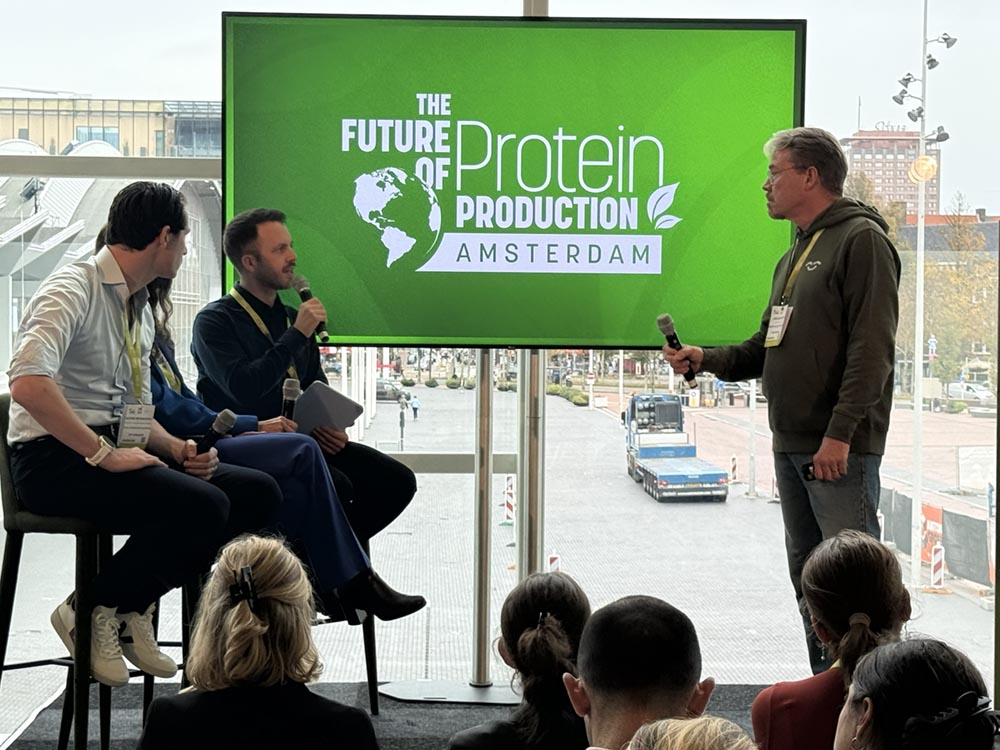
Andrew D. Ive is one of 24 experts shaping the agenda for The Future of Protein Production/Cultured Meat Symposium Amsterdam on 4/5 November 2026, taking place at RAI Amsterdam. To join +100 speakers and more than 750 other attendees, book your conference ticket today and use the code, 'PPTI10', for an extra 10% discount on the current Super Early Bird rate of €995 (closes 29 May 2026). Click here

Join Us At One Of Our Upcoming Events

If you have any questions or would like to get in touch with us, please email info@futureofproteinproduction.com

More News