GEA steps in to scale BFF, building Europe’s missing middle for food-grade fermentation

GEA was selected to deliver and commission a precision and biomass fermentation upscaling line for the Biotechnology Fermentation Factory at the NIZO Food Innovation Campus in Ede, the Netherlands, a move designed to address one of the most persistent bottlenecks in fermentation-based food innovation: the jump from lab proof-of-concept to commercial readiness.
• GEA was selected to deliver and commission a food-grade precision and biomass fermentation upscaling line for the Biotechnology Fermentation Factory at the NIZO Food Innovation Campus in Ede, the Netherlands.
• Installation of the new line was scheduled for 2026, with pilot operations expected to begin from 2027.
• The open-access facility was designed to help companies validate processes under food-grade, scalable conditions before committing to full commercial manufacturing.
The new line was planned as part of BFF’s open-access model, which offers food and ingredient companies a shared, bookable infrastructure to test, validate, and scale fermentation processes without having to build their own pilot facilities. Installation was scheduled for 2026, with pilot operations targeted to begin in 2027.
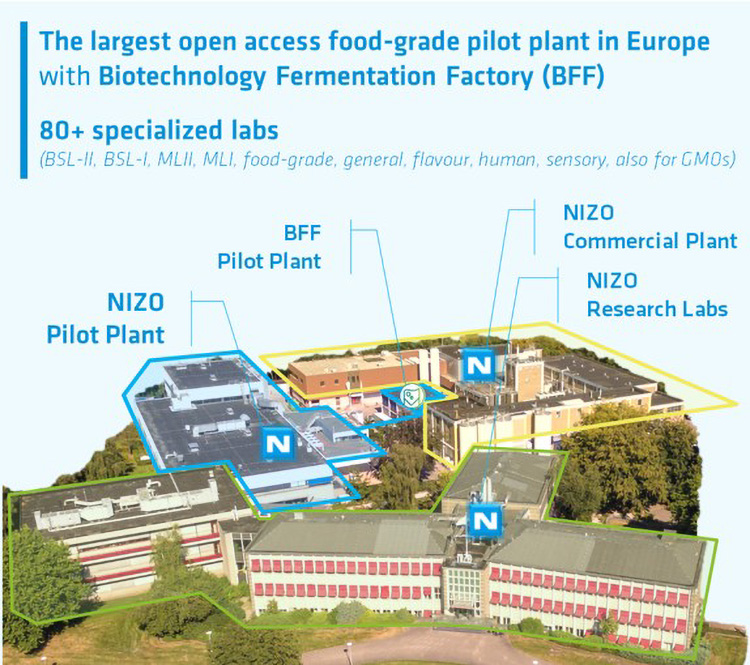
Located on the NIZO Food Innovation Campus, BFF was set up to serve companies working on precision and biomass fermentation products, including animal-free dairy proteins, egg-white proteins, specialty enzymes, flavors and fragrances, and other functional biomolecules. The goal was to provide a realistic, food-grade environment where processes could be stress-tested at meaningful scale and generate data suitable for investment and commercial decisions.
Frederieke Reiners, Vice President New Food at GEA, said open-access pilot capacity remained a critical gap for many innovators. “Open-access capacity is the critical development link many innovators have been missing,” she said. “By delivering BFF’s line, we help teams validate their processes faster under food-grade conditions, and as the logical next step from our GEA New Food Application & Technology Center, this pilot environment enables application-ready material and decision-grade data sets that de-risk the move toward commercial manufacturing. It also advances Mission 30, where biotechnology meets scalable industrial production.”
The project reflected GEA’s broader focus on supporting alternative protein and biotechnology-driven food systems through industrially relevant equipment and expertise. While many startups and research teams can demonstrate functionality at lab scale, translating that success into food-grade pilot runs often requires capital, operational know-how, and infrastructure that sits beyond their reach.
That challenge was central to BFF’s rationale. Marcel Oogink, Managing Director of the Biotechnology Fermentation Factory in Ede, said the facility was designed to remove uncertainty at a crucial development stage. “Our aim is straightforward: to give the industry dependable open-access capacity to validate processes under realistic, food-grade and scalable conditions,” he said. “With GEA supplying this line, companies will gain the technical reliability and speed they need to move confidently from lab development toward industrial readiness.”
Many fermentation projects stall in what is often described as the “missing middle,” the stage between successful lab trials and the first major commercial investment decision. At this point, companies must prove not only that a product works, but that it can be produced consistently, safely, and economically under conditions that resemble commercial manufacturing.
BFF’s open-access model was designed to close that gap. The facility offered bookable fermentation upscaling capacity, along with process expertise and food-grade quality procedures. This allowed companies to run pilot campaigns, validate tech transfer steps, and generate decision-grade data without committing to their own capital-intensive facilities.

Operating under food-grade standards, the site was intended to produce trial volumes suitable for sensory evaluation and application testing. For product development teams, that meant access to material that could be used in downstream formulation and end-product development, rather than relying solely on lab-scale samples.
The line delivered by GEA was anchored by both a 1,000-liter and a 10,000-liter main fermenter, creating a meaningful step up from benchtop and small pilot systems. GEA’s scope covered an integrated upstream-to-downstream setup, including media preparation, controlled fermentation, cell harvest, and a filtration train for recovery and polishing.
Commissioning and validation support were included to ensure the line could produce robust, decision-grade data while maintaining confidentiality around organisms, recipes, and commercial parameters. This was a key consideration for companies working with proprietary strains or processes in a shared facility.
The setup also complemented BFF’s existing pre-pilot assets and biomass fermentation lines, and it directly connected to the downstream processing pilot plant operated by NIZO on the same campus. This co-location allowed teams to carry out fermentation, primary recovery, and professional-scale concentration and purification in one place, reducing handover risks and timelines.
Taken together, the partners described the combined infrastructure as one of Europe’s most complete mid-scale, food-grade validation environments for precision and biomass fermentation. For companies navigating the transition from innovation to industrial reality, the aim was not to promise faster commercialization, but to make the path clearer, more predictable, and grounded in data that investors and manufacturers could trust.

Join Us At One Of Our Upcoming Events

If you have any questions or would like to get in touch with us, please email info@futureofproteinproduction.com

More News