


FIU researchers turn Florida’s Sargassum surge into potential food ingredient

As record-breaking amounts of sargassum seaweed drift toward Florida’s shores, researchers at Florida International University have identified a potential use for the coastal nuisance as a food-grade ingredient.
• FIU researchers found that sargassum contained significant amounts of alginate, a natural polysaccharide used to stabilize and thicken foods.
• The study, published in Food Hydrocolloids, was conducted with researchers from Florida State University and Florida Atlantic University.
• The team reported extraction yields of roughly 45% and has been assessing processing methods to reduce microbial and contaminant risks.
The new findings, published in Food Hydrocolloids, showed that sargassum could serve as a promising source of alginate, a widely used food additive found in products such as ice cream, sauces and dairy alternatives.
Sargassum, a brown algae that forms large blooms in the Atlantic Ocean, routinely washes onto South Florida beaches, where it creates strong odors, disrupts ecosystems and triggers costly cleanup efforts. The study was conducted in collaboration with researchers from Florida State University and Florida Atlantic University.
Rather than treating the seaweed solely as a waste problem, the researchers have been exploring how useful compounds could be extracted from the material and repurposed for food and industrial applications.
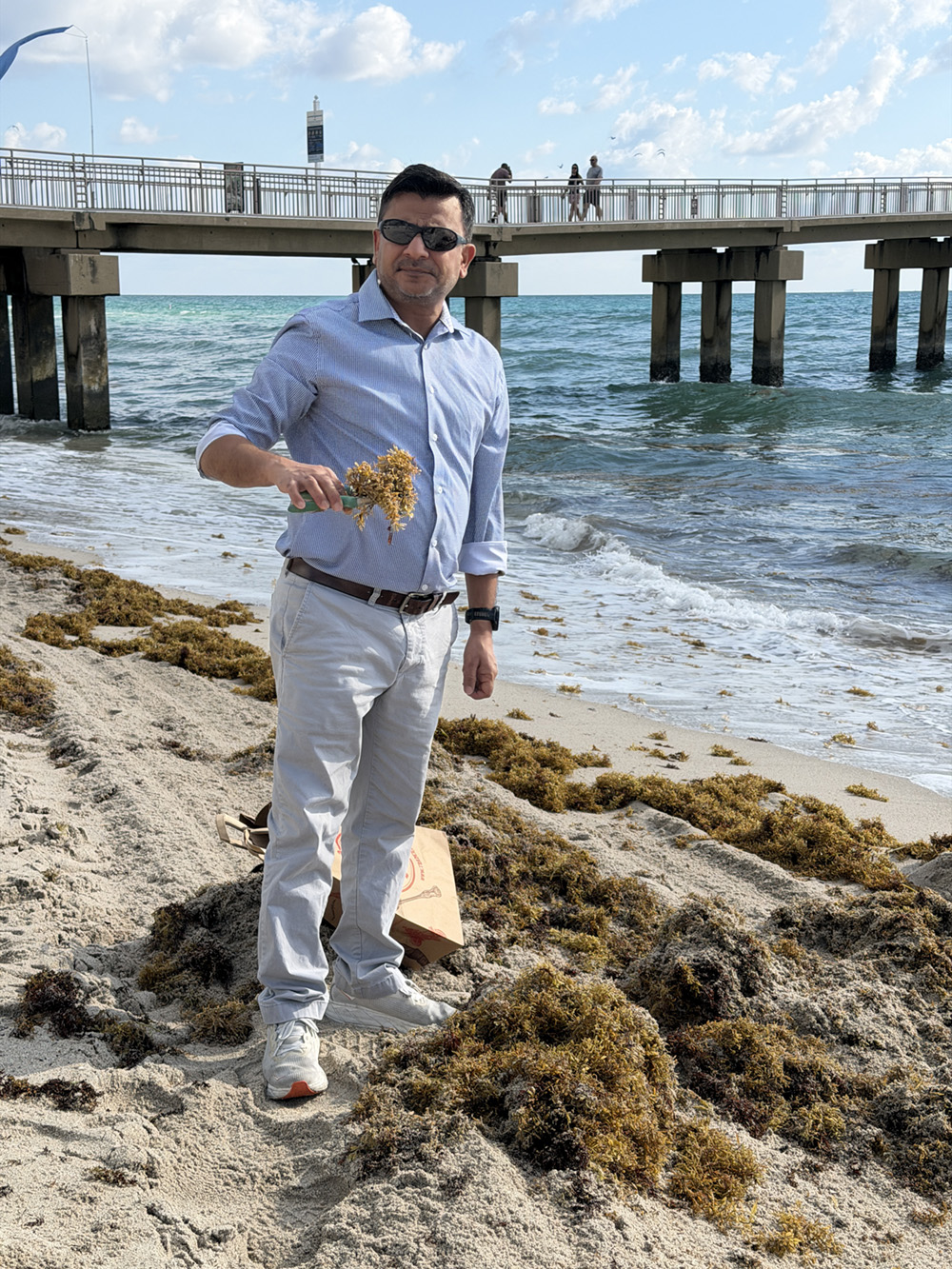
“The usual approach has been, ‘How do we get rid of it?’ We wanted to ask a different question: ‘Can we use it for something valuable?’” said Imran Ahmad, a food science and technology research professor in FIU’s Chaplin School of Hospitality & Tourism Management and co-author of the study.
The study found that sargassum contained significant amounts of alginate, a natural polysaccharide commonly used to stabilize and thicken foods. Researchers reported extraction yields of roughly 45%, highlighting its potential as an alternative source to traditionally harvested seaweeds.
Because sargassum is not currently classified as a food source and can carry contaminants, the team also examined how the material might be processed safely.
“It’s generally treated as waste because it smells, affects tourism and can carry contaminants or bacteria,” Ahmad said.
As part of the broader research effort, the team has been evaluating techniques such as high-pressure processing, a method already used in the food industry, to reduce microbial risks while preserving useful compounds.
“Instead of using heat, which can damage nutrients and structure, we apply extremely high pressure,” Ahmad said. “That high pressure kills harmful microorganisms but preserves the useful compounds we want to extract.”
The work remains at an early stage. Researchers have identified and extracted key compounds from sargassum and are now working to refine processing methods and evaluate possible applications. Developing consumer-ready products would require further testing and regulatory approval.
“Our researchers at the Chaplin School are always looking for ways to solve problems that affect and can help improve the hospitality and tourism industry,” said Michael Cheng, dean and professor of the hospitality school. “We are proud of Dr. Ahmad’s innovative research and look forward to seeing how his work can help solve not only a Florida, but much larger global issue.”
Beyond potential food applications, the research has addressed a growing environmental challenge across Florida and the Caribbean. By turning sargassum into a usable resource, scientists have sought to reduce waste, lower cleanup costs and support more sustainable supply chains.
“If we can turn it into something useful, we shift the conversation from disposal to opportunity,” Ahmad said.

Join Us At One Of Our Upcoming Events

If you have any questions or would like to get in touch with us, please email info@futureofproteinproduction.com


