
EPIC-SHIFT tests 28 protein ingredients to find their best food applications

Sustainable protein development should begin by identifying where ingredients perform best rather than trying to substitute one protein for another in a predetermined product, according to EPIC-SHIFT research combining ingredient testing, prototype development and market analysis.
The EU-funded project characterized 28 protein ingredients across seven source categories and developed seven prototypes, including pasta, a snack bar, a burger analogue, a spreadable cheese analogue, a biscuit, a dense cake and dark chocolate.
• EPIC-SHIFT assessed 28 protein ingredients for nutritional, sensory and functional properties, then used the findings to guide seven food prototypes.
• The research found complementary strengths across protein sources, supporting application-specific blends rather than a universal replacement ingredient.
• A consumer survey involving 502 respondents across five European countries helped identify familiar formats and potential routes to adoption.
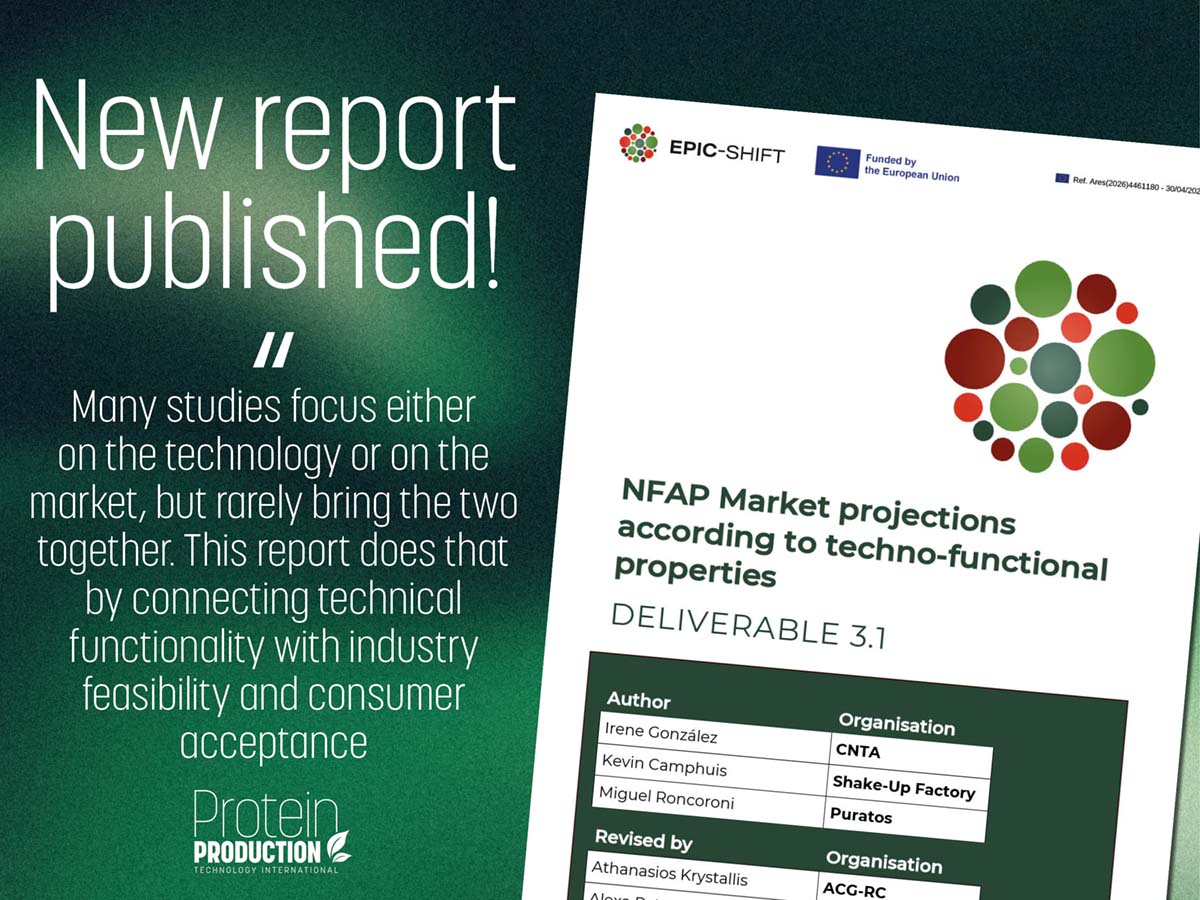
The findings are presented in NFAP Market Projections According to Techno-Functional Properties, a report prepared by Spain’s National Centre for Food Technology and Safety (CNTA), Puratos and Shake-Up Factory. An accompanying interview published on October 12 explains how the researchers connected laboratory performance with practical sourcing constraints, industry requirements and consumer expectations.
“The main gap was that techno-functional performance and market potential are often looked at separately. Many studies focus either on the technology or on the market, but rarely bring the two together,” said Irene González Pérez, report coordinator and sensory and consumer science researcher at CNTA.
“This report does that by connecting technical functionality with industry feasibility and consumer acceptance. Thanks to that we can identify innovation opportunities that are realistic, not just theoretically promising.”
The team assessed ingredients from fungi, bacteria, insects, microalgae, macroalgae, food by-products and aquaculture by-products. Its wider market analysis also considered precision fermentation and plant molecular farming, extending the commercial assessment beyond the categories covered by the core ingredient testing.
Rather than finding a single protein capable of performing every role, the analysis identified different strengths in emulsification, hydration, stabilization, texture, color and flavor. Limitations included solubility, pronounced sensory characteristics, lower protein density in some ingredients and insufficient foaming or gelling performance for certain applications.
“The goal was not simply to replace one protein with another, but to use each protein where it performs best,” said Irene Arce Gutierrez, a food product development researcher at CNTA who co-leads prototype development within the project.
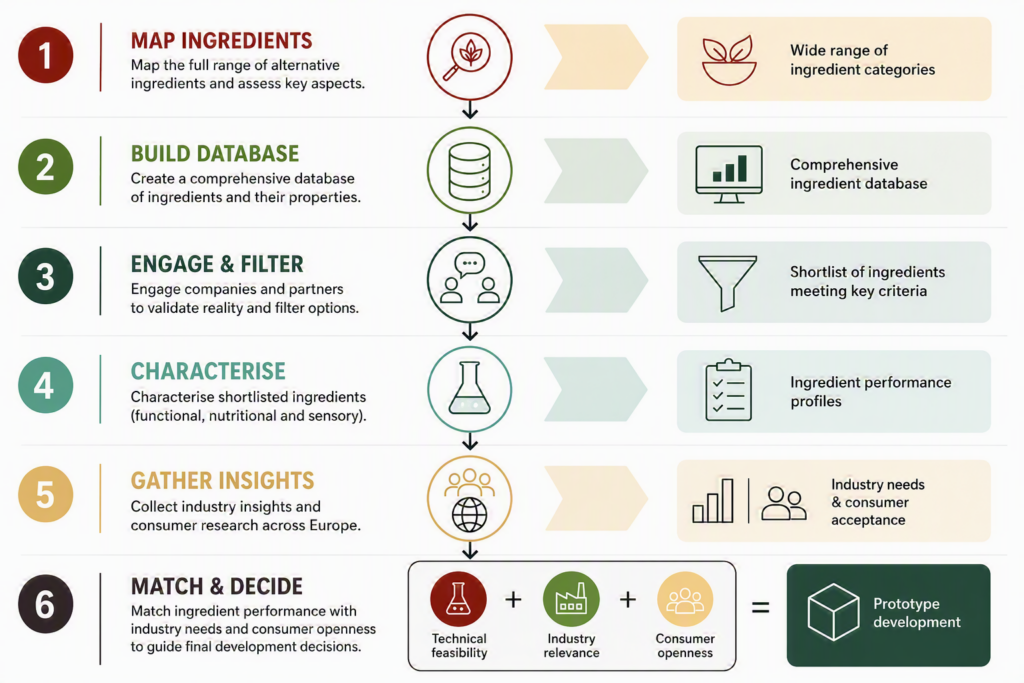
The development process began with ingredient mapping and an assessment of practical factors, including availability, consistency, regulatory suitability and access to larger quantities. Researchers then contacted suppliers and project partners before narrowing the selection for prototype work.
Availability proved an early constraint. González Pérez said some ingredients appeared promising on paper but were difficult to source because suppliers were still at the startup stage. Nutritional, sensory and functional testing subsequently ran alongside industry consultation and consumer research.
The resulting prototypes illustrate how ingredients were assigned specific roles. These included a snack bar containing mealworm powder, pasta incorporating the microalga Tetraselmis chuii, and a burger analogue using mushroom stem flour for flavor, color and texture.
Macroalgae was the only core category without a final prototype. Its strong marine sensory profile and lower protein density limited suitability for the product formats prioritized in this phase. The report treats that outcome as a reason to avoid forcing an ingredient into an unsuitable application.
Consumer research collected 502 valid online responses across Spain, Belgium, Greece, Estonia and Hungary, with approximately 100 respondents per country. Participants were targeted on the basis of having full or shared responsibility for household grocery purchases. The sample provides insight across those five countries rather than a representative measure of the entire EU population.
Some 39% reported having tried alternative protein products, while 51% had not and 10% were unsure. Breakfast was the most frequently selected potential consumption occasion at 38%, followed by afternoon snacks at 28%, supporting further investigation of familiar convenience formats.
Industry feedback emphasized solubility, neutral flavor, regulatory feasibility and dependable supply. The report consequently identifies blends and hybrid formulations as practical ways to combine useful properties while managing individual ingredients’ limitations.
Its market projections anticipate earlier uptake through business-to-business ingredients in familiar foods, followed by broader adoption as costs fall, regulatory processes advance and consumer familiarity grows.
“When multiple applications were possible, the final choice depended on where these three dimensions aligned best: technical feasibility, industry relevance and consumer expectations,” González Pérez said.
If you liked this, check these out...
• Heriot-Watt and Greenwich test potato protein as gluten replacement in plant-based meat
• Protein under pressure: Balancing nutrition and texture
• EIT Food study finds consumers willing to try precision fermentation, but trust remains a hurdle

Join Us At One Of Our Upcoming Events

If you have any questions or would like to get in touch with us, please email info@futureofproteinproduction.com