

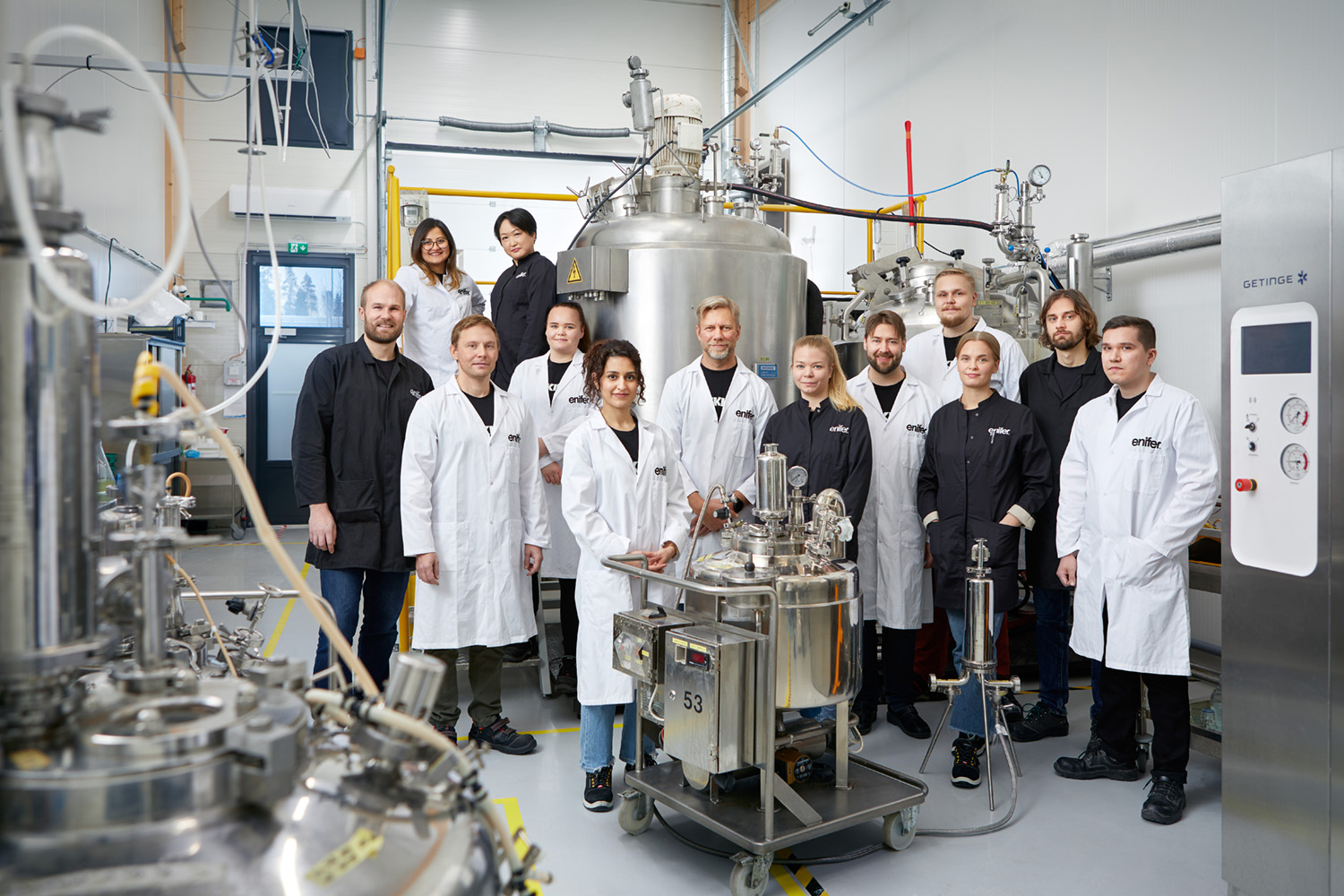
Enifer and Rovio turn PEKILO mycoprotein into commercial dog treat launch following four-ton production run

Most alternative proteins look convincing at pilot scale. Far fewer survive contact with manufacturing. For years, the alternative protein sector has produced an expanding pipeline of promising ingredients backed by digestibility studies, sustainability claims, and carefully engineered nutritional profiles. The harder challenge has been translating those ingredients into products manufacturers can run consistently, brands can position credibly, and consumers – or in this case pets – repeatedly choose.
That transition sat at the center of Enifer’s latest milestone. The Finnish biotech company and Rovio Pet Foods have launched a semi-moist dog treat made with PEKILO, Enifer’s fermentation-derived mycoprotein ingredient, following the company’s first four-ton commercial production batch. More than a simple product launch, the project represented one of the clearest indications yet that PEKILO was beginning to move beyond pilot-stage development and into practical commercial manufacturing.
• Enifer and Rovio Pet Foods launched a semi-moist dog treat made with PEKILO following Enifer’s first four-ton commercial production run of the ingredient.
• Feeding trials showed PEKILO achieved high digestibility, strong palatability, and biomarker changes linked to immune activity and oxidative balance in dogs.
• Enifer said the launch represented an important commercial validation milestone as it prepared to scale production at its Kantvik facility.
“This partnership represents an important validation milestone in PEKILO’s journey, demonstrating how the ingredient works in real production conditions and products, across processability, palatability, and consumer acceptance,” Simo Ellilä, CEO at Enifer, told Protein Production Technology International.
“The consumer reception of the launch product has been overwhelmingly positive, providing strong validation for PEKILO and Enifer. At this stage, being able to point to a market-ready product is a critical step as we continue to scale and expand PEKILO into new applications.”

That distinction mattered in a market increasingly defined less by technical novelty and more by commercial execution.
Sustainability alone no longer guaranteed attention. Nor did high protein content. Pet food manufacturers faced growing pressure to deliver products that combined functionality, manufacturing reliability, ingredient differentiation, and increasingly sophisticated health claims in categories where premiumization continued to accelerate.
“Sustainability is the basis of most new ingredients coming onto the market – it is no longer the sole differentiating factor,” Ellilä said. “However, it continues to play an important role, especially for large companies.”
PEKILO itself carries unusually long industrial roots for a modern alternative protein ingredient. Originally developed decades ago in Finland, the fungal biomass ingredient has been redeveloped by Enifer for modern food and feed applications. The ingredient contains more than 60% protein, alongside fungal beta glucan fiber and an amino acid profile resembling meat.
Pet food emerged early as a strategic entry point.

For many alternative protein companies, pet nutrition has become one of the industry’s most commercially accessible proving grounds: faster product cycles than human food, fewer regulatory hurdles, and consumers increasingly willing to pay premium prices for products linked to wellness and sustainability.
“Pet food has been a core focus for Enifer from the very beginning,” Ellilä said.
“It’s a category with a clear need for novel, sustainable protein sources, and one where innovations can reach the market relatively quickly. In pet nutrition, we’re able to validate both our technology and the functionality of the PEKILO ingredient.”
The collaboration also aligned with Rovio Pet Foods’ own development work around functional ingredients and premium treat concepts. Rather than launching directly into large-volume kibble production, the companies focused initially on semi-moist treats – a format that offered smaller manufacturing runs while still providing meaningful commercial validation.
“Treats are also typically produced in smaller batches than kibble, which makes them well suited for testing production performance and palatability, while still bringing a meaningful, consumer-ready product to market,” Ellilä said.
The choice also reflected one of the most unforgiving realities in pet nutrition: sustainability claims become irrelevant if animals refuse the product.
Alternative proteins have repeatedly encountered that barrier. Nutritional performance on paper often failed to translate into repeat purchase behavior when palatability suffered.
Enifer’s internal and partner testing suggested PEKILO avoided that problem.
“We are very confident on palatability,” Ellilä said.
“In a customer survey conducted by Rovio Pet Foods, palatability results were consistently positive, showing that PEKILO treat was favored over the control 62% of the time.”

The company said dogs also selected PEKILO-based treats over comparable meat-based alternatives during preference testing.
“When offered a choice between two otherwise comparable treats, one containing PEKILO and one meat based, the PEKILO treat was selected 62% of the time,” he said.
Palatability, however, was only part of the challenge.
The alternative protein sector has accumulated no shortage of ingredients capable of generating promising laboratory data. Industrial manufacturing has proved considerably less forgiving. Fermentation-derived proteins in particular have faced persistent questions around process economics, downstream functionality, ingredient consistency, and scale-up reliability.
That was where the four-ton batch became commercially significant.
“The four-tonne batch marks an important step in scaling PEKILO from pilot to commercially relevant volumes,” Ellilä said.
“It enables our partners to move beyond small-scale testing into more representative production trials and formulation validation, which is often required by customers before being able to receive larger commercial quantities.”
The milestone also allowed manufacturers to evaluate how PEKILO behaved under practical production conditions rather than controlled development environments.
“Rovio Pet Foods found that PEKILO performed exceptionally well in terms of processability, with no issues observed during extrusion,” Ellilä said.
That result carried broader implications because the same extrusion processes used in treat production are widely used across dry kibble manufacturing.
“As the same extrusion process is used in Rovio Pet Foods’ dry kibble production, this result indicates that PEKILO is also well suited for kibble applications from a processing standpoint,” he said.
The ingredient’s functionality extended beyond manufacturing performance alone.

Much of the current pet nutrition market has shifted toward products marketed around gut health, immunity support, microbiome balance, and digestive performance. Functional treats, once considered niche, have become one of the category’s fastest-growing premium segments.
“Functional treats are a growing area in pet nutrition, but to succeed in that category, the product still has to perform where it matters most - especially in palatability and consistency,” Piritta Koistinen, Chief Commercial Officer at Rovio Pet Foods, said.
“PEKILO stood out as an interesting ingredient because it offered both a novel profile and the reliable raw material performance needed for product development.”
Enifer has increasingly leaned into that functional positioning through feeding studies and microbiome research.
“PEKILO has been shown to increase the abundance of health-beneficial gut microbes, and reduce bacterial genera linked to negative health outcomes even at the smallest inclusion rate (4%), as well as boost the production of short chain fatty acids, which are important for gut health,” Ellilä said.
He also pointed to newer findings linked to immune activity and oxidative balance.
“More recent research showed significant changes in several biomarkers linked to immune activity and oxidative balance, suggesting a shift toward a more balanced and controlled immune response,” he said.
“That means PEKILO truly fits the description of a functional ingredient, going beyond just nutrition.”
The company’s recent 60-day feeding study involving 16 dogs appeared to reinforce that argument. According to Enifer, the trials demonstrated high digestibility, strong palatability, no negative impact on stool quality, and biomarker changes associated with immune activity and oxidative balance.
Digestibility remained a particularly sensitive issue across alternative proteins, especially in pet nutrition applications where gastrointestinal tolerance can quickly undermine adoption.
“In canine feeding trials on PEKILO, no intestinal distress or negative effects on stool quality were observed,” Ellilä said.
“This is notable, as gastrointestinal sensitivity can sometimes occur with certain plant-based protein alternatives.”
The ingredient’s nutritional profile also gave Enifer a way to differentiate PEKILO from more conventional plant proteins already established across pet food formulations.
“From a nutritional standpoint, PEKILO has a well-balanced amino acid profile, making it more complete than many single-source plant proteins,” Ellilä said.
The ingredient also combined multiple characteristics rarely found together in a single raw material.
“PEKILO works very well in both wet and dry food formats,” he said.
“The ingredient also combines highly digestible protein (83.9% digestibility shown in dogs), a high content of fungal beta glucan fiber (12.5%), and low carbon footprint. This combination is highly unusual: ingredients typically offer either digestible protein or functional fiber, but rarely both at meaningful levels.”
The sustainability component nevertheless remained central to Enifer’s long-term commercial argument.
According to the company’s life cycle assessment, PEKILO is seven times more carbon efficient than soy protein concentrate. Unlike crop-dependent protein systems, fermentation also offers year-round production in controlled environments using substantially lower land and water inputs.
“Fermentation offers a more resource-efficient way to produce protein,” Ellilä said.
“PEKILO is produced in a controlled environment, using less land and water, and enabling year-round production independent of climate or geography.”
He also contrasted the ingredient with insect protein systems, many of which continued to face scale-up and acceptance challenges despite years of industry investment.

“Compared to some emerging alternatives, such as insects – which continue to face challenges related to large-scale production and broader acceptance – PEKILO has a proven production history and clear scalability pathway,” he said.
At the same time, Enifer acknowledged that different segments of the pet food industry continued to prioritize different commercial drivers.
“Smaller brands tend to prioritize functionality, such as gut health and immunity-supporting benefits,” Ellilä said.
“Larger brands, on the other hand, place greater emphasis on a low carbon footprint and reducing supply chain risk.”
Cost pressures remained unavoidable throughout the sector, particularly as manufacturers navigated volatile commodity markets and increasingly crowded premium categories.
“Cost is always a consideration,” Ellilä said. “At the same time, innovation remains essential. Brands that want to stand out need to look beyond the handful of most commonly used protein sources and adopt differentiated ingredients.”
Part of Enifer’s commercialization strategy involved reducing barriers for brands still unfamiliar with fermentation-derived ingredients by connecting them directly with manufacturing partners already experienced with PEKILO.
“Enifer is well positioned to connect brands with manufacturing partners that have already completed preliminary evaluations of PEKILO,” Ellilä said.
“Because these production facilities are familiar with the ingredient, they can quickly formulate and manufacture new products for brands that outsource their production.”
He described that matchmaking role as temporarily important while industry familiarity with the ingredient continued to develop.
“As PEKILO becomes more widely known and understood across the industry, this kind of matchmaking will become less critical,” Ellilä said. “But at this stage, it plays an important role in accelerating product development and market entry for our partners.”
Enifer said the next stage of commercial scale-up would continue through its planned Kantvik facility.
“Product development cycles in pet food typically take a year or longer, as customers go through multiple stages before launching a new product,” Ellilä said.
“Some smaller brands are moving quickly and are expected to bring new products to market in the near term. For larger customers, launches are expected once commercial-scale volumes are available, following the completion of our Kantvik plant.”
Rovio Pet Foods, which develops both branded and white-label pet nutrition products, also viewed the collaboration as a broader demonstration of Finnish ingredient development and manufacturing capabilities.
“It was also especially meaningful to build this product together with another Finnish company, combining local ingredient innovation with Finnish pet food development and manufacturing expertise,” Koistinen said.
Enifer said samples of the new treat would be available at Interzoo 2026, where the company planned to discuss PEKILO’s broader applications across pet nutrition categories.
For an alternative protein industry still struggling to prove which ingredients can move beyond technical promise and survive the realities of industrial manufacturing, that distinction may have mattered as much as the product itself.

Join Us At One Of Our Upcoming Events

If you have any questions or would like to get in touch with us, please email info@futureofproteinproduction.com


