

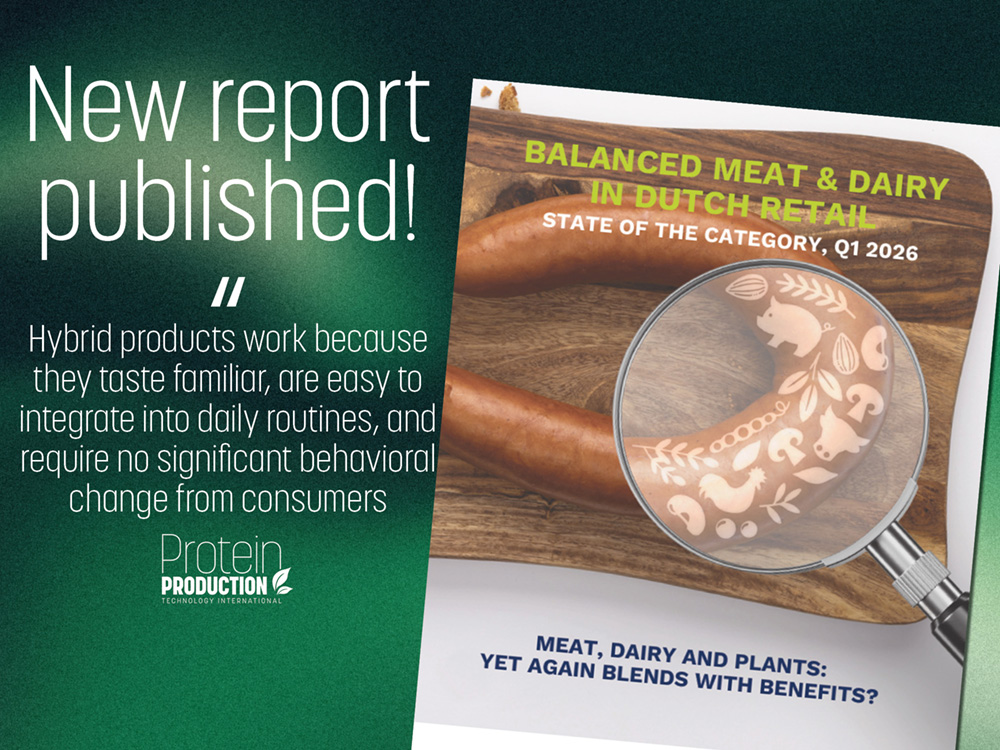
Dutch retail data shows hybrid meat gaining ground as price, not ideology, drives adoption

A new analysis of hybrid meat and dairy products in the Netherlands has revealed a rapidly expanding category led not by startups or challenger brands, but by retailers quietly reformulating familiar products to reduce animal content while maintaining taste, price competitiveness, and consumer acceptance.
The report, which examined 115 'balanced' products introduced since 2024, found that these hybrid formats – combining animal and plant-based ingredients – are gaining traction as a pragmatic approach to protein diversification, particularly in mainstream retail environments.
• A total of 115 hybrid meat and dairy products were identified in Dutch retail since 2024, with 91% launched under private label by major supermarkets.
• Around 60% of hybrid products were priced lower than conventional equivalents, averaging €1.27/kg (US$1.38) less, reinforcing affordability as a key driver.
• Most products contained relatively low plant inclusion rates, averaging 10.5%, and often did not highlight this on front-of-pack labeling.
Rather than presenting a disruptive alternative to conventional meat, hybrid products have been introduced in formats that closely mirror existing offerings, particularly in processed categories such as burgers and sausages. The data showed that meat-based hybrids dominate the category, while dairy applications remain limited for now.
The approach reflects a shift away from the more visible, values-driven positioning that has defined much of the plant-based sector over the past decade. Instead, retailers appear to be embedding plant ingredients into products in a way that minimizes friction for consumers, both in terms of taste expectations and purchasing behavior.
Private label accounted for 91% of all hybrid products identified in the study, with Dutch supermarket chains including Albert Heijn and Jumbo leading the rollout. Branded products made up just 9% of the total, underlining the extent to which the category is being shaped by retail strategy rather than brand-led innovation.
This dynamic has allowed retailers to move quickly, using hybrid formulations as a tool to address multiple pressures simultaneously, including rising raw material costs, sustainability targets, and shifting consumer preferences around health and nutrition.
Price emerged as one of the most significant differentiators. The report found that 60% of hybrid products were cheaper than their conventional counterparts, with an average price reduction of €1.27/kg (US$1.38), equivalent to around 4.4%. In a category where price sensitivity remains high, particularly in staple protein products, this gap is likely to play a decisive role in driving uptake.
At the same time, the nutritional profile of hybrid products showed modest but consistent improvements. A large majority, 81%, contained higher levels of fiber than conventional equivalents, in some cases delivering up to five times more. Protein levels, however, were slightly lower on average, with hybrid products providing 14.3g per 100g compared to 16.1g for conventional meat products.
Nutri-Score ratings, where available, showed incremental gains rather than dramatic shifts. Around 35% of hybrid products achieved a better score than their conventional counterparts, while 55% remained the same. This suggests that while hybridization can contribute to improved nutritional outcomes, it is not being positioned primarily as a health transformation.
Instead, the strategy appears to center on maintaining familiarity. Plant-based ingredients such as pea protein, fava bean protein, vegetables, and fibers are being incorporated at relatively low inclusion rates, averaging 10.5% across the dataset. In cases where the plant content was explicitly highlighted on packaging, this rose to around 19.5%, but such transparency was not the norm.
In fact, labeling practices revealed a deliberate effort to downplay the hybrid nature of many products. The report found that 70% of products mentioned plant-based ingredients only on the back of the packaging, with just 30% communicating this clearly on the front. This approach suggests a conscious attempt to avoid triggering preconceived notions associated with plant-based products, particularly around taste and texture.
By keeping messaging subtle, retailers are effectively repositioning hybrid products as a seamless evolution of existing categories rather than a distinct alternative. Products remain in the same shelf locations, carry similar branding cues, and are priced competitively, allowing consumers to adopt them without making an explicit behavioral or ideological shift.
This contrasts with the trajectory of plant-based meat, which has often relied on clear front-of-pack messaging and sustainability claims to differentiate itself. While that strategy has succeeded in building awareness, it has also introduced barriers for some consumers, particularly those who remain skeptical about taste or processing.
Hybrid products, by comparison, are designed to avoid those barriers altogether. They do not ask consumers to replace meat, but rather to consume slightly less of it without noticing a significant difference.
The report suggested that this low-friction model could prove more scalable in the near term, particularly in markets where price sensitivity and taste expectations remain dominant factors in purchasing decisions.
Looking ahead, the category is expected to expand further. The number of hybrid products in Dutch retail is projected to double over the next 12 months, with increased activity anticipated in dairy applications such as yogurt, cheese, and quark, as well as potential extensions into fish products.
Ingredient innovation is also expected to play a role in the next phase of development. Advances in plant protein functionality, along with the use of tools such as AI in formulation, could enable higher inclusion rates without compromising sensory performance, potentially enhancing both nutritional and environmental benefits.
For now, however, the data points to a category that is evolving through incremental change rather than radical transformation. Hybrid products are not seeking to redefine consumer behavior, but to work within it, offering a quieter pathway toward reduced reliance on animal proteins.
By focusing on price, familiarity, and accessibility, retailers appear to be testing a model that prioritizes adoption over advocacy. In doing so, they may be reshaping how protein transition plays out in everyday purchasing decisions, not through visible disruption, but through gradual, largely unnoticed reformulation.

Join Us At One Of Our Upcoming Events

If you have any questions or would like to get in touch with us, please email info@futureofproteinproduction.com


