

Cellcraft launches AI operating system for bioreactors to address control gap in biomanufacturing

Cellcraft has launched Cellcraft IQ, an AI-powered operating system designed to bring real-time adaptive control to bioreactors, targeting what the company identifies as a critical bottleneck in scaling cultivated meat and broader biomanufacturing.
• Cellcraft launched Cellcraft IQ, a cloud-based AI operating system that integrates with existing bioreactors to enable real-time adaptive control and automation.
• Internal testing showed a 99% reduction in control error, 98% improvement in precision, and a 45% reduction in settling time compared to conventional systems.
• The company has begun commercial deployments and is working with partners across biomanufacturing, while raising funding to expand adoption.
The Cambridge-based startup describes Cellcraft IQ as a plug-and-play intelligence layer that sits on top of existing bioreactor infrastructure, shifting operations away from static, setpoint-driven processes toward systems that continuously adapt to cellular behavior in real time.
“Today, bioreactors rely on outdated software and manual optimisation between runs, leading to inconsistent yields and high costs,” said Clarisse Beurrier, Co-founder & CTO of Cellcraft. “Cellcraft IQ replaces this with real-time, AI adaptive control, accounting for what cells need at every stage of a run, and enabling bioreactors to deliver consistent, high performance through advanced AI control that gets the biology right.”
From static setpoints to adaptive systems
Much of the innovation across cultivated meat and precision fermentation has centered on cell lines, media formulations, and upstream biology. Cellcraft’s founders argue that even well-optimized biology can struggle to translate into consistent production outcomes without a corresponding evolution in how bioreactors are controlled.
“Better bioreactor and thus bioprocess control means better biology,” added Yash Mishra, CEO, Co-founder & Director of Cellcraft. “You could have excellent biology and still lose a batch because the process control wasn’t keeping up with what the cells needed in real time.”
“Cells are complex, dynamic biological systems. In bioreactors, cells are constantly changing, with greatly varying metabolic activities and needs,” Beurrier said. “However, the conditions in bioreactors with conventional software remain static, based on manually input operator setpoints and there is a lack of bioprocess insight. Optimization only occurs manually between long runs and bioreactors remain inefficient.”

Making better use of existing data
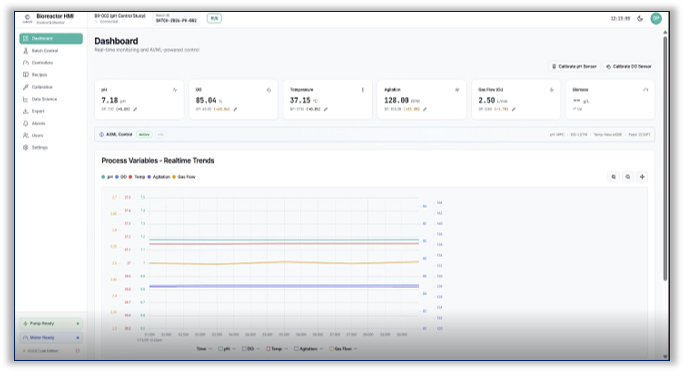
At the core of Cellcraft’s approach is the idea that modern bioreactors already generate large volumes of underutilized data. Rather than introducing new hardware, the system integrates with existing sensors and control software, drawing on signals such as pH, dissolved oxygen, temperature, agitation, and gas flow to infer what is happening at the cellular level.
“How much information is already in the bioreactor vessel that nobody is using,” Mishra said. “You have pH, dissolved oxygen, temperature, agitation, gas flow, etc, all being measured in real time. But conventional control systems use each of those signals in isolation to maintain a setpoint.”
“They're not combining them to infer what's actually happening to the cells,” Beurrier added. “The bioreactor is already telling you what’s happening inside it. The industry just hasn’t built a system that can listen properly.”
Bringing AI into real-world production
The platform is designed to fit into existing workflows rather than replace them, reflecting the practical constraints of industrial biomanufacturing environments. Cellcraft IQ operates in both advisory and fully automated modes, allowing teams to adopt AI-driven control incrementally.
“We have just started commercial deployments, and have found that many players are already interested in integrating AI into their bioreactors, but are not sure how to go about it due to a lack of AI expertise internally,” Mishra said. “By partnering with us, they can achieve this within a few weeks, without needing to spend years and millions on in-house AI system development.”
Early deployments have also shaped how the system is used in practice.
“We also found that some partners wanted to approve any changes made by AI before those changes were actioned,” Mishra said. “This is one of the reasons we have added an Advisory Mode on Cellcraft IQ.
“There’s an assumption going in that deploying an AI control system means a significant infrastructure project that entails the purchase of new sensors, new hardware,” he added. “In most cases, we’re just connecting to what’s already there.”
“Cellcraft IQ is an AI intelligence layer that integrates with the existing software and sits on top of it rather than changing or replacing it,” Beurrier said.
Integration typically takes between two and 12 weeks, depending on the existing setup, with the system able to begin generating useful recommendations early in deployment.
Why consistency matters at scale
Performance gains have centered on stability and precision, two factors that underpin both efficiency and scalability in bioprocessing.
“We have seen our biggest gains so far in consistency go hand-in-hand with efficiency,” Mishra said. “Before you can optimize yield or scale a process, you need runs that are reproducible and comparable to each other.”
Internal data showed a 90% reduction in overshoot, a 19% reduction in rise time, a 45% reduction in settling time, over 99% reduction in steady-state error, and a 98% reduction in control variance.
“In simpler terms, this means that our system is reaching optimal conditions much faster and is actually keeping them optimal with lower variation and higher precision,” Beurrier said. “As a result, it is more efficient too, as energy and resources are not lost from inaccuracy.”
Those improvements carry implications beyond process performance. Greater consistency can support regulatory validation, reduce development timelines, and improve confidence in scaling decisions.
“Consistency also builds the foundation for all other gains such as yield and cost improvements,” Mishra said. “All this translates to improved batch-to-batch consistency, which not only enables scaling with confidence, but also helps with regulatory considerations and investor conversations.”
The system also shifts how operators interact with bioreactors, moving away from continuous monitoring toward more structured decision-making.
“A bioreactor run with Cellcraft IQ can be set up in mere minutes and we have made it similar to standard bioreactor software to make it intuitive and easy to adopt,” Beurrier said. “In Advisory Mode, the operator still makes the calls. But instead of watching trend lines and reacting when something goes wrong, they're reviewing recommendations from IQ and deciding whether to act.”
“The practical change we expect is that people spend less time at the bench watching the bioreactor,” Mishra said. “They check in, review what IQ has been doing, look at the trend data, and move on.”
The economics of process control
As production scales, the economic impact of process control becomes more pronounced, particularly in relation to batch failure and media utilization.
“As production volumes increase, the gains from Cellcraft IQ are even higher in each run, as its optimizations can save a lot more costs and resources, and every percentage of yield improvement matters a lot more,” Mishra said. “Most companies assume batch failure rates between 5 and 10%. As a single large-scale batch can cost hundreds of thousands of dollars, reducing batch failures can save millions.”
“Media is a dominant cost driver, so improving conditions for cells to use media more efficiently, or any reduction in failed batches that write off a full media load, compounds quickly,” Beurrier said. “Cellcraft IQ's real time control directly affects both of those.”

External partners have pointed to the broader implications of combining AI with existing bioprocess infrastructure.
“The integration of AI and biosensor technology represents a transformative advancement of bioreactors, delivering optimized performance with greater efficiency,” said Dr. Rachel Hewitt, Assistant Research Professor at the University of Cambridge.
Adoption in regulated environments remains a key consideration, with the company emphasizing traceability and operator control as part of its design.
“21 CFR p11 compliance and full data traceability are offered so that teams can continue to get the standardized data they are familiar with and can also have visibility and understanding of the AI optimizations,” Mishra said. “Trust is built incrementally and has to be earned through the system's performance, not just through explanation.”
“The near-term shift is from AI as an analytical tool, something you use to understand data after a run, to AI as an automation and operational layer that is running the process,” he said. “AI bioreactor control will become the standard for bio-manufacturing.”
“Our long-term vision is an AI-powered, autonomous turnkey bio-factory, a facility that self-optimises from cell seeding to harvest, reducing the distinction between process development and production.”

Join Us At One Of Our Upcoming Events

If you have any questions or would like to get in touch with us, please email info@futureofproteinproduction.com


