Can GenAI transform biomanufacturing? It’s complicated

Omri Schanin of Algocell explores whether generative AI can finally deliver on biomanufacturing’s promise – and why validated process models remain essential to turning AI potential into practical results
Only a few years ago, a major transformation in food production appeared imminent. A 2019 analyst report, Rethinking Food & Agriculture, predicted that precision-fermentation protein would fall below US$10 per kilogram by 2025, helping make animal-derived proteins uncompetitive. One of the key assumptions was the central role of AI in improving microbial-strain design, optimizing fermentation, and accelerating scale-up.
Despite advances, AI has not yet delivered on its promise within bioprocessing, and widespread disruption of the food supply chain never occurred.
Today, we find ourselves in a similar position. The rapid emergence of generative AI has renewed expectations of far-reaching change across software development, customer service, and knowledge management. As biomanufacturing enters a new cycle of AI investment, the harder question is whether GenAI will overcome the limitations of earlier approaches – or simply create another gap between expectation and impact.
This article examines the potential and limitations of GenAI in bioprocessing and sets out guiding principles for where it can credibly reshape bioprocess development.
The shift to language: What makes Generative AI different?
Generative AI, specifically large language models (LLMs), allows users to retrieve, summarize, write code, and organize information through natural-language interaction. This differs fundamentally from the machine learning (ML) of the previous decade. Earlier analytical systems were narrow, built to predict a single process variable or identify anomalies, and required deep data science expertise. GenAI provides a broader interface that works across documents, code, databases, and analytical tools, allowing engineers to query dispersed data such as academic papers, lab notes, batch files, and scripts.
GenAI creates value and brings risk
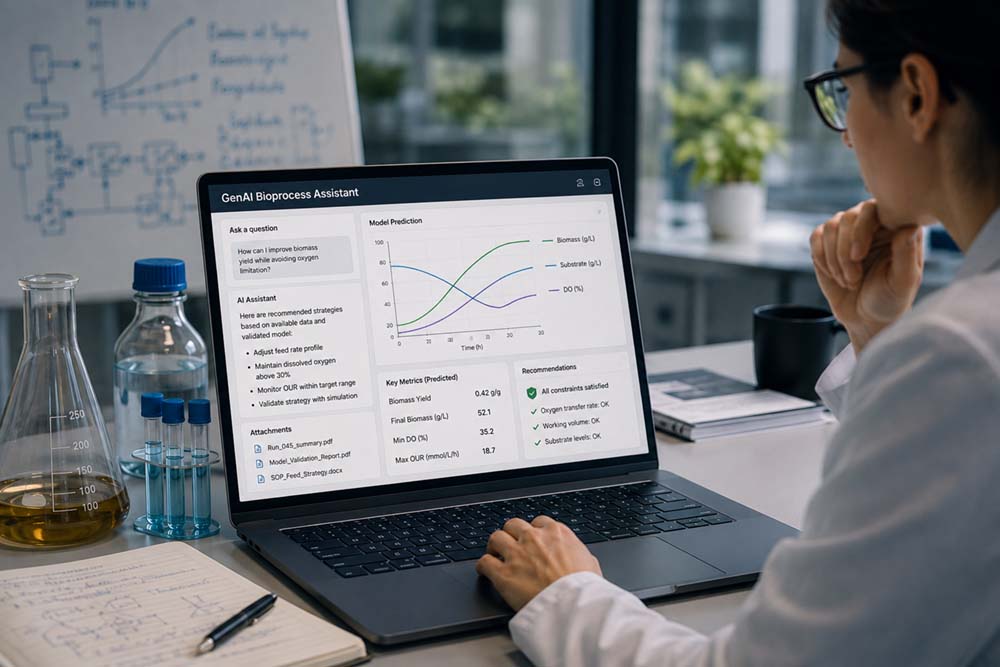
In process development, GenAI can turn scattered records into searchable knowledge. Using retrieval-augmented generation (RAG), an LLM can search approved internal folders, extract historical data, and compare previous runs through natural language. It can also generate code and draft initial batch reports.
However, these capabilities must not be confused with biological modeling. An LLM generates plausible language based on patterns, but it does not inherently understand the physical laws governing time-series behavior. It does not inherently enforce conservation laws, mathematical balances, or equipment constraints. Consequently, standalone LLMs can produce technically convincing recommendations that rely on incorrect assumptions or physically impossible operating conditions.
A 2024 study explained that because language models generate responses one token at a time, they are fundamentally unsuited to multi-step numerical calculations; minor early mathematical errors compound exponentially. In fermentation, where biomass, substrate consumption, and oxygen demand dynamically influence one another, standalone LLMs cannot reliably calculate feed profiles. Without a connection to a validated physical model, an LLM cannot determine if a proposed strategy will cause substrate accumulation, exceed oxygen-transfer limits, or violate working-volume constraints. The recommendation remains quantitatively unverified.
Adoption is moving faster than impact
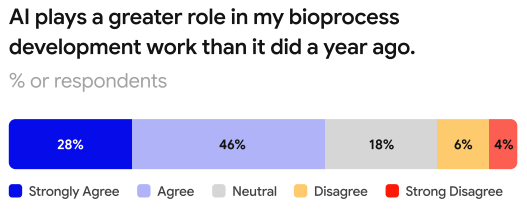
This tension is critical as AI adoption accelerates. A mid-2026 Algocell survey of 124 bioprocessing professionals highlights a paradox: the AI footprint is expanding rapidly, yet performance lags behind expectations.
The survey found that 74% of respondents reported AI playing a greater role in their work than a year prior, and 76% stated that AI tools were already embedded in their workflows.
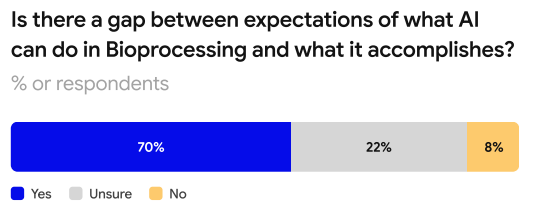
Yet only 8% reported no gap between expected and actual performance.
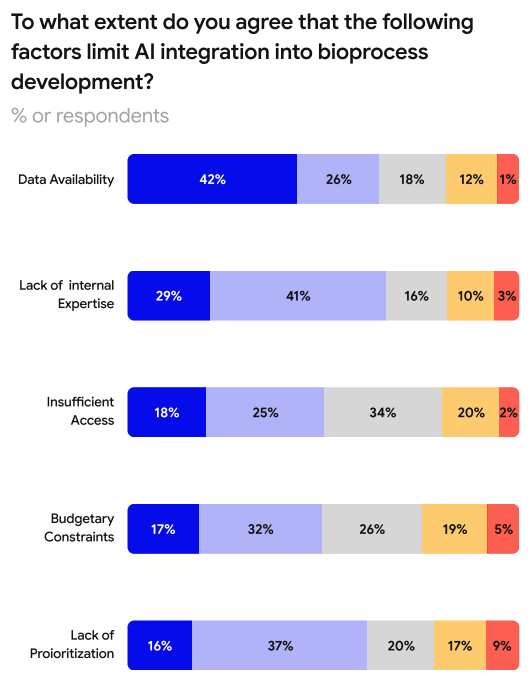
This gap is driven by operational bottlenecks rather than budget constraints. Respondents identified a lack of internal expertise (70% agreement) and poor data availability (68% agreement) as the primary barriers, whereas budgetary constraints (49%) and organizational prioritization (53%) were minor concerns.
To bridge this gap, companies are looking inward. Instead of seeking scarce external AI specialists, there are efforts to prioritize internal data management optimization (81% agreement) and upskilling existing engineers (71%). This highlights GenAI’s true role. It should serve as a natural-language bridge, enabling upskilled engineers to query and control the complex databases and physical models that hold the actual ground truth.
Why hybrid models define the source of truth
GenAI is only as useful as the intelligence sitting behind its interface. In a robust bioprocess architecture, documents provide recorded knowledge and databases store raw experimental data. Analytical tools perform calculations, while process models predict behavior. GenAI acts as the common interface connecting them. While approved documents and databases are sufficient for knowledge retrieval, they cannot handle quantitative prediction. That requires a model capable of representing the physical and biological process itself.
Mechanistic models describe biological and engineering relationships mathematically, representing how substrate is consumed, biomass grows, and oxygen is transferred over time while enforcing conservation laws. This is vital because a recommendation must be physically feasible. Increasing a feed rate may support faster growth, but it can also exceed the bioreactor’s oxygen-transfer capacity or cause substrate accumulation.
Because mechanistic models cannot fully represent biological variation, hybrid models combine mechanistic equations with machine learning. The mechanistic component represents known process boundaries, biological phenomena, and engineering constraints, while the machine learning component captures physical rates, correlations, and metabolism that are difficult to define through equations. Built and validated using actual process data, the hybrid model produces the quantitative prediction; GenAI then helps scientists access, interrogate, and interpret it.
Three conditions for GenAI to deliver value
For GenAI to transition from a popular novelty to a tool that actually improves biomanufacturing, it must meet three practical conditions:
1. Translating Everyday Language into Model Settings: GenAI should bridge the gap between human intent and complex software. A bioprocess engineer’s bottleneck is the time required to turn a biological goal (“feed the culture slowly so we don’t run out of oxygen”) into the rigid code or math required by software models. GenAI is highly effective as a translator, taking natural language and instantly configuring it into the precise settings that an underlying process model needs to run a simulation.
2. Fact-Checking Against Process-Specific Physics and Biology: A language model on its own does not understand real-world constraints. Because biology is inherently variable, every process operates within its own unique design space, metabolic rates, and distinct biological phenomena. Any AI recommendation (such as a nutrient-feeding schedule) must be automatically checked against the specific process boundaries before an engineer ever sees it. The system must verify that the strategy respects both physical equipment limits (e.g., bioreactor volume, oxygen-transfer capabilities) and the precise biological limits of that specific system.
3. Reducing Expensive Lab Trials: In biomanufacturing, the only two metrics that matter are whether the technology reduces the number of costly, time-consuming physical lab runs and whether we can push the biology to provide better gross margins. If connecting a conversational AI to a process model allows an engineering team to successfully optimize a fermentation run in two physical trials instead of six, it has delivered direct, undeniable commercial value.
Conclusion: Is it different this time?
The unmet expectations of the 2019 Rethinking Food & Agriculture report stem from a basic misunderstanding of what it takes to scale up biological systems. For years, the industry operated under a tech-startup mindset, focusing primarily on strain design.
Today, the metrics of success have changed. According to a 2026 report, the industry has entered a make-or-break era, and companies are judged on concrete metrics of scale: bioreactor capacity, metric tons of output, and actual cost in dollars per kilogram. There is now a move away from trying to replace bulk commodity proteins (like cheap meat and dairy) and toward focusing on high-value functional ingredients (like novel sweeteners or proteins) that can be scaled profitably using existing infrastructure.
This is where GenAI can help, provided we change our expectations. Asking standalone language models to autonomously design feeding strategies or manage fermentation runs will only repeat the failures of the last decade.
The true breakthrough of GenAI is not that it invents new science, but that it democratizes the engineering models we already have. By acting as a simple, natural-language interface, GenAI can put complex, validated process data directly into the hands of those running these massive systems.
The future of biomanufacturing will be driven by upskilled engineers using GenAI to query data, test physical scenarios, and scale up production with fewer failed batches while being able to understand and capture the full design space of their biological systems. It is a narrower, more practical promise, but it is the only one that will deliver cost-competitive biological products to the market.
Omri Schanin is Co-founder & CEO of Algocell, a biotechnology software company developing AI-powered tools for bioprocess development and optimization. His work focuses on combining mechanistic modeling, machine learning and process data to help biomanufacturing teams improve fermentation performance, reduce experimental workloads and accelerate scale-up
If you liked this, check these out...
• AI, fermentation and GLP-1: Cargill outlines its future food priorities
• Inaara NeoFoods raises US$2.4 million seed round to scale AI-driven farm-to-formulation plant protein platform
• Proxy Foods AI raises US$6 million seed round to expand AI platform for food and beverage R&D

Join Us At One Of Our Upcoming Events

If you have any questions or would like to get in touch with us, please email info@futureofproteinproduction.com