

Beyond Meat crunches the numbers on Beyond Burger IV’s climate footprint

Beyond Meat has released a new life cycle assessment for its Beyond Burger IV alongside its 2024 Corporate Responsibility Report, placing the environmental performance of its flagship product at the center of its latest disclosures.
The assessment compared the fourth-generation Beyond Burger with an industry average US beef patty and estimated substantial reductions across land use, water consumption, greenhouse gas emissions and non-renewable energy demand. The study was conducted in line with ISO recommendations and underwent a third-party critical review, according to the company.
Ethan Brown, Founder, President and CEO of Beyond Meat, said the findings reflected the company’s long-standing ambition to rethink how meat is produced. “Beyond Meat champions a better food system, one where taste, nutrition, and value align to drive progress in human health, climate, environment, and animal welfare,” Brown said.
According to the life cycle assessment, Beyond Burger IV required 97% less land use than an industry average US beef patty. Land use remains one of the most scrutinized aspects of beef production, given the scale of pasture and feed crops associated with cattle farming and the resulting pressure on ecosystems.
Water consumption was also markedly lower. The study estimated that Beyond Burger IV required 92% less water than its beef equivalent. Water use has become an increasingly prominent concern for food producers as climate variability and competing demands place strain on freshwater resources in many agricultural regions.
Greenhouse gas emissions represented another major point of contrast. The assessment estimated that Beyond Burger IV generated 88% less greenhouse gas emissions than an industry average US beef patty. Beef production is widely recognized as one of the most emissions-intensive forms of animal agriculture, driven by methane emissions from cattle as well as feed production, manure management and land-use change.
The study also examined non-renewable energy use, estimating that Beyond Burger IV required 28% less non-renewable energy than conventional beef. While plant-based meat production involves industrial processing, the analysis suggested that overall fossil energy demand remained lower across the full life cycle.
Brown said the findings reflected a deliberate effort to balance nutrition and environmental performance. “We balance our commitment to health with our commitment to the environment,” he said. “Our life cycle assessment for the Beyond Burger IV estimated that compared to an industry average U.S. beef patty, our new burger uses 97% less land, 92% less water, generates 88% less greenhouse gas emissions, and uses 28% less non-renewable energy compared to an animal-based beef patty.”
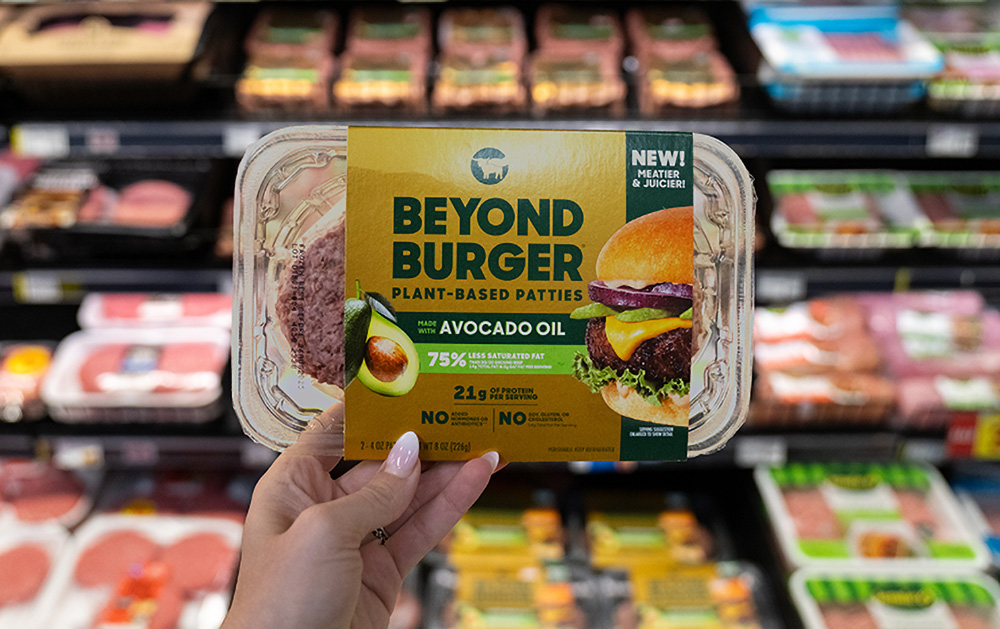
The assessment focused on Beyond Burger IV, which launched in 2024 and is now made with avocado oil. According to Beyond Meat, the reformulation was part of a broader effort to improve nutritional profile while maintaining taste and texture. The company said the fourth-generation burger contained two grams of saturated fat per serving and was designed to meet the standards of certain national health organizations.
Brown said the product represented the latest step in a longer development journey. “Over 16 years ago, we began by marrying innovation with plant proteins to deliver great tasting plant-based meats,” he said. “Today, we continue to chase perfection, and in 2024, we launched the fourth generation of the Beyond Burger to acclaim from leading nutritionists and health organizations.”
Beyond Meat said Beyond Burger IV was the first plant-based meat product to be Clean Label Project Certified and noted continued consumer recognition for the product. Brown said the Beyond Burger was ranked the number one best vegan burger by consumers for the seventh year running in a 2025 VegNews survey.
The life cycle assessment formed part of Beyond Meat’s broader approach to substantiating environmental claims with standardized analysis. The company said it periodically conducts LCAs to measure impacts from cradle to distribution and to compare its products with animal-based equivalents, with the Beyond Burger IV study intended to reflect its current retail formulation.
Beyond Meat emphasized that the beef comparator used in the assessment reflected an industry average US beef patty rather than a specific production system. Industry averages are commonly used in LCAs but can encompass a wide range of farming practices with varying environmental profiles.
Alongside the product-level assessment, the company disclosed that it submitted environmental data to CDP for the first time in November 2025. CDP operates a global disclosure system used by investors and companies to assess climate-related performance and risk.
Brown said the company viewed detailed, third-party-reviewed analysis as essential to how it communicates the environmental performance of its products, particularly as scrutiny of sustainability claims across the food sector continues to intensify.
Beyond Meat also pointed to its efforts to counter what it described as persistent misconceptions around plant-based meat. “We also aim to dispel misinformation about plant-based meat, which unfortunately has become widespread from incumbent industries that fear any challenge to the status quo,” Brown said.
As part of that effort, Beyond Meat released a short film titled Planting Change, which debuted in 2025. Brown said the film had garnered more than three million views on YouTube by December 2025 and featured medical and nutrition experts, climate advocates, historians and multi-generational farmers discussing the role of plant-based protein.
While the Corporate Responsibility Report covered a wide range of environmental, social and governance topics, Beyond Meat positioned the Beyond Burger IV life cycle assessment as a clear example of how product-level data fits within its wider environmental strategy, anchoring sustainability claims in documented and independently reviewed analysis.

Join Us At One Of Our Upcoming Events

If you have any questions or would like to get in touch with us, please email info@futureofproteinproduction.com


