

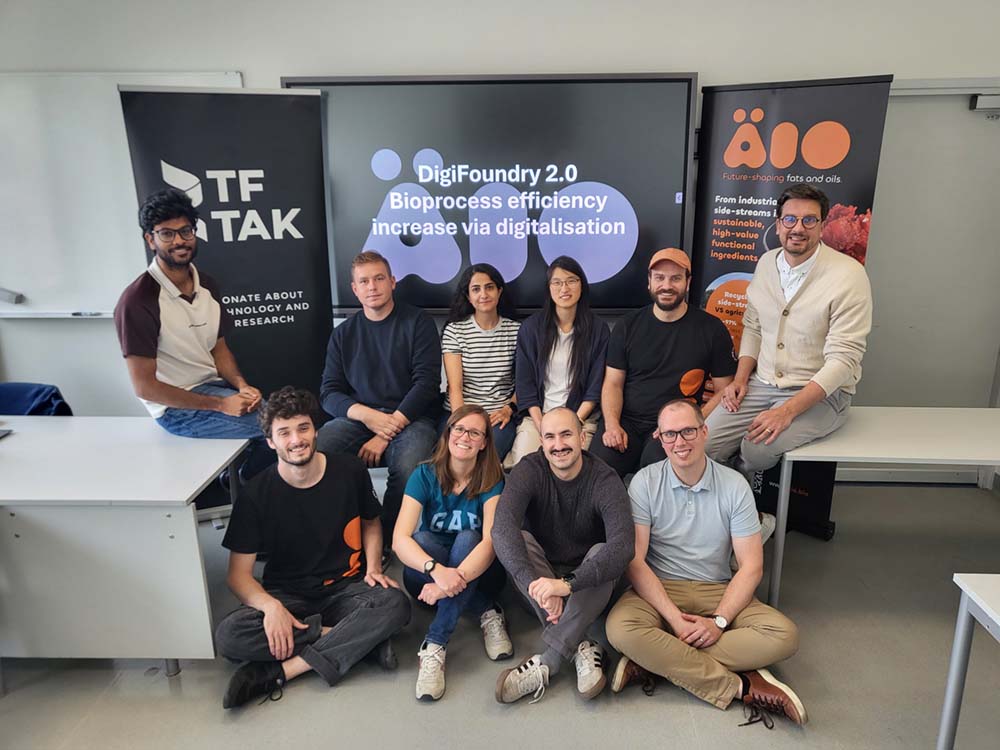
ÄIO and TFTAK secure €1.94 million to cut microbial oil production costs

Estonian biotechnology company ÄIO and applied research organization TFTAK have secured €1.94 million in public funding for a three-year project designed to improve the economics and scalability of microbial oil production.
• ÄIO and TFTAK secured up to €1.94 million through Estonia’s Applied Research Programme for DigiFoundry 2.0, which has a total budget of approximately €2.53 million.
• The partners will integrate strain development, fermentation, automation and digital process control to reduce development and manufacturing costs for fermentation-derived oils and fats.
• The project followed ÄIO’s first ton-scale production run and previous scale-up programs targeting industrial manufacturing, regulatory readiness and lower production costs.
The DigiFoundry 2.0 – Bioprocess Efficiency Increase via Digitalisation (DF2.0) project will run until June 2029 and aims to establish an integrated biomanufacturing platform capable of converting food and wood industry side-streams into oils and fats for food, cosmetics and other consumer applications.
Funding was awarded through the Applied Research Programme of the Estonian Business and Innovation Agency (EIS), backed by the Estonian Ministry of Economic Affairs and Communications. The project has a total budget of approximately €2.53 million, with a maximum contribution of €1.94 million from EIS. ÄIO said its application ranked first among projects approved in the program’s 10th funding round.
DF2.0 follows the original DigiFoundry collaboration between ÄIO and TFTAK, which ran from 2023 to 2026 and developed a prototype platform for automated microbial strain design alongside a Design-Build-Test-Learn cycle for microorganisms producing specialized fats through precision fermentation.
The new program will extend that approach across the production process, connecting biological development with fermentation optimization, automation and digital process control.
“With DigiFoundry, we built the foundation. With DF2.0, we are connecting biology, fermentation and digitalisation into one integrated production system,” said Petri-Jaan Lahtvee, Co-founder and COO of ÄIO and Professor at Tallinn University of Technology.
“Our goal is to make microbial oil production not only sustainable, but also highly efficient and economically competitive at an industrial scale. By combining improved fermentation with automation and data-driven process development, we can learn faster, optimise faster, and ultimately produce better ingredients with fewer resources.”
The latest funding adds another component to ÄIO’s scale-up strategy. In September 2025, the company [produced its first ton of yeast-based oil alternative], completing a 300-fold scale-up from its laboratory capabilities. At the time, CFO Martin Mets said ÄIO had reduced unit costs by 80% through scale and process optimization.
ÄIO has also been developing its technology outside food. In July 2025, it [secured €1 million to develop fermentation-derived oils for cosmetics and personal care], targeting alternatives to ingredients including palm oil, coconut oil, animal fats and petroleum-derived mineral oils.
Together, the programs address different parts of the company’s route toward commercial manufacturing: ingredient development and regulatory validation through FERM-OIL, application development in sectors including cosmetics, and now greater automation and digital control of the underlying bioprocess through DF2.0.
Founded as a TalTech spin-off in 2022, ÄIO uses microorganisms to convert low-value organic side-streams from the food, agricultural and wood industries into oils and fats. According to company data, its fermentation process can reduce land use by up to 97% and water consumption by up to 90% compared with conventional production methods.
A central part of DF2.0 will be connecting data generated across microbial performance, fermentation conditions, productivity and product characteristics. ÄIO expects greater automation and real-time process information to shorten development cycles, improve process control and make laboratory processes easier to reproduce at industrial scale.
“The future of biotechnology is not only about engineering better microorganisms. It is about creating smarter processes around them,” Lahtvee said. “If we can understand and control fermentation in real time, we can use resources more efficiently, reduce production costs and adapt the process much faster to different raw materials and products.”
TFTAK will contribute expertise in synthetic biology, precision fermentation and bioprocess development. Its work on the original DigiFoundry project included microbial screening, sensory analysis and methods for identifying unwanted flavors and aromas.
“DF2.0 brings together two areas that are essential for the next generation of industrial biotechnology: advanced biology and intelligent process development,” said Steven van der Hoek, Scientific Lead at TFTAK.
“By integrating synthetic biology, fermentation and digital tools, we can generate much more information from every development cycle and use that knowledge to make the next cycle better.”
The work comes as ÄIO continues preparations for larger-scale manufacturing. Following its first ton-scale run, the company said it was targeting a commercial facility capable of producing 2,000 tons annually and had completed pre-engineering concept work for the plant.
FERM-OIL, meanwhile, is intended to provide technical and regulatory groundwork for a potential 4,000-ton-per-year production facility.
DF2.0 adds process efficiency to that scale-up effort. By integrating strain development, fermentation and digitalisation, ÄIO aims to shorten the time required to develop new ingredients while lowering the cost of producing them at industrial scale.
“DF2.0 is about turning side-streams into the oils of tomorrow,” Lahtvee said. “With digitalisation and automation, we can make that transformation faster, smarter, and more competitive and build a new generation of ingredients produced locally from resources we already have.”
DF2.0 began on 1 July 2026 and will run until 30 June 2029.
If you liked this, check these out...
• Botaneco targets next-generation plant-based fats with expanded oilseed oleosome platform
• POS Biosciences study finds protein potential in borage oil byproduct
• NoPalm Ingredients named Food Planet Prize finalist for fermentation-based palm oil alternative

Join Us At One Of Our Upcoming Events

If you have any questions or would like to get in touch with us, please email info@futureofproteinproduction.com


