Pipettes to precision: Inside the tools driving the biorevolution

Maria Savino of Beckman Coulter Life Sciences explains how fermentation has shifted from ancient craft to precision science, and why the tools driving this biorevolution are reshaping the future of protein research
Maria Savino, Beckman Coulter Life Sciences’ Global Segment Development Manager – Biomanufacturing, still remembers the long nights during her PhD, painstakingly pipetting and cloning proteins. “What took me five years could now be done in five months,” she says, reflecting on the pace of change. The contrast is not just personal – it captures the transformation of an entire field.
Fermentation, once synonymous with beer brewing or bread baking, has become one of the defining technologies of the biorevolution. No longer the quiet work of farmers and food artisans, it is now precision science powered by automation, molecular biology, and industrial engineering. “Fermentation is no longer just a farm task, it’s a high-tech, precision-driven process,” she notes.
That process increasingly underpins the future of protein research. Traditional fermentation still matters – tempeh and yogurt prove that. But the real momentum lies with biomass fermentation, where microorganisms themselves provide protein, and with precision fermentation, where microbes are engineered into cell factories capable of producing everything from casein to colorants. “It is a powerful enabling technology that is increasingly driving innovations across the alternative protein industry,” she says.
From farms to biofoundries
Most consumers still think of fermentation in familiar terms – bread dough rising, cheese aging, beer fermenting in tanks. Yet the modern field looks very different. “Inputs such as sugars, starches, and biomass – even from waste – are no longer farm-specific. Outputs such as enzymes, proteins, and ethanol are now central to industries ranging from pharmaceuticals to sustainable materials,” Savino explains.
This leap from farms to biofoundries has been driven by necessity. Feeding a growing global population, coping with environmental constraints, and meeting market demand for faster, more sustainable innovation requires tools that are both high-tech and scalable. And in that transformation, Beckman Coulter Life Sciences has become a critical partner.
“Our vision is to empower those seeking answers to life’s important scientific and healthcare questions,” Savino continues. For decades, the company has supported agricultural and biotech innovation, from high-throughput plant genotyping to biomass processing. Its Biomek i-Series liquid handlers are essential in crop and seed development. Its centrifuge portfolio – from benchtop models to analytical ultracentrifuges – is indispensable for harvesting fermenters and clarifying products.
“I was always told by researchers that when they set up a lab from scratch, the first thing they need – and cannot do by hand – is centrifuging,” she remarks. “With liquid handlers, genomic reagents, flow cytometers, microbioreactors, and centrifuges you could almost have a complete biofoundry with Beckman solutions.”
Engineering microbes at scale
The heart of modern fermentation lies not only in managing processes but in reimagining organisms themselves. Advances in strain selection and engineering are reshaping what is possible, with biofoundries and companies such as Ginkgo Bioworks pushing the boundaries of design. Beckman Coulter’s contribution here is profound. “Our expertise in bioengineering and molecular biology positions us as a key player in upstream organism development, especially in alternative proteins,” Savino says. The Echo acoustic liquid handler, capable of transferring volumes as low as 25 nanoliters, is central to gene assembly and CRISPR screening. In combination with the Biomek workstations, it allows researchers to automate highly complex workflows, from clone generation to colony screening.

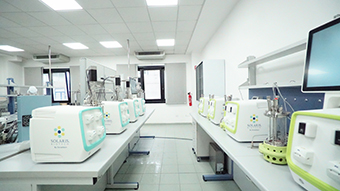
One major milestone was the acquisition of m2p-labs, developers of the BioLector XT microfermentation system. “The BioLector XT microbioreactor stands out for its ability to monitor biomass, pH, dissolved oxygen, and fluorescence in real time across up to 48 parallel cultures,” Savino explains. This enables researchers to screen strains with unprecedented throughput and reproducibility.
The impact on real-world research has been immediate. “Faced with a tight deadline, our team set out to develop a microbial consortium producing a complete product – lipids, carbs, and proteins – in a constrained medium,” recalls Professor Vijay Singh of the University of Illinois. “Enter the BioLector XT Microbioreactor. This tool enabled rapid parallel assays, smarter experimental design, and faster optimization. What would’ve taken six months, we achieved in just one.”
For Savino, this is the essence of Beckman’s approach: enabling scientists to meet ambitious goals with speed and confidence. “Our microbioreactor’s integration with automated liquid handling systems ensures reproducibility and scalability, making it a cornerstone for modern biofoundries and protein producers,” says Savino.
A career shaped by innovation
Savino’s own journey into this world began with the painstaking realities of early molecular biology. “During my PhD, I was the first in my lab to clone a protein with GFP and track it using a 4D microscope. Back then, every step was tedious – pipetting and patience were hand-in-hand with long hours at the bench.”
Her career took a decisive turn when she joined Labcyte, the company behind the Echo acoustic dispensing system. Originally designed for pharmaceutical screening, the Echo system’s potential quickly caught the attention of bioengineers. “When aqueous dispensing in 25nL drops became possible, researchers began using the Echo instrument for combinatorial gene design. Imagine assembling 384 combinations of promoters, enzymes, and termination sequences in minutes – what took me five years could now be done in five months!”
For Savino, though, the technology was not just a productivity tool but a symbol of how science itself was changing. “Where four months would have been used to write my memoir,” she jokes, “now researchers can generate the results instead.”
If Beckman’s technologies form the backbone of biomanufacturing, collaboration provides the lifeblood, and Savino points to partnerships demonstrating this spirit.
“About five to six years ago, I was contacted by Olivier Borkowski when he was back in France, after completing a PhD in the UK. Olivier was finishing his work for publication and needed access to the technology. I connected him with Fabrice Agou’s lab at the Institut Pasteur in Paris, which had just acquired an Echo instrument. Today, he’s published at least two papers, one co-signed with the Institut Pasteur, and works at INRAE, modeling cell-free transcription-translation with AI and testing it using their own Echo liquid handler.”
Fermentation is not just an old practice given new clothes – it is the engine of the biorevolution
The results have been striking. Borkowski’s team developed predictive models for protein production in cell-free systems using machine learning, enabling thousands of transcription-translation conditions to be simulated and optimized in silico. Other collaborations, such as the Nava et al. (2023) paper, have demonstrated how Beckman’s Echo and Biomek systems can streamline plasmid construction, accelerating cell-free protein synthesis. “This kind of collaboration is essential,” Savino says. “At Beckman, we don’t just sell solutions – we learn and grow with our customers. I train our sales teams to engage deeply with researchers, understand their workflows, and use this knowledge to develop applications and products to help scientists get better and faster results.”
Inspiring the next generation
For all the breakthroughs in tools and processes, Savino believes the real excitement lies in the people driving the next wave. Beckman Coulter Life Sciences has sponsored the iGEM competition for years, providing genomic reagents and technical support to student teams. “We’ve supported 30-40 teams worldwide with reagents ike CosMCPrep kits for plasmid extraction,” she says.

in protein R&D
“My generation and companies like Beckman are giving the tools to advance in science. This will enable new generations to make it happen and find solutions to today’s challenges in sustainability.”
She sees passion, creativity, and access to sophisticated tools as the foundation for breakthroughs in protein production, particularly scalable, animal-free ingredients. “Our automated workflow solutions – liquid handlers, analytical instruments – streamline R&D and production, enabling high-throughput, error-free processes,”
she says. “This accelerates innovation and helps companies meet the growing demand for animal-free products, ensuring consistent quality and faster time-to-market.”
Looking back on her own career, Savino recognizes how far the field has come in a short time. The progress is staggering. But she insists that the best is yet to come.
“I’m inspired by the energy of young scientists,” she says. “They are the ones who will take these tools and turn them into solutions we can’t even imagine yet. Fermentation is not just an old practice given new clothes – it is the engine of the biorevolution.”
And as her journey shows, giving scientists the right tools at the right time can make the difference between a slow process and a breakthrough that reshapes an industry.
For more information visit www.beckman.com
If you have any questions or would like to get in touch with us, please email info@futureofproteinproduction.com