From off-flavors to functionality: How TFTAK is redefining protein with fermentation

Sirli Rosenvald, R&D Director of Food Science at TFTAK, believes fermentation is poised to become a mainstream driver of affordable, resilient proteins
When Sirli Rosenvald talks about fermentation, she doesn’t treat it as a relic of the past. For her, the technique that gave us bread, wine, and cheese is also one of the most powerful levers to redesign global food systems. As R&D Director of Food Science at TFTAK – the Estonian center renowned for applied research in food innovation – she is working to push fermentation into entirely new territory.
“Efficiency is the first factor,” she explains. “We need to get more nutrients out of the resources we use – whether it’s land, water, or energy – while also reducing the carbon footprint. Fermentation has strong potential here, as it can help valorize materials that are currently underutilized.”
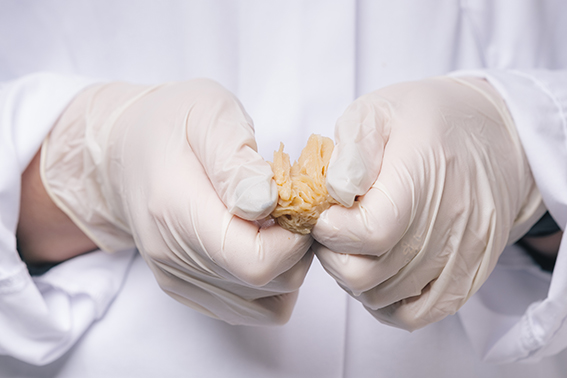
can improve water-holding capacity for a juicier product
But efficiency is only part of the story. As climate change and supply chain disruptions continue to test the resilience of food systems, Rosenvald argues that microbial innovation can provide a buffer against volatility. “Fermentation offers real potential to minimize risks and strengthen food security,” she says.
Despite a surge of investment in fermentation startups, public understanding lags behind. “For most people, fermentation is still associated with yogurt, beer, or wine,” Rosenvald notes. “But the reality is that there are millions – if not billions – of microorganisms out there, and even scientists are still uncovering their potential.”
That gap between perception and possibility is what drives TFTAK’s work. From screening novel strains to developing consumer-ready applications, the team is showing that fermentation can do much more than produce bubbles and sour notes – it can rewire how proteins are made, processed, and experienced.
Taming plant protein’s off-notes
If there is a recurring roadblock for plant-based foods, it’s flavor. Pea, soy, and faba bean proteins carry volatile compounds that conjure descriptors like ‘beany’, ‘green’, or ‘astringent’. Masking them with additives or heavy processing rarely satisfies.
“Fermentation really helps to reduce some of the most critical off-flavor molecules,” Rosenvald says. She categorizes them into two groups. Aroma compounds – volatile molecules such as aldehydes – produce grassy or pea-like notes. Taste compounds, including saponins and phytates, create bitterness or dryness. Both are hurdles for consumers, and both can be mitigated by microbes.
“Microbes have enzymes capable of reducing aldehydes into alcohols, which have much lower odor thresholds,” she explains. “You don’t perceive them sensorially.”
TFTAK goes further upstream than many expect. “The earlier you address these issues, the better,” Rosenvald says. That includes screening crop varieties with lower inherent off-flavor intensity – a subtle but critical step that improves ingredient quality before fermentation even begins.
Engineering function, not just flavor
For food producers, it isn’t enough to solve taste. Proteins also need to perform. “In plant-based yogurt, microbes that produce exopolysaccharides play a crucial role,” Rosenvald says. “These are carbohydrates that give thickness and improve the texture.”
The same applies to solubility, foaming, or gelation properties – functionalities that determine whether a protein isolate becomes creamy, fluffy, or fibrous. Rosenvald points to one experiment where textured pea or faba bean protein was combined with fungal biomass. “You not only gain nutritional benefits but also improve the water-holding capacity of the final material,” she says. “In practice, this means you can create a juicier product.”
Fermentation isn’t just an ancient craft – it’s a technology with the power to make proteins tastier, more nutritious, and resilient enough for the future
These improvements matter because consumers rarely tolerate compromises on texture. As Rosenvald puts it, “Functionality directly translates into better experiences in the final product.”
Taste and texture are visible, but digestibility is just as critical. “Fermentation can break down very complex protein molecules into smaller ones that are easier to digest,” Rosenvald explains. “It also reduces anti-nutrients, which further increases availability.”
The results are measurable. “You could see digestibility improve from around 50% up to 80%,” she says. “That’s a huge impact.” TFTAK uses in vitro digestion models to test this, simulating the human digestive process with enzymes and mapping amino acid absorption.

Again, fungal proteins add another layer of opportunity. By combining them with plant proteins, it’s possible to modify amino acid profiles and achieve a more complete nutritional picture.
Submerged versus solid-state
When it comes to scaling fermentation, no single process fits all. Submerged fermentation – the kind used in industrial tanks – is controllable and consistent, but resource-intensive. “It demands a lot of energy and strict sterility,” Rosenvald says. “Still, the ability to deliver a highly controlled, consistent-quality ingredient is a huge advantage.”
Solid-state fermentation tells a different story. It’s less predictable, but it can tap directly into agricultural side streams – think bran, hulls, or other fibrous residues. “Tempeh is the classic example,” Rosenvald notes. “You’re not just producing biomass – you’re upgrading a substrate with microbial activity.”
That flexibility opens new doors, but it also comes with variability. “The key is to determine which parameters must be standardized,” she explains. Carbon-to-nitrogen ratios, carbohydrate content, and inhibitory compounds must all be monitored to stabilize outputs.
Complementary, not alternative
Rosenvald resists the binary framing of ‘alternative proteins’. Instead, she sees complementarity. “The goal should be to diversify our options and mitigate risks,” she says. “Fungal biomass proteins, for example, tend to be very neutral in taste compared to many plant proteins, and they’re less vulnerable to climate-related disruptions.”
Combining categories – plant with fungal, or even microbial with animal – creates what she calls “hybrid opportunities”. The point is not to replace but to enhance.
“By taking the best aspects of each category and building products around them, we can improve functionality and bring consumers along with new technologies.”
The economics of application
Not all uses demand the same quality. For meat alternatives, fibrous textures are essential. That means slower growth and higher complexity. For pet food, a powder form may suffice – lowering costs.
“It really comes down to balancing the quality required for each application while always keeping cost in mind,” Rosenvald says. “The aim should be to optimize for the minimum cost possible without adding anything unnecessary or expensive.”
Precision fermentation follows the same logic. Producing enzymes, colorants, or functional molecules only makes sense if they work in small quantities with high efficiency. “You need to identify the key pain points you want your ingredient to solve – and focus only on those,” Rosenvald says.
Color illustrates the point vividly. “We developed a salmon fillet from plant protein, and one of the biggest challenges was the color,” she recalls. Raw salmon is dark orange but lightens when cooked. “Most coloring agents do the opposite – they get darker when heated. It would be a real breakthrough to develop colorants that mimic the way animal proteins naturally change.”
Blurred boundaries
In Rosenvald’s view, the boundaries between biomass fermentation and precision fermentation are porous. “It can be difficult to draw a clear line,” she says. “Are we talking only about highly functional molecules, or does biomass fermentation also count when you target a specific fatty acid profile?”
In practice, TFTAK often combines approaches – using biomass fermentation for base nutrition, then applying precision fermentation to fine-tune flavors or colors. “The real opportunity lies in thinking outside the box,” she emphasizes.
A recurring challenge in R&D is managing timelines. “Our main business is supporting partners, and most of them want very fast results,” Rosenvald says. That might mean starter cultures or flavor tweaks ready for immediate use. But TFTAK also invests in longer-horizon strain screening or breakthrough technologies.
“It’s the struggle of our everyday work,” she admits. “We develop technologies not only for today’s needs but also to prepare for what’s coming next.”
The AI factor
Data-driven tools are beginning to reshape how fermentation R&D is conducted. “AI is very powerful, but to use it effectively you need a deep understanding of the process itself,” Rosenvald cautions. Models are only as strong as the data inputs, so precision in measurement is non-negotiable. “With high-quality data, AI and modeling can really unlock new possibilities for strain selection and process optimization.”

Asked to project forward a decade, Rosenvald points to two levers: biomass fermentation, naturally, but also strain engineering. “As more knowledge becomes available, it will be easier to set up these technologies and build factories around them,” she says. “Greater availability will also help build trust among consumers and stakeholders.”
Strain engineering, meanwhile, offers a route to scale and affordability. “This is how we can truly bring down costs, improve efficiency, and enable the use of different substrates,” she argues. “It allows us to speed up processes, trigger the production of molecules we want, and suppress the ones we don’t.”
Put together, these forces could shift fermentation from niche to normal. “I’m quite sure that fermented proteins will become a mainstream protein source – essentially a commodity,” Rosenvald concludes. “Of course, reaching that point will require significant investment in infrastructure. But I believe they have what it takes to move firmly into the mainstream.”
For more information visit www.tftak.eu
If you have any questions or would like to get in touch with us, please email info@futureofproteinproduction.com