University of Texas scientists grow chickpeas in simulated moon soil, opening path to lunar agriculture

Scientists at the University of Texas at Austin have successfully grown and harvested chickpeas in simulated lunar soil, offering new insights into how crops could one day be cultivated on the Moon.
The research, conducted in collaboration with Texas A&M University and published in the journal Scientific Reports, explored how plants might survive in lunar regolith, the dusty surface material that covers the Moon. As NASA prepares for future missions under its Artemis program, including Artemis II, researchers are increasingly examining how astronauts could produce food during long-term lunar exploration.
• Researchers from the University of Texas at Austin and Texas A&M University have successfully grown and harvested chickpeas in simulated lunar soil.
• The study demonstrated that plants could grow in mixtures containing up to 75% lunar soil simulant when supplemented with vermicompost and beneficial fungi.
• The work has been supported by a NASA FINESST grant and has been published in the journal Scientific Reports.
The team selected the ‘Myles’ variety of chickpea for the study due to its compact size and resilience, qualities that could make it suitable for crop production in the confined environments expected during space missions.
Sara Oliveira Santos, principal investigator of the project and a distinguished postdoctoral fellow at the University of Texas Institute for Geophysics at the Jackson School of Geosciences, said the research represented a significant step toward understanding whether crops could be grown beyond Earth.
“The research is about understanding the viability of growing crops on the moon,” Santos said. “How do we transform this regolith into soil? What kinds of natural mechanisms can cause this conversion?”
Lunar regolith differs substantially from terrestrial soil. It lacks the microorganisms and organic matter that support plant life on Earth, and while it contains several minerals and nutrients required for plant growth, it also includes heavy metals that can be toxic to plants.
To recreate lunar conditions, the researchers used a simulated lunar soil developed by Exolith Labs. The material models the chemical composition of lunar samples returned by the Apollo missions.
Because regolith lacks the biological and organic components needed to sustain plant growth, the researchers supplemented the simulant with vermicompost. Produced by red wiggler earthworms, vermicompost is rich in nutrients and contains a diverse microbial community.
The use of vermicompost also reflects the potential for recycling organic waste during space missions. Earthworms produce the material by consuming organic matter such as food scraps, as well as cotton-based clothing or hygiene products that could otherwise become waste in closed-loop mission systems.
Before planting, the researchers coated chickpea seeds with arbuscular mycorrhizal fungi. These fungi form symbiotic relationships with plant roots, helping plants absorb nutrients while also reducing the uptake of harmful heavy metals.
The scientists then planted the chickpeas in mixtures containing different proportions of simulated lunar soil and vermicompost.
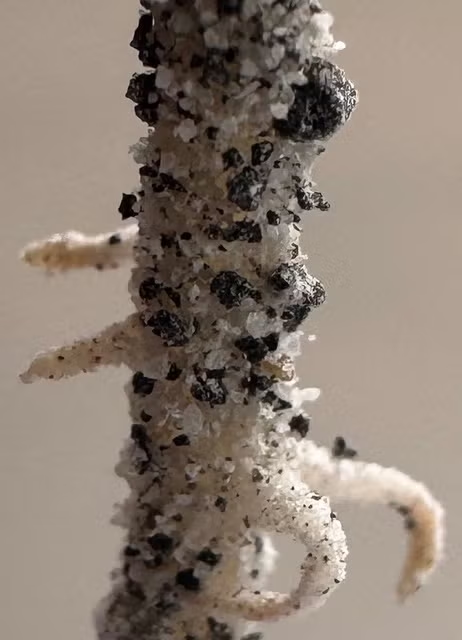
The experiments showed that plants grown in mixtures containing up to 75% lunar soil simulant were able to produce harvestable chickpeas. However, higher concentrations of lunar soil led to visible stress in the plants and shortened lifespans.
Even under these more challenging conditions, the plants treated with fungi survived longer than those grown without fungal inoculation. The researchers also observed that the fungi were able to colonize and survive within the simulated lunar soil.
This finding suggested that beneficial microbes could potentially be introduced once into a lunar agricultural system and then persist within the growing environment.
Growing crops in regolith presents numerous challenges beyond the absence of organic material. Lunar soil particles are sharp and abrasive, with glass-like structures formed by billions of years of meteorite impacts. These properties make the material difficult for plant roots to penetrate and retain water.
To address hydration challenges, the team developed a cotton wick-based irrigation system designed to deliver water directly to the root zone. The system helped maintain consistent moisture levels in the growing medium despite the unusual physical properties of the simulant.
Although the researchers successfully harvested chickpeas, several questions remain before such crops could become a reliable food source for astronauts.
Jessica Atkin, first author of the paper and a doctoral candidate in the Department of Soil and Crop Sciences at Texas A&M University, said further work will focus on evaluating the safety and nutritional value of the crop.
“We want to understand their feasibility as a food source,” Atkin said. “How healthy are they? Do they have the nutrients astronauts need? If they aren’t safe to eat, how many generations until they are?”
One key concern is whether the chickpeas absorb harmful metals from the lunar soil simulant during growth. Determining the presence and concentration of any such contaminants will be necessary before considering the crop suitable for human consumption.
The findings contribute to a growing body of research aimed at developing sustainable food systems for space exploration. Producing food directly on the Moon could reduce the need to transport supplies from Earth, lowering mission costs and increasing the viability of long-duration stays.
While the research was initially funded by Santos and Atkin, the project has since received support from a NASA FINESST grant, which funds graduate student-led research related to future space exploration.
For now, the successful harvest represents an early but important step toward understanding how agriculture might function beyond Earth.
(Main picture: The researchers chose the ‘Myles’ variety of chickpea for this study. Its compact size and resiliency support crop production in space-limited mission environments)

Join Us At One Of Our Upcoming Events

If you have any questions or would like to get in touch with us, please email info@futureofproteinproduction.com

More News