New Wave Biotech and iMEAN unite to eliminate costly bioprocess blind spots

New Wave Biotech and iMEAN have joined forces to tackle one of biomanufacturing’s most persistent and expensive challenges: the disconnect between upstream design and downstream reality.
The partnership brings together iMEAN’s metabolic modeling and bioprocess simulation capabilities with New Wave Biotech’s downstream optimization, techno-economic analysis (TEA), and life cycle assessment (LCA), creating a combined offering designed to evaluate full process performance from the earliest stages of development.
• New Wave Biotech and iMEAN partnered to integrate upstream metabolic modeling with downstream process optimization, TEA, and LCA into a unified offering.
• The companies reported prior results including up to 8.6x yield improvement, 55% cost reduction, and 92% fewer experiments in process development.
• The collaboration aimed to enable earlier assessment of cost, scalability, and sustainability to reduce scale-up risk and rework.
Bioprocessing is shaped by a web of tradeoffs. Adjustments to feed strategies, residence time, or downstream processing sequences can ripple across yield, cost, and environmental performance. Yet these interactions are rarely explored holistically, often because doing so requires extensive experimentation, time, and infrastructure that many companies cannot access.
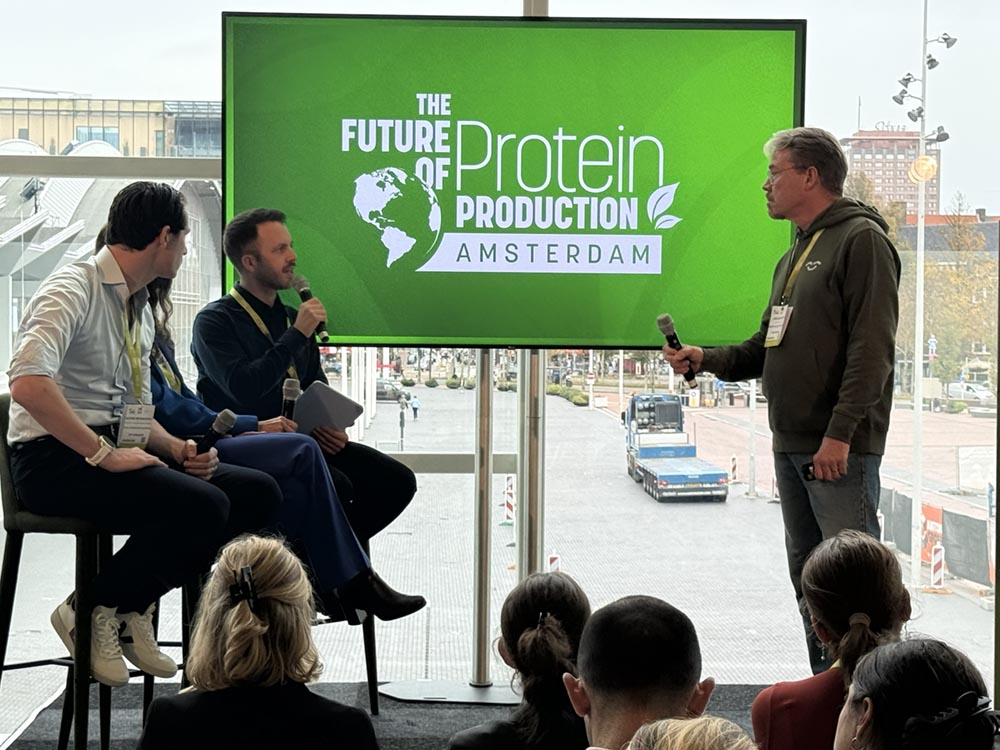
“In a field bottlenecked by infrastructure, the fastest route to scale begins on a screen, not on a stainless steel floor,” said Nix Hall, CTO & Co-founder of New Wave Biotech, describing the company’s broader approach to process development in a recent interview with Protein Production Technology International.
New Wave Biotech has developed its Bioprocess Foresight platform to simulate and optimize processes in silico, allowing developers to evaluate yield, throughput, cost, and sustainability simultaneously. Hall said this approach can reduce physical experiments by up to 92% compared to conventional design of experiments methods.
“We have developed Bioprocess Foresight, a software platform leveraging hybrid AI modeling to simulate and optimize bioprocesses in-silico,” Hall said. “This enables companies to evaluate yield, throughput, cost and sustainability in parallel, accelerating scale-up and de-risking R&D and investment decisions, allowing them to identify the biggest levers for improvement.”
The partnership with iMEAN extends this philosophy by linking upstream biological design more directly with downstream and economic constraints. Traditionally, these domains have been optimized separately, with upstream teams focusing on strain performance and downstream teams addressing purification and recovery later in the process.
That separation can lead to costly misalignment.
“The most expensive mistakes in bioprocess development happen when upstream and downstream teams can't see each other's constraints – and that's exactly the gap we're closing with iMEAN. We have the combined modeling capabilities and the customer results to back it up,” added Zoe Yu Tung Law, CEO of New Wave Biotech.
iMEAN’s CEO Rémi Peyraud pointed to a similar limitation in upstream-focused approaches. “Metabolic modelling tells you how to design a better organism and optimise the bioprocess, but it doesn’t tell you whether beyond this milestone that bioprocess leads to an economic process at scale. Finally, partnering with New Wave Biotech is a natural extension of our mission at iMEAN, to deliver high-quality, end-to-end services that accelerate and de-risk our customer’s R&D. Together, we enable companies to visualize the full picture from day one.”
For Hall, the need for integration reflects deeper limitations in existing modeling approaches. Traditional mechanistic models offer transparency but struggle with complex, poorly understood biological systems. Pure machine learning approaches, by contrast, can deliver accuracy but require large datasets and often lack explainability.
“We combine these two approaches, using a hybrid modeling technique that allows us to get the best of both worlds, creating an approach that is explainable while requiring only small amounts of data to produce highly accurate results,” Hall said.
Crucially, the platform extends beyond technical optimization to include economic and environmental dimensions.
“We also focus not only on the pure technical and process dynamics, but also zoom out and show the economic and sustainability impacts of processes,” Hall said. “This allows users to understand all sides of the problem and tailor their processes to meet their specific needs from the very first steps in process development.”
The companies pointed to previous project outcomes as evidence of the approach’s potential. New Wave Biotech reported achieving up to an 8.6x improvement in yield, alongside a 55% reduction in costs and a 92% reduction in experiments. iMEAN reported a 2.8x increase in titer and more than €600,000 (US$650,000) in R&D savings within six months.
One area Hall believes remains underappreciated is downstream processing, or DSP, which she described as central to commercial success.
“The sheer complexity of bioprocessing, particularly DSP, is often overlooked,” she said. “A DSP process can have hundreds of different parameters and variables to adjust, and the number of possible processes is near infinite. It’s also the stage that really makes or breaks a process, determining scalability, sustainability and unit economics.”
Despite advances in biology, infrastructure constraints continue to limit progress. Hall pointed to a lack of scaling capacity, particularly in the UK, as a persistent bottleneck for biotechnology companies.
“In both the UK and across the world, there’s a real lack of scaling support for many biotech companies,” she said. “Being able to do more with less is key to being able to scale despite the restrictions in capacity and infrastructure.”
In that context, the integration of upstream and downstream modeling is intended to act as a force multiplier, enabling companies to explore more process scenarios digitally before committing to physical trials.
For New Wave Biotech, the long-term goal extends beyond process efficiency. “Having a positive impact on the world is a thread that unites our team,” Hall said. “We see food security and sustainability as key challenges for the coming decades, and we want our platform to help as many vital innovations scale effectively and have real impact as possible.”
By linking biology, engineering, and economics into a single workflow, the partnership with iMEAN reflects a broader shift toward more integrated, data-driven bioprocess development, where fewer assumptions are left to chance and fewer resources are spent correcting them later.

Join Us At One Of Our Upcoming Events

If you have any questions or would like to get in touch with us, please email info@futureofproteinproduction.com

More News