
FPP/CMS Chicago 2026 Exhibitor Spotlight: Why seed preparation has become fermentation’s weakest link

Seed preparation has become one of the most expensive and failure-prone steps in fermentation-based food production. Swan Neck Bio’s approach focuses on simplifying that stage, drawing attention from both startups and large manufacturing partners ahead of The Future of Protein Production Chicago
When fermentation runs fail, the cause is often found at the very start of the process. Contamination, uneven growth, and lost batches frequently originate during seed preparation, before material ever reaches a production fermenter.

As fermentation-based food production pushes beyond the lab, that upstream step has become harder to treat as routine. Propagating organisms reliably, repeatedly, and at increasing volumes places pressure on teams that are already managing cost, timelines, and regulatory expectations. For many companies, seed preparation has emerged as a recurring source of delay and rework.
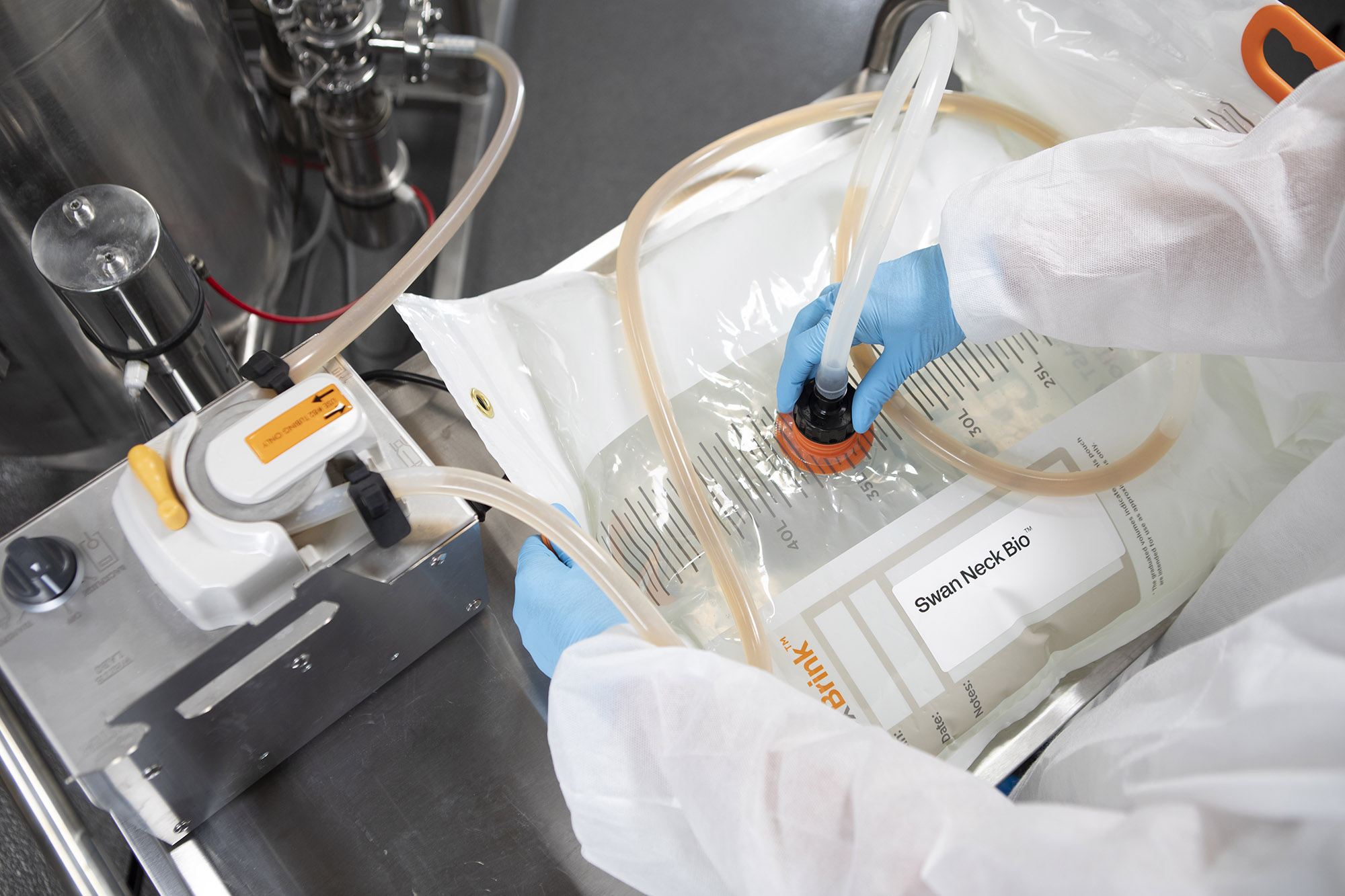
Swan Neck Bio was set up to deal with that problem directly. Based in Denmark, the company focuses on inoculum and seed train services intended to remove one of the most failure-prone stages of fermentation scale-up. Instead of requiring companies to propagate their own organisms through multi-stage seed trains, Swan Neck Bio supplies ready-to-use, quality-certified inoculum that can be added directly to production bioreactors.
That approach drew wider attention in September, when Tetra Pak announced a collaboration with Swan Neck Bio to incorporate its DIRINOC technology into the Tetra Pak New Food Technology Development Centre in Karlshamn, Sweden. The agreement centered on seed preparation, an area where both companies saw repeated operational challenges across fermentation projects.
DIRINOC, short for direct inoculation concentrate, allows companies to bypass traditional seed train infrastructure. The inoculum is concentrated, storable, and prepared under controlled conditions, reducing exposure to contamination and batch-to-batch variability. For producers, outsourcing this step removes the need to design, operate, and continuously adapt upstream propagation systems as processes evolve.
The appeal is largely practical. Seed trains take time to establish, require specialized expertise, and often need to be rebuilt as organisms or operating parameters change. When problems occur, the impact can extend across an entire production campaign. Removing that step can simplify operations, reduce waste, and make pilot and commercial runs more predictable.
Swan Neck Bio’s roots lie in White Labs Copenhagen, a fermentation specialist with a history stretching back to 1995. As a spin-off, the company built on that experience while narrowing its focus to food, ingredient, and biosolutions companies working at pilot and pre-commercial scale.
Alongside DIRINOC, the company developed FlexCell, a patented single-use bioreactor technology designed to support controlled fermentation runs from lab scale through to 1,000 liters. The system allows multiple conditions to be tested in parallel, enabling faster iteration without the capital costs associated with conventional pilot plants.
According to Swan Neck Bio, FlexCell has been used to generate starter cultures while reducing both time and cost compared with traditional approaches. The ability to run parallel experiments is intended to preserve flexibility during scale-up, allowing teams to adjust assumptions before committing to fixed infrastructure or long-term manufacturing contracts.
For startups and scale-ups, this can reduce reliance on early capital-intensive decisions or CDMO arrangements during product development. For larger companies and CDMOs, Swan Neck Bio provides services for handling and propagating inoculum, a labor-intensive step that can otherwise draw resources away from core production and formulation work.
The company works with a wide range of microbial species, including wild-type and genetically modified organisms. By remaining agnostic to organism type, Swan Neck Bio aims to support fermentation projects across food, nutrition, and functional ingredient applications, where specialized strains are increasingly common.
Its technical team brings experience from across food and biosolutions, including backgrounds at White Labs, Novonesis, Noma, 21st Bio, and the Novo Nordisk Foundation. That mix informs a service-led approach focused on process robustness, yield consistency, and operational repeatability rather than isolated performance metrics.
The collaboration with Tetra Pak highlighted a broader shift in fermentation scale-up. While early projects often adopted methods from pharmaceutical bioprocessing, food manufacturing brings different constraints around cost, hygiene, throughput, and reliability. Treating seed preparation as a service rather than an internal capability reflects a move toward more modular production strategies.
These questions are expected to surface repeatedly at The Future of Protein Production Chicago on 24 and 25 February. As companies plan first commercial facilities or reassess development pathways, decisions around inoculum preparation increasingly shape cost structures and risk profiles.
Swan Neck Bio will be exhibiting at Stand S2 in the Startup Showcase, offering attendees the chance to discuss how different seed strategies affect fermentation outcomes. Troels Prahl, Founder & CEO, will also be speaking as part of the conference program, bringing a microbiologist’s perspective shaped by more than two decades in fermentation science.
For companies working to reduce contamination risk, simplify upstream operations, or shorten development cycles, seed preparation has become a practical issue with direct commercial consequences. The exhibition floor at The Future of Protein Production Chicago is free to walk, providing access to teams working on these challenges in operational settings rather than theory.
More than 100 speakers will be taking to the stage at The Future of Protein Production/Cultured Meat Symposium on 24/25 February 2026. To join them and more than 400 other attendees, book your conference ticket today and use the code, 'PPTI10', for an extra 10% discount on the current rate. Click here. If you just want to walk the exhibition floor, meet the experts and network with the delegates, book your free pass here

Join Us At One Of Our Upcoming Events

If you have any questions or would like to get in touch with us, please email info@futureofproteinproduction.com


