
Designing resilience: Europe’s food system at a breaking point

Europe’s food system may appear stable, but beneath the surface it remains highly exposed to disruption. Emilia Nordlund of VTT argues that building true resilience will require a fundamental redesign of how food is produced, scaled, and experienced
Europe’s food system is not failing. Supermarkets are stocked, supply chains are functioning, and for most consumers, disruption remains abstract. That is precisely the problem. The system appears stable. But when it fails, it does so quickly, because it has been engineered for efficiency, not for disruption.
“When we talk about diversifying food production in Europe, we are not just talking about adding a few new products to supermarket shelves,” suggests Emilia Nordlund, Research Manager at VTT. “In practice, diversification means redesigning the food system so that it is less dependent on a narrow set of raw materials, regions, and production methods, and therefore less exposed to climate shocks, geopolitical disruptions, or supply chain failures.”
What emerges from her work at VTT, Finland’s state-owned research and technology organization, is not a vision of alternative proteins replacing conventional agriculture, but something more fundamental: a reconfiguration of how food is produced, distributed, and experienced.
When we talk about diversifying food production in Europe, we are not just talking about adding a few new products to supermarket shelves

The illusion of stability
The risks in Europe’s food system are easy to miss precisely because they rarely show up all at once.
“Europe’s biggest vulnerabilities are not always visible in everyday life, because the system still functions – until it doesn’t,” Nordlund says. “Today, Europe relies heavily on imported feed proteins, fertilizers, energy, and certain raw materials, even though we have strong scientific and industrial capabilities.”
That dependence is structural, not incidental. It is reinforced by decades of consolidation and specialization.
“One key vulnerability is concentration of production: when production is highly centralized, disruptions cascade quickly.”
The real issue is not any single pressure point, but how they interact.
“Climate change adds another layer of risk. Droughts, floods, and heatwaves affect yields and quality, while geopolitical tensions affect energy prices, fertilizer availability, and logistics. What makes this particularly challenging is that these risks don’t happen in isolation – they compound each other.”
This is where the limits of the current system begin to show.
“From a resilience perspective, the problem is not that Europe lacks technology or knowledge. The problem is that our food system has been optimized for efficiency, not for uncertainty. Diversifying protein sources and production technologies is one of the most effective ways to rebalance that.

Diversification as design
Diversification is often reduced to a question of adding new ingredients or protein sources. Nordlund describes something far more systemic.
“Diversification means harnessing the diversity of terrestrial (i.e. existing and new plants/crops, insect and animal farming), aquatic (fish and shellfish, algae, insects, aquatic plants), and biotech-based (fermentation based, cultivated meat and fish, plant cell cultures) food production systems.”
This is not about replacing one system with another. It is about layering them.
“It is about complementing primary production with new technologies that may also operate independently of climate variability, use side streams more efficiently, and reduce pressure on land and water.”
It also changes where production happens.
“It can also mean more modular and flexible systems, and moving some food production closer to where it is consumed, using decentralized and scalable production units rather than only large, centralized factories.”
Taken together, this points to a different architecture for food production – one that distributes risk rather than concentrating it.
“When done well, diversification should strengthen the role of farmers and regional food systems rather than undermining them.”
Europe’s biggest vulnerabilities are not always visible in everyday life, because the system still functions – until it doesn’t

When autonomy becomes real
‘Strategic autonomy’ is now a familiar phrase in European policy. But its meaning only matters if it translates into something tangible.
“It becomes real when it shows up as tangible capabilities: technologies that can be scaled, value chains that function economically, and products that people actually want to eat,” Nordlund says.
That last point is where many innovations falter. Scientific feasibility does not guarantee relevance.
“At our work at VTT, this means focusing on end-to-end development – from raw materials and production processes to food design, nutrition, and consumer experience,” she says. “Instead of asking whether a technology is scientifically interesting, we ask whether it can be integrated into existing food systems, whether it can use regional feedstocks, and whether it delivers nutritional and sensory value.”
“Strategic autonomy is not achieved in the lab alone. It is achieved when solutions are deployable under real-world constraints.”
Strategic autonomy is not achieved in the lab alone. It is achieved when solutions are deployable under real-world constraints
The missing link: from production to eating
For all the advances in novel technologies – such as biotechnology - for food production, one gap remains stubbornly unresolved. “Cell2Food started from a very simple observation: plant cell culture technology was scientifically promising, but food-wise underdeveloped,” Nordlund says. “Most work had focused on producing compounds or ingredients, not food applications.”
The project she leads starts with a different question.
“What would it take to turn plant cell cultures into actual food that people would enjoy and trust?”
That shift exposes a deeper challenge.
“The gap was not technology alone. It was the missing link between production and eating.”
Plant cell cultures introduce a very different set of challenges once they move beyond the lab.
“Plant cell cultures can behave very differently from conventional raw materials and their composition and functionality don’t automatically fit existing food processing methods.”
“We need more understanding of texture formation, flavor development, nutritional quality, and consumer expectations; all at the same time.”
This is where many technologies stall – not because they cannot be scaled, but because they have not yet been translated into food.
.jpg)
Bringing chefs into the lab
If the problem is the gap between production and eating, the solution is not purely technical.
“Because food is ultimately eaten, not engineered,” Nordlund says.
That insight has led to one of the more unusual aspects of Cell2Food: the integration of chefs into the development process.
“They are helping us translate technical properties of cell cultures into sensory outcomes: mouthfeel, flavor release, visual appeal.
“They are challenging us to think beyond prototypes: Would someone actually choose this? In what context?
“This collaboration shifted our focus from ‘can we produce this?’ to ‘does this make sense as food?’”
Scaling is not a single problem
In food tech, ‘scaling’ is often treated as a single hurdle. In practice, it is a web of constraints that only becomes visible once technologies leave the lab. “Scaling is not about a single barrier. It is a combination of cost, infrastructure, regulation, and market readiness,” Nordlund says.
Those constraints don’t sit neatly alongside one another – they interact, often unpredictably. Lowering cost depends on scale, but scale depends on infrastructure. Infrastructure requires investment, which in turn depends on regulatory clarity and market confidence.
“Costs will come down with scale and learning. Infrastructure requires investment and shared scaleup facilities. Regulation needs to be predictable and science-based.”
Even when those elements begin to align, another challenge emerges – one that is less technical, and harder to solve.
“One of the biggest challenges is integration: connecting new technologies to existing value chains in a way that works economically and is easily deployed by the societies.”
This is where many promising ideas slow down – not because they fail, but because they don’t yet fit.
We need more understanding of texture formation, flavor development, nutritional quality, and consumer expectations; all at the same time

From ingredients to impact
The conversation around alternative proteins is often framed in terms of replacing animal protein. But that lens misses a broader shift in how food is being designed. “From a nutritional perspective, these new protein sources are very interesting, as when compared to animal proteins the microbial or plant cell culture based, or conventional plant protein concentrates contain also plenty of dietary fiber that is one of the key compounds we typically eat too little in the western/developed countries.”
Rather than mimicking existing foods, these systems open up new possibilities – combining protein with fiber, tailoring amino acid profiles, and designing for functionality as well as nutrition.
“Microbial protein is also highly valuable as it typically contains all the essential amino acids that are missing e.g. in some plant-based proteins.”
At the same time, this is still an emerging science, and the unknowns matter. “There are still open questions, especially around long term nutritional impacts and how different processing routes affect bioavailability of the different macro and micronutrients present in the novel food sources.”
Which is why development cannot be separated into silos. “That’s why rigorous nutritional research must go hand in hand with technology development.”
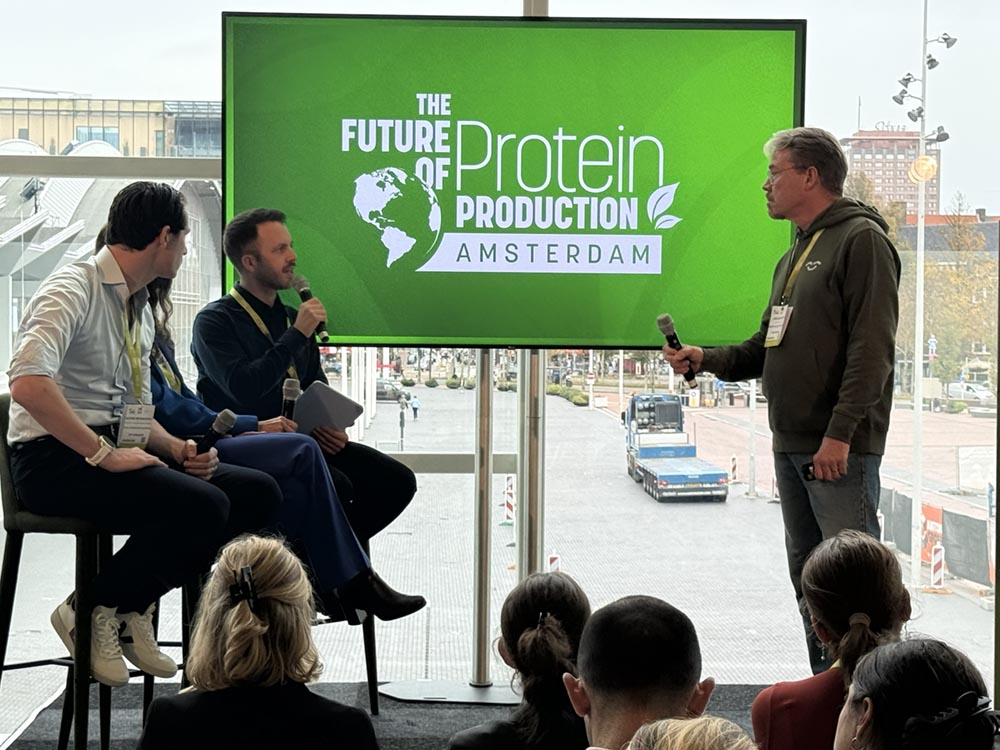
Emilia Nordlund is one of 24 experts shaping the agenda for The Future of Protein Production/Cultured Meat Symposium Amsterdam on 4/5 November 2026, taking place at RAI Amsterdam. To join +100 speakers and more than 750 other attendees, book your conference ticket today and use the code, 'PPTI10', for an extra 10% discount on the current Super Early Bird rate of €995 (closes 29 May 2026). Click here

Join Us At One Of Our Upcoming Events

If you have any questions or would like to get in touch with us, please email info@futureofproteinproduction.com

More News