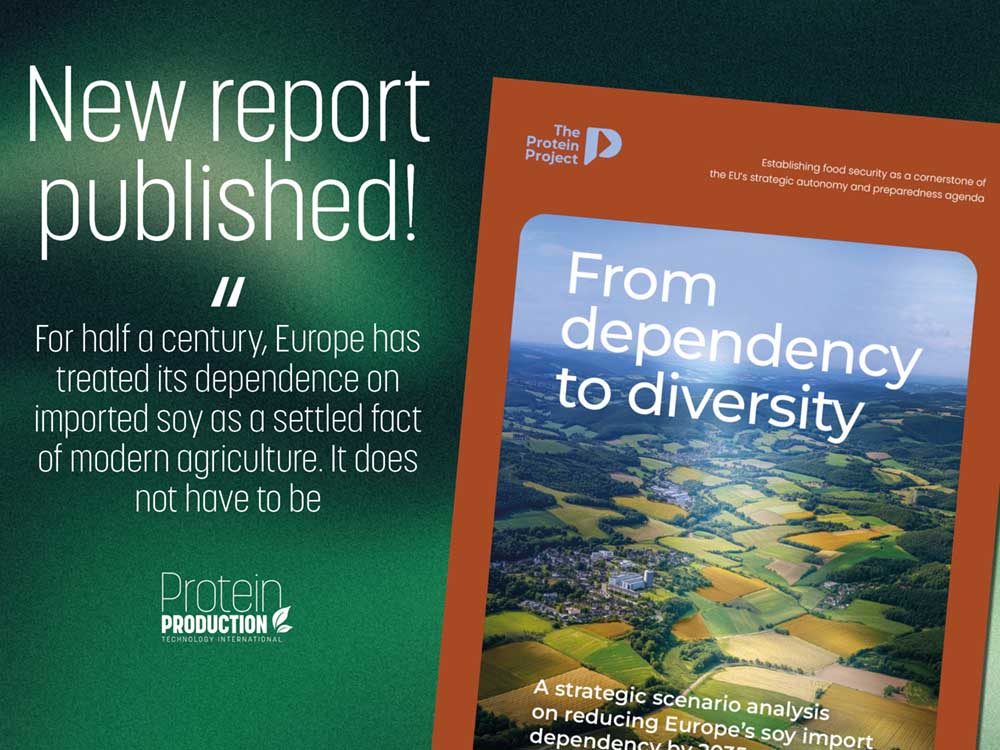
Balanced strategy offers Europe a roadmap to cut soy import dependence by 20%, according to The Protein Project

Europe could reduce its dependence on imported soy by one-fifth within the next decade, but only by pursuing a balanced mix of agricultural, technological and dietary measures rather than relying on any single solution, according to a new report from The Protein Project.
• New report says the EU could reduce soy imports by 20% by 2035 through a balanced protein diversification strategy.
• Analysis concludes combining protein crops, circular feed, innovative proteins and dietary diversification is more feasible than relying on any single approach.
• Authors argue food security should become a central pillar of the EU's strategic autonomy agenda alongside energy and defense.
The report, From Dependency to Diversity, argues that food security has become a strategic issue on par with energy, defense and critical raw materials, warning that the European Union's reliance on imported soy represents one of its greatest food system vulnerabilities.
Currently, the EU produces just 9% of the soy protein it consumes, importing the remaining 91%, primarily from Brazil, the United States and Argentina. Around 90% of that soy is used in animal feed, making it fundamental to Europe's livestock sector.
The report estimates that without access to imported high-protein feed, the EU would lose approximately 40% of its livestock production capacity, with poultry and egg production potentially falling by as much as 60%. Pork production would decline by around 40%, while beef and dairy production would each fall by approximately 15%.
Rather than advocating self-sufficiency, the authors argue Europe should strengthen its resilience by diversifying protein production and reducing its exposure to supply shocks.
The report was developed by The Protein Project, with lead authors Jasper Zwinkels, Katrien Martens and Marin Vandamme. It also draws on expert review from researchers across Europe and discussions held during a Brussels policy roundtable involving European Commission officials, Member State representatives and national organizations.
The analysis models four different scenarios through to 2035 against a common objective of reducing soy protein imports by 20%, equivalent to around three million metric tons of protein. These range from maintaining current policies through to approaches focused primarily on agriculture, innovation or a balanced combination of both supply- and demand-side measures.
Under the business-as-usual scenario, soy imports would decline by only around 1%, leaving Europe's structural dependency largely unchanged. By contrast, the three intervention scenarios all achieve the 20% reduction target, but with very different assumptions about how that outcome is reached.
The report concludes that concentrating policy support on only agriculture or only innovation would require unrealistic levels of change.
An agriculture-focused pathway would require an additional three million hectares of protein crop cultivation and a sixfold increase in the use of agri-food side streams for feed. An innovation-led pathway would demand a dramatic expansion of innovative protein production alongside a dietary shift of more than 32% toward alternative protein sources.
Instead, the authors conclude that a balanced approach offers the most achievable route.
Under this scenario, protein crop production expands by around 1.6 million hectares, circular feedstocks increase by 11.2 million metric tons, innovative protein production reaches 2.2 million metric tons, and dietary diversification accounts for a more modest 10.3% shift in consumption patterns. According to the report, each of these targets remains within what is considered feasible by 2035.
The report identifies four complementary strategies that together underpin this balanced approach.
The first focuses on expanding domestic protein crop production through greater cultivation of legumes and other protein-rich crops. The second aims to increase the circular use of protein-rich agri-food side streams by redirecting suitable byproducts back into food and feed production. The third calls for scaling innovative protein production using technologies such as biomass fermentation and precision fermentation, while the fourth encourages greater dietary diversification by increasing consumption of plant-based foods and innovative proteins.
According to the report, these strategies reinforce one another rather than compete.
For example, increased demand for diversified protein products would strengthen markets for European-grown protein crops, while protein-rich side streams could serve as feedstocks for fermentation technologies. The authors argue these synergies allow Europe to achieve greater reductions in soy dependence with less pressure placed on any individual intervention.
Beyond reducing soy imports, the report also evaluates each scenario across wider environmental, economic and social outcomes.
The balanced pathway performs most consistently across all three categories. It delivers positive outcomes for emissions, biodiversity and resource use while also supporting rural employment, innovation, consumer health and farmer profitability. By comparison, agriculture-focused and innovation-focused scenarios each perform well in some areas but create larger trade-offs elsewhere.
The report also argues that the balanced scenario better reflects the diversity of Europe's agricultural and industrial strengths.
France and Austria are highlighted for protein crop strategies, Ireland and Belgium for circular feed initiatives, Finland and Germany for support of innovative protein technologies, and the Netherlands and Denmark for policies encouraging protein diversification in consumer diets. Rather than expecting every Member State to pursue identical approaches, the authors argue each country should build on its comparative advantages within an EU-wide framework.
Looking ahead, the report calls for food and protein security to become a cross-cutting political priority across the European Commission rather than remaining primarily an agricultural issue.
It recommends that the forthcoming EU Comprehensive Protein Plan coordinates action across multiple policy areas, including the Common Agricultural Policy, Common Market Organisation, European Competitiveness Fund, biotechnology legislation, research funding, public procurement and dietary guidance.
Specific recommendations include stronger incentives for protein crop production, investment in regional processing infrastructure, clearer regulatory pathways for circular feedstocks, recognition of food and feed biotechnology as a strategic sector, additional scale-up support for innovative protein companies, and updated dietary guidelines alongside public procurement policies designed to encourage protein diversification.
The report concludes that Europe's dependence on imported soy should no longer be viewed as an unavoidable feature of modern agriculture.
Instead, it argues that a coordinated combination of farming, biotechnology, circular economy approaches and changing consumption patterns can strengthen resilience while supporting farmers, consumers and industry.
"Food security should be a cross-cutting EU priority," the authors write. "The EU has shown that in times of mounting pressures and instabilities it can respond decisively to strategic dependencies in energy, defence and technology. The response logic is well established: identify the dependency, assess the disruption risk, diversify supply and build domestic capacity before a crisis forces improvisation. Food, and the protein system that underpins it, demands exactly that same response."

Join Us At One Of Our Upcoming Events

If you have any questions or would like to get in touch with us, please email info@futureofproteinproduction.com