

Atlantic Fish Co and Revo Foods test hybrid path to whole-cut cell-cultivated seafood

USA-based Atlantic Fish Co and Austrian food-tech startup Revo Foods had begun exploring a hybrid approach aimed at overcoming one of the most persistent technical barriers in cell-cultivated seafood: producing scalable, whole-cut products that mirror conventional fish fillets.
Rather than focusing solely on cell growth, the collaboration combined Atlantic Fish Co’s proprietary whitefish cell lines and tissue engineering expertise with Revo Foods’ industrial mycoprotein structuring and 3D food extrusion platform. Together, the companies had investigated whether structured mycoprotein matrices could serve as a scalable backbone for integrating cell-cultivated seafood cells into recognizable whole-cut formats.
• Atlantic Fish Co and Revo Foods had explored a hybrid seafood approach combining cell-cultivated whitefish cells with structured mycoprotein as a scalable whole-cut format.
• The collaboration evaluated whether Revo Foods’ industrial 3D structuring platform could host cultivated seafood cells economically and at scale.
• The companies targeted whole-cut whitefish formats, which accounted for more than 80% of global whitefish consumption.
One of the core challenges facing cell-cultivated seafood had not been cell proliferation itself, but translating those cells into structured products that could be produced efficiently and accepted by consumers. Whole-cut seafood, particularly whitefish fillets, remained a dominant consumption format globally, yet replicating its layered texture and mouthfeel using cell-based methods alone continued to present cost and scale constraints.
The hybrid concept under evaluation sought to shift where structure originated. Instead of relying on cells to generate both biomass and texture, the approach used mycoprotein, a fermented fungi-derived protein already produced at industrial scale, as the primary structural carrier. Cell-cultivated material could then be incorporated within that matrix, contributing species-specific taste and sensory characteristics while benefiting from an established, scalable production base.
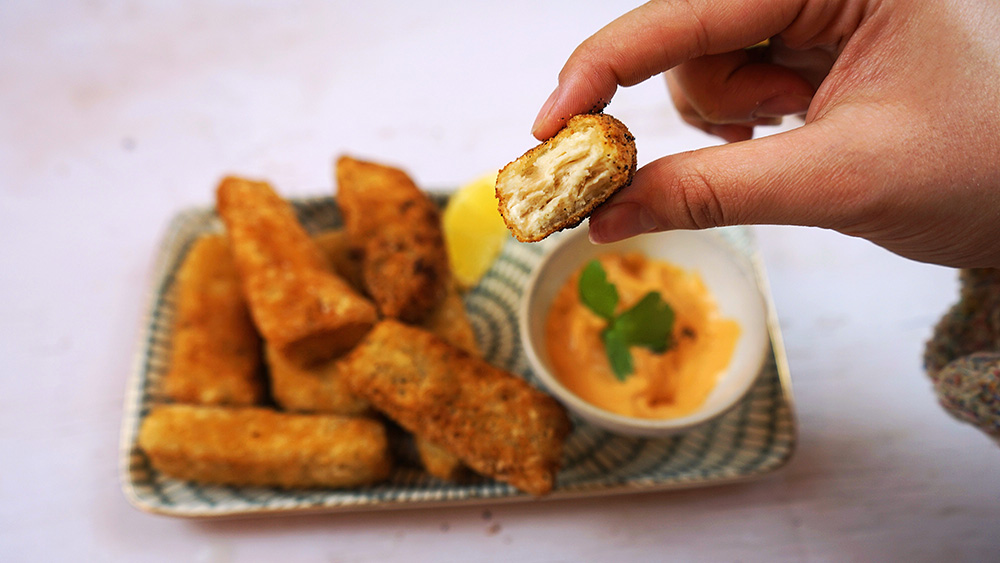
Revo Foods had already demonstrated the commercial viability of its structuring technology through existing whole-cut fish alternatives. Its product EL BLANCO – Inspired by Black Cod used layered protein architectures to replicate the texture of conventional fish fillets at industrial volumes. Within the collaboration, that same platform was evaluated as a potential host matrix for Atlantic Fish Co’s cultivated whitefish cells.
During the exploratory phase, the companies intended to test how cell-based ingredients interacted with Revo Foods’ 3D structuring system, assessing technical compatibility, production economics, and sensory performance. The objective was to determine whether cultivated cells could be integrated into a structured mycoprotein base without compromising manufacturability or product quality.
%20(1).jpg)
By pairing proven structuring technology with cell-cultivated ingredients, the project had aimed to address what many developers considered one of the final technical hurdles for cultivated seafood: delivering whole-cut products in a way that made economic sense at scale. For whitefish in particular, where the majority of products were sold as intact fillets rather than minced or processed forms, achieving that format was closely tied to consumer acceptance.
The collaboration also reflected a broader shift within alternative proteins toward hybrid development strategies. Rather than viewing plant-based, fermentation-derived, and cell-cultivated approaches as competing pathways, more companies were exploring how the strengths of each could be combined. Hybrid products were increasingly seen as a way to shorten timelines to market, reduce costs, and improve sensory performance compared to plant-only alternatives, while avoiding some of the scale challenges associated with fully cell-based products.
For Atlantic Fish Co, the approach aligned with its focus on developing cell-cultivated whitefish products that addressed both environmental pressures and market realities. The North Carolina-based company had been developing cultivated seafood technologies with an emphasis on species that faced overfishing and supply constraints, while remaining central to global seafood consumption.
Revo Foods, founded in Vienna in 2021, had focused on advancing large-volume 3D food extrusion for mycoprotein-rich foods. In 2024, the company opened what it described as the world’s first industrial production facility dedicated to 3D food extrusion, known as The Taste Factory, enabling continuous, high-throughput structuring of protein-based products. Its mycoprotein products were already available through major European retailers, including EDEKA, REWE, BILLA, and SPAR.
The hybrid investigation did not seek to replace fully cell-cultivated seafood ambitions, but rather to complement them with a more immediately manufacturable pathway. By decoupling structure from cell growth, the companies explored whether cell-cultivated seafood could be incorporated into products that looked, cooked, and ate like conventional whole cuts, while remaining feasible within existing industrial food production frameworks.
The collaboration followed a series of recent developments for both companies. Revo Foods had continued to expand the commercial reach of its whole-cut mycoprotein platform, including a collaboration with Juicy Marbles that saw its Kinda Cod plant-based filet sell out within an hour of launch, followed by the release of Kinda Salmon in the US market. Atlantic Fish Co, meanwhile, had secured a US$305,000 Small Business Innovation Research grant from the National Science Foundation to support the scale-up of its cultivated black sea bass program, bringing its total non-dilutive funding to more than US$700,000.

Join Us At One Of Our Upcoming Events

If you have any questions or would like to get in touch with us, please email info@futureofproteinproduction.com


