AI Protein Biotech bets on brains over fields as US$2.1 million LOIs stack up

As competition accelerates in the global race to develop scalable alternative proteins, Egypt-based AI Protein Biotech has secured more than US$2.1 million in letters of intent for its AI-optimized microalgae and water lentil protein ingredients, signaling early international demand despite the company remaining pre-revenue.
• AI Protein Biotech has secured more than US$2.1 million in signed letters of intent, with roughly 65-70% tied to international customers in Europe and the wider MENA region.
• The company develops microalgae and water lentil protein ingredients using AI and IoT systems to reduce costs, water use, and land requirements.
• AI Protein Biotech has been listed in the FoodTech 500 global ranking for two consecutive years.
The announcement comes against a backdrop of rapid growth in both food technology and alternative proteins. Egypt’s food-tech sector closed 2024 with online meal delivery revenues exceeding US$517 million, nearly seven times higher than in 2020, according to data cited by Arab Finance. Globally, sustainable proteins were valued at US$20.75 billion in 2024 and are forecast to reach US$40 billion by 2033, while microalgae proteins alone were valued at US$841 million in 2025 and are projected to grow at a compound annual rate of 7.25% through 2034.
Founded to address the environmental limits of conventional agriculture, AI Protein Biotech focuses on producing functional protein ingredients derived from microalgae and water lentils. The company’s core proposition centers on decoupling protein production from arable land and freshwater while delivering performance characteristics tailored for food manufacturing.
Chief Executive Omar Zaghloul said the company was established to confront what he described as a fundamental structural problem in global food systems. “The company was founded to address a critical global challenge: producing scalable, high-quality protein while minimizing water use, land dependency, and environmental impact,” he said.
Zaghloul traced the company’s origins to a realization that incremental improvements in traditional crops would not be sufficient to meet future protein demand. “The key moment was realizing the food production could be completely decoupled from traditional agriculture’s limitations,” he said. “Seeing the immense environmental damage from land-intensive crops, we knew the future was not just a better crop, but a better system.”
AI Protein Biotech applies artificial intelligence and connected sensors to optimize the growth of microalgae and water lentils, including co-culture systems. Zaghloul said early trials validated the approach. “When we first saw our AI successfully optimize a co-culture, boosting yields by over 20% while using brackish water, we knew we had found it: a new, intelligent way to farm that could turn deserts into food hubs,” he said.
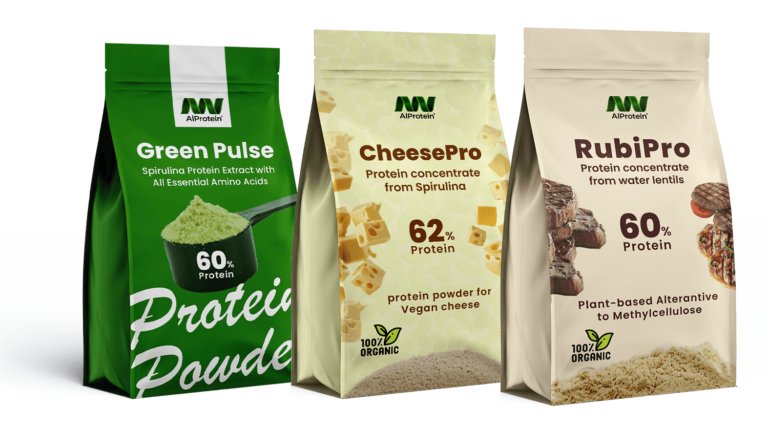
The company’s product portfolio includes RubiPro and CheesePro, which are positioned as functional protein ingredients rather than commodity protein powders. According to Zaghloul, the primary differentiator lies in performance as well as cost.
“Our single biggest value proposition is superior performance without compromise,” he said. “Our ingredients replace both unhealthy synthetic binders and expensive, unsustainable nut proteins.”
He added that the proteins offered more than 60% protein content, delivered 35% better emulsification, and could be produced at up to five times lower cost than traditional sources, while remaining clean-label and organic.
Operational efficiency sits at the center of the company’s production model. Zaghloul said the firm’s AI and IoT platform continuously monitored thousands of data points across cultivation systems.
“Our AI is our efficiency engine,” he said. “It allows us to slash operational costs by up to 40% by predicting and neutralizing contamination early-on.”
The system also optimized nutrient uptake and harvest timing, increasing yields by more than 10%, while enabling production with zero arable land and recycling roughly 85% of the brackish water used.
While AI Protein Biotech remains pre-revenue, its near-term commercial focus has narrowed around RubiPro, driven by demand from plant-based meat manufacturers seeking alternatives to synthetic binders such as methylcellulose.
“Food manufacturers are actively seeking a clean-label, high-performance solution right now, and RubiPro is the perfect answer,” Zaghloul said, noting that the majority of the company’s signed letters of intent were linked to the product.
Geographically, the company’s pipeline skewed toward export markets. Zaghloul said approximately 65–70% of committed LOIs originated from Europe and the wider MENA region, with the remainder tied to domestic Egyptian opportunities.
At the same time, AI Protein Biotech relied heavily on local sourcing. Around 90% of nutrient inputs were sourced within Egypt, a strategy Zaghloul described as a structural advantage.
“This dramatically lowers our production costs, shortens our supply chain, and makes us incredibly resilient to the global commodity price shocks that affect our competitors,” he said.
Looking ahead, the company aims to establish a dominant position in Egypt’s emerging alternative protein ecosystem. “By 2030, our ambition is to be the undisputed leader in high-value, functional protein ingredients in Egypt,” Zaghloul said, adding that the company targeted a double-digit share of the B2B functional ingredient segment.
For other deep-tech founders in the region, Zaghloul offered pragmatic advice shaped by capital constraints and long development cycles. “Think global from day one, but build local first,” he said. “Your primary goal is to stay alive.”
He emphasized capital efficiency over publicity, arguing that endurance mattered more than visibility in the early stages. “Forget the vanity metrics,” he said. “Your greatest achievement in the early days is not a flashy headline; it’s surviving long enough to see your deep-tech innovation break through.”

Join Us At One Of Our Upcoming Events

If you have any questions or would like to get in touch with us, please email info@futureofproteinproduction.com

More News