

Ones to Watch: The transformers
Louise Davis explores a new wave of sophisticated tools and technologies that are reshaping the future of alternative protein development and production
The alternative proteins sector sits at a compelling crossroads of the digital and physical realms. Much of its growth and scale-up depends on infrastructure – huge bioreactors, heavy-duty processing equipment, and purpose-built facilities to house it all. Yet given the high-tech nature of this biotech-driven field, digital tools are equally critical in driving progress.
What’s striking is how this emerging industry is applying and adapting digital solutions from the wider engineering and manufacturing worlds. Modeling and simulation tools, along with industrial control and automation systems, are already bringing Industry 4.0-style momentum to the development and scale-up of alternative proteins. And, naturally for a tech-focused market, AI is the buzzword du jour.
Intelligent design
AI-based tools are proving to be a powerful enabler. In both academic and commercial settings, AI is being applied to unlock new efficiencies and precision in areas such as ingredient formulation, texture prediction, fermentation optimization, and real-time process control. “We see AI as the fundamental accelerator for the entire cultivated protein sector, rapidly moving it from the lab to industrial scale,” says Shannon Falconer, CEO of Biocraft.
Paul Bevan, CEO of Magic Valley, shares Falconer’s conviction that AI will be key – but he offers a note of caution. “It needs the context, creativity, and strategic thinking of experienced scientists and engineers,” he says. Bevan, who is profiled below, emphasizes that despite the wave of new digital tools discussed throughout this article, the human element remains essential: “In our view, the future is human-AI collaboration.”

Feeling good
Carlos Corvalan is looking to AI to tackle one of the toughest challenges in food innovation: texture. “The search to perfect food texture is a holy grail in food design because how a food feels in the mouth often defines our enjoyment,” begins the Associate Professor of Food Science at Purdue University. “The inspiration for this work came from a well-known paradox: our lab instruments (such as rheometers) can measure two foods as physically different, yet human tasters report their texture as identical. Our goal was to create an AI that could resolve this disconnect, translating the objective language of measurable physics into the subjective experience of human perception.”

Corvalan assembled a small student research group at Purdue’s Department of Food Science, and together they developed an AI model described as a “sensory-based autoencoder” to accurately predict texture perception. “The autoencoder functions like a digital sommelier for food texture,” he explains. “It learns (encodes) the hidden language that connects objective physical properties of foods – in our case, flow dynamics – to the subjective feeling of texture in the mouth. It can then work in reverse (decodes), enabling a food designer to say something like, ‘create a sauce that feels rich and velvety’, and the AI generates the physical recipes needed to achieve that sensation.” It’s an explanation worth re-reading to grasp just how groundbreaking this tool could be.
Accelerated development
In practical terms, Corvalan says the tool’s primary use is to accelerate the design of foods with specific textures. “The tool is versatile, with potential in the alternative proteins field for precisely engineering the texture of products such as plant-based yogurts, cheeses, and meats to better match the sensory experience of their traditional counterparts.”
The biggest impact, he argues, lies in speeding up the R&D cycle. “Our tool allows developers to predictively design formulations. This enables a much faster path from concept to market with a consumer-driven texture.” Beyond recipe refinement, the AI could reduce reliance on subjective tasting panels, cutting both time and cost across the development process.
The natural question is what happens next: how does the tool move from the academic sphere to commercial reality? Corvalan reports strong momentum since the team published its paper, suggesting that commercialization will follow organically. “As a university team, our goal was to prove the science. Now that we have this proof of concept, the next step is to bring it to industrial product development,” he comments.
Our goal was to create an AI to translate the objective language of measurable physics into the subjective experience of human perception
Its potential is particularly clear in alternative proteins, where processors could use the tool to mimic the mouthfeel of dairy or fibrous meat, effectively providing a ‘recipe’ for the desired texture. Critically, Corvalan adds, the AI can identify multiple different recipes that achieve the same sensory outcome. “A company could use it to choose more cost-effective ingredients,” he notes – a major advantage in today’s capital-constrained environment.
Corvalan also points out that the model could help de-risk the use of new proteins by simulating their textural impact before a physical prototype is made. “For all of these applications and more, we are actively talking with industry partners to help us translate this successful research into a real-world tool that accelerates how food is designed.”

Cultivating cost efficiencies
Many players in the alternative proteins sector are developing in-house AI tools to support their commercial scale-up. But when Paul Bevan considered the role of AI within Australian cultivated meat company Magic Valley, he was clear that bringing in experts would deliver better results than adopting a DIY approach. “We’re laser-focused on perfecting the science and scaling of cultivated meat using our iPSC technology. Developing an in-house AI platform from scratch would have taken significant time, resources, and talent away from that core mission,” he says.
Instead, Bevan sought a best-in-class partner. Magic Valley has since announced a collaboration with Pythag Tech, an AI platform provider. “Pythag Tech already has world-class expertise in AI-powered bioprocess monitoring, and its Cell Monitor platform is purpose-built for cultivated meat applications,” he notes. “Partnering allows us to integrate proven technology immediately, accelerate our progress, and leverage Pythag Tech’s deep AI and data science capabilities while we focus on product development and commercialization. In fast-moving industries such as ours, speed matters – and partnerships let us move years faster than going it alone.”

Bevan describes the adoption of AI as a breakthrough in tackling bottlenecks. “Cultivated meat production is incredibly complex – we’re working with living cells that respond to dozens of environmental variables in real time. Traditionally, detecting issues such as contamination, nutrient imbalances, or suboptimal growth rates could take hours or even days, often relying on manual sampling and lab analysis,” he explains. “With Cell Monitor, we get continuous, real-time precision analytics without disrupting the process. This means detecting and correcting problems instantly rather than after a batch is compromised; fine-tuning nutrient feeds, temperature, and other parameters to maximize cell growth and viability; and reducing the number of failed or suboptimal runs – saving weeks of work and significant cost per batch.”
This isn’t just theoretical. Bevan reports that Magic Valley has already seen “meaningful reductions in time-to-diagnosis for issues and a cut in material waste – both of which directly lower costs and speed up R&D cycles”.
Perfecting production
Magic Valley is now exploring how the AI platform can be applied to process optimization at industrial scale. “At scale, even small inefficiencies compound into major costs. Real-time analytics will allow us to run bioreactors at peak efficiency every hour of every day,” Bevan says. “This translates to maximizing cell density and yield from each run, using predictive modeling to anticipate and prevent performance drops, and optimizing resource use – from growth media to energy – which is key for both cost reduction and sustainability metrics.”
Putting this into context, he adds, “Ultimately, this isn’t just about making production more efficient – it’s about making cultivated meat cost-competitive with conventional meat sooner. The ability to optimize on the fly at an industrial level is a critical step toward reaching that goal.”
The ability to optimize on the fly at an industrial level is a critical step in making cultivated meat cost-competitive with conventional meat
Bevan believes the industry has reached a tipping point. “AI will be a core enabler of scale in alternative proteins,” he asserts. “As bioprocessing data sets grow, AI will uncover patterns and optimization opportunities that would be impossible for humans to detect manually. This will shorten R&D timelines, cut costs, and improve product consistency across the board.”
Even so, he emphasizes that human expertise remains essential. “In our view, the future is human-AI collaboration: AI handles the constant monitoring, analysis, and optimization, while humans focus on innovation, design, and solving the bigger challenges that will define the next generation of sustainable food production.”

Bright sparks
When Pablo Quintero, CEO & Founder of flint, was choosing a name for his new company, he landed on ‘flint’ – meaning spark-maker – as the ideal way to convey its purpose. “In the past, flint lit the first fires; and our work is about sparking the next food revolution,” he says. “We aim to ignite a shift in how food companies and health platforms understand the impact of what we eat – predicting not just calories or labels, but how meals truly interact with our bodies.”
Quintero already has a track record in alternative proteins: during his time at cultivated meat company Vow, he first saw the potential of AI to accelerate the way new foods are developed and tested. He also holds a PhD in nutrition, a foundation that underpins flint’s mission. Today, he is building an AI-based platform to solve one of the sector’s most pressing challenges: proving that novel foods are not just sustainable, but healthier. “To replace animal-based foods successfully, alternatives need three key qualities: they must be cheaper, healthier, and tastier. Right now, many consumers still see alternative proteins as ultra-processed foods. The real breakthrough will come when companies can demonstrate that their products deliver measurable health benefits. That’s where we come in: predicting how foods will affect different groups, from athletes to people managing diabetes,” he explains.

When flint’s platform reaches the market, it will not be the only AI-powered solution targeting alternative proteins. But Quintero believes his product serves a niche others have overlooked. “Most AI solutions in this sector today are focused on R&D and manufacturing – things like scaling precision fermentation or automating lab workflows. Very few are tackling the nutrition and health dimension. Our difference is clear: we don’t just optimize how to make products, we help companies prove why their products matter for health,” he says. “We bridge the gap between molecular composition, consumer health outcomes, and market positioning – an area largely underserved by existing tools.”
Next top model
Quintero and his team are currently developing initial machine-learning models to predict the health outcomes of novel foods, with plans to expand as the science and data evolve. “Our goal is to create models with a general understanding of metabolic responses, which we can then enrich with each company’s specific data,” he says. “So far, we’ve spoken with over 20 companies and are in early talks with several for first trials. At this stage, we aim to work with a maximum of two partners to validate the platform in real-world use. We are also in discussions with nutrition departments at leading European universities to plan collaborations, ensuring our models are grounded in the latest research.”
What Quintero cannot confirm is a specific timeline for launch. “Although we prioritize moving quickly, there’s one non-negotiable principle: we build on solid science. The accuracy of our models will ultimately determine our launch timeline,” he says.
As models get better at predicting metabolic outcomes, food companies will be able to design products that are not only sustainable and tasty, but also demonstrably healthier
That emphasis on accuracy, he argues, will be the defining factor in the success of AI-based tools. “As models get better at predicting metabolic outcomes, food companies will be able to design products that are not only sustainable and tasty, but also demonstrably healthier,” he predicts. “This means fewer blind spots, faster iteration, and the ability to create entirely new product categories tailored to specific health needs. But AI alone won’t replace the craft. The best outcomes will come from pairing machine intelligence with human expertise in nutrition, food science, and consumer insight. It’s this human-machine collaboration that will shape the next decade of alternative protein innovation.”

Data-driven development
Achieving optimal cell proliferation and nutrient production in cultivated meat is the focus of Dr Shannon Falconer, Founder & CEO of BioCraft Pet Nutrition. She is looking to AI to power this work through a proprietary platform developed to accelerate the company’s scale-up. “Our AI-powered platform primarily tackles challenges in media development. It streamlines the process of identifying novel ingredients that promote desired biological responses in cell cultures,” Falconer explains.
Putting her enthusiasm into context, she adds, “We see AI as the fundamental accelerator for the entire cultivated protein sector, rapidly moving it from the lab to industrial scale. Its real power lies in navigating immense biological complexity. Where we once relied on years of iterative trial-and-error, predictive AI models now allow us to optimize cell media formulations, enhance nutritional profiles, and maximize bioprocess yields in a fraction of the time.

“This radical acceleration doesn’t just lower costs; it unlocks the next frontier of innovation, enabling the development of novel proteins from more exotic species to strengthen supply chain resilience and, for a market such as pet nutrition, finally make truly hypoallergenic diets both accessible and affordable.”
BioCraft’s platform, first developed in 2023, has already produced two significant use cases. “Promoting cell production of specific nutrients is the first; optimizing the nutritional profile of our ingredient so that it best supports the health needs of dogs and cats is a priority for BioCraft. The second involves removing unapproved or unwanted ingredients from our growth media. Many components routinely used in academic and pharmaceutical cell culture are simply not appropriate for food-grade applications. Our AI tool helped us overcome hurdles in both these instances,” Falconer says.
As for how the tool works, she explains, “It first collects and processes data from publicly available scientific literature and databases. It then synthesizes this data into a picture of the biochemical machinery inside a cell and analyzes it to identify potential nutrient inputs that can elicit or enhance cell growth, nutrient biosynthesis, or other biological processes that are key to cultivated meat production.”
Optimal outcomes
Like others reaping the benefits of AI, Falconer believes a focused approach – rather than treating AI as a silver bullet – will deliver the most value. “Our AI platform was specifically developed to address the critical aspects of media optimization at scale. Although many excellent tools exist for process optimization, we found no open-source or commercial options that met our specific needs for media optimization,” she notes.
Our AI platform was specifically developed to address the critical aspects of media optimization at scale
Falconer also highlights the advantage of developing systems in-house. “Our custom-built platform continues to be refined to best suit our requirements,” she says. For fast-growing industries where being first often matters, the ability to refine and evolve proprietary platforms could prove a major commercial advantage.
That said, she doesn’t entirely rule out broader applications. “I have no plans to offer our AI platform as a commercial product at this time. Perhaps in the future, but at the moment our primary business is offering cell-cultured ingredients to pet food manufacturers, and this is where 100% of our focus is.”

Fishing for information
When asked what inspired his initial idea to apply computational modeling to understand how fish cells grow and transform, Rikard Saqe, a researcher at the University of Waterloo, Canada, gives an answer that neatly reveals the untapped opportunity he spotted. “Coming from a background in computational biology, where I had worked on applying machine learning to improve drug discovery, much of the data and processes I took for granted were not yet present in the field of cultivated meat. My initial motivation was that there seemed to be an abundance of potentially high-value, low-hanging-fruit work in simply porting over successful approaches from adjacent fields,” he explains. “Bringing cultivated meat up to speed in this sense will hopefully unlock new applications for these tools, and bring novel participants who are familiar with these types of tools into the field.”
Saqe notes that this latter point struck him as particularly important. “It felt like there were comparatively very few people doing this in cultivated meat, and especially so in seafood, which is even more understudied and has its own unique set of problems,” he says. He emphasizes that aquatic foods are essential for a significant part of the world’s diets. “And with 90% of aquatic food production at risk because of climate change, cultivated seafood may be the only way large parts of the world will be able to consume the majority of aquatic species in a safe and sustainable way in the future.”

At Waterloo, Saqe and his small team are using AI to address some of the technical challenges of commercializing cultivated meat. “I believe computational techniques can help better tackle problems at every step of the value chain, from the early stages of cell line and media optimization to the end stages of food and bioprocessing,” he says. “We outlined these use cases in our first research paper in 2024, produced with New Harvest and the Alberta Machine Intelligence Institute (Amii). Despite this potential, it is still difficult to quantify cost and performance improvements across most of these use cases, as they haven’t yet been deployed and compared against a relevant baseline – at least publicly.”
So far, the area showing the most progress and adoption, he continues, “is media optimization using traditional machine-learning techniques or simple neural networks”. Some emerging areas he is excited about include expanding the set of media components for testing by designing better and cheaper recombinant proteins and basal media, digital twin/bioprocess modeling technologies, metabolic modeling, and getting more value from limited context-specific data. For now, Saqe believes the most exciting work will come from clearly quantifying the value of these hypothetical use cases. “My hope is that our work will help define and supplement the data and standardization needed for this.”
Open-source optimism
Reflecting his earlier point about bringing resources from other fields into cultivated meat, as well as his collaborations with groups such as New Harvest and Amii, Saqe confirms there will be no “university spin-off startup” story from him any time soon. “While there is absolutely value in offering a SaaS-type model in this context – and several companies have already emerged that are doing this on different parts of the cultivated meat value chain – our work is committed to being fully open source with the hopes of broadly accelerating the field,” he says.
“In looking at the tasks where machine learning has proved the most transformative, particularly in science, it has been driven by a clear and shared common-task framework, which cultivated meat does not currently have,” he elaborates. “It is encouraging to see an increasing recognition of this need within the field, including with the Bezos Earth Fund funding our work alongside New Harvest and Amii to start developing this for cultivated meat.”
Cultivated seafood may be the only way large parts of the world will be able to consume the majority of aquatic species in a safe and sustainable way in the future
Saqe’s altruistic approach is admirable, but he is also pragmatic. “Before even starting to think about what AI applications can look like at scale, you need to consider what data most matters to enable this, and how to design the necessary active learning/design-build-test-learn cycles to ensure you’re solving a real problem,” he observes. “I’m keen to continue working toward establishing these procedures for cultivated meat and seafood alike through my graduate work at the University of Waterloo, supported by Dr Christian Euler, Dr Nguyen (Nathan) Vo, and Dr Brian Ingalls.”

Twin talents
We’re used to hearing about world-firsts from French cultivated meat startup Gourmey, often around regulatory approvals. But in June 2025, the company announced an intriguing development that highlights its future-focused approach elsewhere: a partnership with DeepLife to unveil the world’s first avian digital twin, designed to advance cultivated meat production.
Explaining the inspiration behind this focus on digital tools, CEO Nicolas Morin-Forest says, “Our production process involves an extraordinary number of variables, from cell metabolism to bioreactor conditions. AI is a powerful way to make sense of this complexity and guide better decision-making. We believe smarter tools such as digital twins will be essential for the industry to scale efficiently, and we are proud to be pioneering their application in cultivated meat.”

The new modeling platform processes data from millions of avian cells through large language models (LLMs) and causal AI, enabling predictive simulations of cellular behavior to optimize yields and reduce feed waste. As Gourmey’s own real-world data underpins the platform, why not build a fully proprietary tool? “The project involved several Gourmey team members with strong expertise in AI and data science, but partnering with DeepLife allowed us to take it to the next level thanks to the company’s advanced cellular digital twin platform. This collaboration was the most efficient use of resources, combining our cultivated protein know-how with DeepLife’s proven technology to accelerate development,” Morin-Forest explains.
And Gourmey is already reaping the benefits. “Although we can’t share specific figures on our R&D or production costs, the savings in materials and equipment are significant,” he confirms. “Time optimization is another major benefit: cell culture processes can’t be rushed, so having a simulation tool that predicts how cells will behave lets us anticipate and test scenarios far faster than we could in the lab. It’s a real game-changer.”
Industrial revolution
These early results are reinforcing Morin-Forest’s belief that the tool will deliver major benefits at industrial scale. “Today, the platform is primarily used in the pre-production phase, but we see a future where AI will fine-tune process variables in real time to maximize yields at the industrial scale. When large-scale cultivated food facilities are running dozens of bioreactors in parallel, AI-driven monitoring and optimization will be critical, and this is the path we’re laying now,” he says.
When large-scale cultivated food facilities are running dozens of bioreactors in parallel, AI-driven monitoring and optimization will be critical
Resource utilization is another promising area, with the platform already pointing the way. “By predicting how cells will respond under different conditions, the platform can highlight opportunities for efficiency gains and optimize the use of inputs across the process,” Morin-Forest notes.
One of the advantages of digital tools is their replicability – across players, applications, and markets. With such a future-focused outlook, Morin-Forest has inevitably considered how this might apply to Gourmey’s own system. While he won’t confirm any plans to sell or license the technology, he does reveal that development will continue. “The model we co-developed with DeepLife is currently tailored to Gourmey’s avian cell lines, but this is only the first step. We anticipate the emergence of cell-agnostic digital twin models in the future, which could be applied across the broader alternative proteins sector,” he says.

Model behavior
"Model-based development, leveraging assets such as process digital shadows and digital twins, accelerates alt-protein innovation across R&D, engineering, and operations,” begins Joana Saldida of Siemens. “Such models, powered by our gPROMS digital process twin technology, facilitate the exploration of numerous ‘what-if?’ scenarios and allow the optimization of bioprocesses, critically de-risking scale-up, enabling companies to produce economically at scale, and ensuring processes run in the most efficient way. Siemens’ extensive experience in optimizing fermentation and downstream processing in other biotech sectors is directly transferable to this space.”
For the alternative proteins industry, virtual experimentation at the early stages of R&D is already proving to be a breakthrough compared with costly physical trials. “Virtual (or in silico) experimentation allows for rapid screening of process parameters and identification of optimal conditions,” Saldida explains. “These virtual experiments can be deployed at both lab and pilot scales to reduce the number of iterations and speed up decision-making, potentially cutting R&D cycles by months and reducing experimental costs by 50-70%. This saving comes from lower material and labor usage and reduced waste. Ultimately, companies can de-risk scale-up and accelerate product development by virtually validating designs before committing to expensive physical infrastructure.”

Saldida also highlights the benefits of a digital approach for early-stage process optimization. “Looking into process optimization before the production stage is crucial for increasing efficiency and reducing costs throughout a product’s lifecycle,” she says. “By embracing this mindset from the R&D stage, companies can leverage models (digital shadows) of their bioprocesses to simulate, optimize, and explore the full design space of operating conditions. Advanced tools such as gPROMS primarily use first-principles (mechanistic) models, which are ideal for early-stage optimization as they provide deep explanatory power, allowing engineers to predict scale-up performance and identify optimal conditions before any physical build. Importantly, these models offer significant adaptability across diverse alternative protein systems – for example, different organisms or fermentation types.”
Production environment
The advantages continue into industrial commercialization. “At the production stage, the same gPROMS digital twin models are connected to live plant data from sensors and control systems for real-time process optimization,” Saldida confirms. “A key strength of these models is their ability to accurately represent the complex, non-linear relationships within bioprocesses, which is crucial for maintaining optimal conditions. This enables continuous monitoring, predictive control, and dynamic adjustment of parameters such as feeding rates or temperature profiles.”
She adds that this digital technology transforms reactive operations into proactive, intelligent manufacturing, maximizing yield and minimizing energy consumption on the fly while avoiding problematic regions of operation. “Ultimately, this ensures competitiveness in the market by enabling optimal operations and maintaining high product quality.”
Another area where Siemens’ technology is being increasingly adopted is resource optimization. “Here, it uses detailed models that predict the impact of process changes on raw material consumption, energy use, and waste generation,” Saldida explains. “This helps companies identify optimal operating points to maximize yield per input, reduce water and energy footprints, and minimize costly by-products, while also providing critical data for lifecycle analysis (LCA).
“A primary focus for alternative proteins is model-based de-risking of scale-up, directly addressing the industry’s scaling challenges. We apply this expertise, for example, by configuring fermenter models for optimized feeding schedules or building bioreactor digital twins for real-time KPI monitoring in operations. Our mission is to help innovative food-tech and biotech startups achieve significant cost reductions, enhanced sustainability, and improved operational efficiency,” she says.
Fermentation takes flight
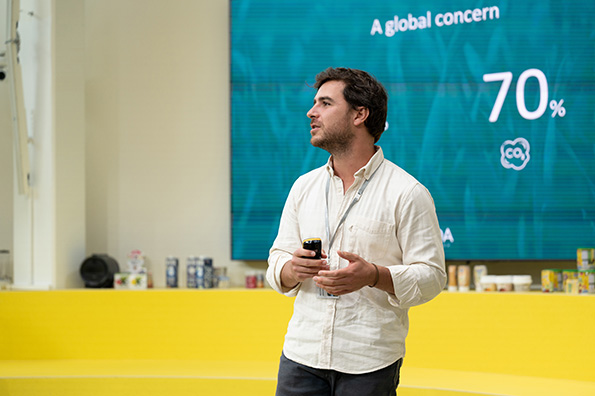
In May 2025, Spanish biotech startup MOA Foodtech unveiled Albatros, an AI-based platform designed to accelerate the development of fermentation-based ingredients while reducing production costs and reliance on refined raw materials. “AI allows us to compress months of trial-and-error into weeks. With Albatros, we can predict optimal strains and fermentation conditions, bringing alternative protein ingredients to market faster and with less risk,” says Bosco Emparanza García, CEO.
Albatros applies machine learning to analyze the nutritional profiles of food industry byproducts and match them with suitable microbial strains and fermentation strategies. This enables manufacturers to upcycle side streams such as starches and other surplus materials into high-value ingredients for food and feed. “Using proprietary protocols, Albatros can analyze a microorganism’s DNA and, in just 10 minutes, predict its nutritional needs and how to reprogram its metabolism,” Emparanza explains. “We’re designing a regenerative food system, one fermentation at a time.”

As for solving industry challenges, he notes, “Fermentation projects often fail due to unpredictability. Albatros de-risks development by guiding strain selection, adapting to variable feedstocks, and anticipating scale-up challenges.” He adds that MOA’s business model itself is an enabler. “Unlike others, MOA is concentrating on fermentation for functional ingredients, powered by a proprietary knowledge base and a business model that aligns our success with our partners.”
MaaS effect
To roll out the platform, Emparanza has made Albatros available to manufacturers under a Microbiology-as-a-Service (MaaS) model. Clients provide data on their byproducts, and MOA’s in-house lab team uses Albatros to design and execute fermentation trials based on the AI’s predictions. “The MaaS model democratizes access to advanced microbial R&D. It lets companies innovate without building costly in-house infrastructure, accelerating time-to-market,” he says.
Alongside Albatros, MOA has launched an online calculator that allows manufacturers to upload specifications of their byproducts and receive an estimate of their commercial and nutritional potential when processed through fermentation. “Among other use cases, we’ve helped partners turn byproducts into 20 times more value and improve protein functionality in just a fraction of the usual time,” Emparanza reveals.
For those curious but uncertain about MOA’s value proposition, Emparanza and his team pose a simple question: what if the journey from a food industry byproduct to a high-value protein ingredient didn’t take six months, but just 14 days? “At MOA, we’ve made this possible,” he says. “Our AI-powered fermentation platform transforms underutilized food byproducts into sustainable protein, cutting R&D time from half a year to just two weeks.
AI allows us to compress months of trial-and-error into weeks
“This isn’t only about efficiency. It’s also about building a circular food system where nothing is wasted and everything has value,” he continues. “At MOA, we don’t see circularity as a nice-to-have; we see it as a requirement for survival and resilience. By turning food industry byproducts into high-value, functional ingredients through fermentation and biotech, we close loops, reduce waste, and shrink carbon footprints. From plant-based foods to pet nutrition and health applications, our ingredients show what’s possible when science and sustainability work hand in hand. Faster. Smarter. More sustainable. That’s the future of protein.”
And where do humans fit into this AI-powered vision? “AI is a force multiplier, not a replacement,” Emparanza states. “The future belongs to those who combine human creativity with AI’s predictive power.”

Virtual duality
For Omri Schanin, the beauty of AI-powered development lies in its ability to accelerate bioprocess innovation by replacing much of the traditional trial-and-error with predictive modeling. “Instead of running hundreds of physical experiments, companies can use virtual experiments to identify optimal conditions faster and with fewer resources,” he says. “This means new formulations and processes can be brought from concept to pilot stage in a fraction of the time. For alternative proteins, where speed to market is critical for both funding and competitiveness, AI allows teams to iterate more rapidly, de-risk decisions, and focus lab capacity on the most promising strategies.”
From Algocell’s own experience in cultivated meat and precision fermentation, Schanin notes that a single year of product development can easily cost several million dollars, with physical trials in cell-based protein production often taking days or weeks. “Virtual experimentation allows teams to explore hundreds of scenarios on a computer before committing to a single physical run,” he says. “In our case studies, companies have cut trial-and-error work by up to 70%, leading to considerable savings on media, utilities, and labor, while freeing valuable bioreactor capacity for the most promising conditions. Beyond cost and time efficiency, this approach has in some cases delivered up to 250% improvements in yield, underscoring the power of combining digital twins with targeted experimentation. The result is lower development costs, shorter timelines, and greater confidence in successful scale-up and consistently higher yields.”

Algocell has recently introduced a suite of AI-based platform services, organized into three modules: the What If simulation module, the Optimizer module, and the Scale-Up module.
Discussing optimization, Schanin explains, “Cell-based production systems are influenced by a highly complex biological environment, shaped by factors such as the metabolic state of the cells, media composition, and bioreactor engineering conditions. In such systems, even incremental improvements in feeding, induction, or timing strategies can have a major impact on productivity and cost of goods. Our advanced Optimizer module is designed to identify the most efficient operational parameters, leading to enhanced resource use and a substantial improvement in overall production efficiency.”
Our approach has delivered up to 250% improvements in yield, underscoring the power of combining digital twins with targeted experimentation
He adds that the Scale-Up module is built to tackle one of the toughest challenges in bioprocessing. “Biological systems rarely behave linearly when reactor size, geometry, and mixing dynamics change. Parameters such as oxygen transfer, shear forces, and nutrient gradients can trigger unexpected shifts in cell growth and productivity. Our platform provides a robust biological model that integrates with engineering constraints, allowing protocols to be adapted with higher accuracy across scales and reactor types, whether moving from batch-fed to continuous or perfusion systems.”
A hybrid vehicle
Algocell is not the only company offering AI-powered tools to the alternative proteins sector, but Schanin says its solution offers clear differentiation. “Many AI tools in the market rely purely on either historical or current large datasets. We take a different path, with a hybrid modeling approach that combines deep domain knowledge through mechanistic models with the predictive power of machine learning and AI,” he says. “This gives us key advantages: mechanistic foundations allow us to build accurate models from relatively few lab runs, without requiring massive datasets; unlike black-box machine learning, our models can predict system behavior outside the exact experimental data, which is critical for exploring the full design space of a bioprocess; and by working extensively in the alternative protein domain, we have developed a robust modeling infrastructure across multiple cell types. This experience translates directly into practical value for our partners, helping them move faster from development to scale-up with greater confidence.”
Schanin confirms that paying customers are already reaping the benefits. “Current customers and early adopters include companies in cultivated meat, alternative dairy, ag-tech, and industrial materials, reflecting the broad demand across multiple sectors,” he says.
And what’s next for Algocell? “In July 2025, we raised US$2.8 million in pre-seed funding to advance our technology. Watch this space to see the next-gen technical developments this funding will enable us to accomplish,” he hints.
If you have any questions or would like to get in touch with us, please email info@futureofproteinproduction.com

More Features

Protein Pioneer: Justin Kolbeck

Deep Dive: Breakout bets

Feeding change

Protein Pioneer: Kesha Stickland


